
Mind map
MEMORY
Map content
MEMORY
Long term memory
- The system that is responsible for storing information for long periods of time eg. an “Archive” of information about past events in our lives and knowledge we have learned, stretches from a very few moments to as far back as we can remember, duration is long, capacity is very large
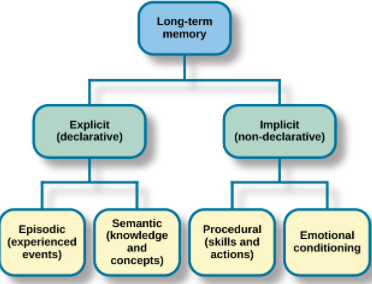
- Explicit/Declarative
- all memories we are aware of
- Semantic
- Experience involves accessing knowledge about the world that does not have to be tied to remembering a personal experience, when we experience semantic memory we are not travelling back to specific events from the past but accessing things FAMILIAR with and know about
- AUTOBIOGRAPHICAL
- has episodic AND semantic components: Memory for specific experiences from our life, can include both episodic and semantic components → personal semantic memories b/c they are FACTS ASSOCIATED WITH PERSONAL EXPERIENCE Westmacott and Mescovitch call memories involving personal episodes autobiographically significant semantic memories, study → found better recall for names of ppl who had higher autobiographical significance BUT all LTM not created equally, more likely to remember something that happened yesterday than something that happened a year ago
- 2 characteristics
- Multidimensional - spatial, emotional and sensory
- Cabeza - photos, diff b/w AM and lab memory - measured brain activation
- difference between autobiographical memory and lab memory, measured brain activation caused by two sets of stimulus photos (one set that the subject took and another set taken by someone else), few days later subjects were shown photos plus some new ones they had never seen RESULTS: own photos and lab photos activated many same structures in the brain (medial temporal lobe) that are associated with episodic memory and also the parietal cortex (involved with processing scenes) and the prefrontal cortex (associated with processing info about the self)
- Medial temporal lobe
- episodic
- parietal cortex (processing scenes)
- prefrontal cortex (processing info about the self
- Cabeza - photos, diff b/w AM and lab memory - measured brain activation
- We remember some events better than others
- transition points in ppls lives more memorable
- Reminiscence bump
- enhanced memory for adolescent and young adulthood found in ppl over 40
- 3 Hypotheses
- Self image hypotheses
- memory enhanced for events that occur as a person’s self image or life identity is being formed
- Cognitive hypothesis
- periods of rapid change that are followed by stability cause stronger encoding of memories (disproved)
- cultural script hypothesis
- distinguishes b/w persons life story and a cultural life script which is the culturally expected events that occur at a particular time in the life span → events become easier to recall when they fit the cultural script for that person’s culture
- Self image hypotheses
- Multidimensional - spatial, emotional and sensory
- Recollection
- remembering specific events related to the person, episodic memory because includes details about what was happening when the past knowledge was acquired
- Semanticization of remote memories
- oss of episodic detail for memories of long ago events (Petrican experiment) Shorter term semanticization makes sense when we consider personal experiences → knowledge that makes up semantic memories is initially obtained through personal experiences that are basis of episodic memories, but memory for these experiences often fades and only semantic remain
- LOSS OF SEMANTIC MEMORY/semantic dementia
- problems describing in episodic detail what might happen in the future → supports theme of division and interaction that episodic/semantic memories both need to be functioning in order to think about the personal future
- Episodic
- Experience of episodic memory involves mental time travel → reconnecting with events in the past, self-knowing/remembering
- Familiarity
- person seems familiar but can’t remember details about the person, associated with semantic memory b/c not associated with circumstances under which knowledge was acquired
- LOSS OF EPISODIC MEMORY
- KC, lost episodic memory, was unable to use imagination to describe personal events that might happen in the future
- Schacter & Addis Constructuve Episodic Simulation Hypothesis
- states that episodic memories are extracted and recombined to construct simulations of future events, suggests main role of episodic memory system is not to remember the past but to enable ppl to simulate possible future scenarios
- Implicit/Non-declarative
- Procedural/skill memory
- stored knowledge that allows us to behave skillfully, cannot remember learning the individual skills needed to perform a particular task eg. tying shoelace
- CLIVE WEARING & KC
- CLIVE WEARING became very good at mirror drawing even though he believed he was doing it for the first time, KC learnt how to stack and sort books in the library, improved performance even though he doesn’t remember learning how to do so
- Emotional conditioning
- occurs when the two following stimulus are paired Neutral stimulus that initially does not result in a response Conditioning stimulus that does result in a response In real life often linked to emotional reactions, eg. causing ip;icit memory is when you meet someone who seems familiar but can’t remember how you know them
- Priming
- occurs when the presentation of one stimulus changes the way a person responds to another stimulus
- Repetition priming
- occurs when test stimulus is the same as or resembles the priming stimulus, eg seeing the word bird bay cause you to respond more quickly to a later presentation of the word bird, even though you don’t remember seeing the word earlier
- tests with amnesiacs
- recall experiment show that amnesiac patients recall fewer words than control groups (poor explicit memory) but results of word completion test showing percentage of primed words that were created show that amnesiac patients performed just as well as controls (increased performance an example of priming)
- Propaganda effect
- subjects more likely to rate statements they have read or heard before as being true b/c they have been exposed to them before, involved implicit memory because can operate when ppl are unaware they have heard or seen a statement before
- Procedural/skill memory
- Interaction with WM
- working memory deals with present and ltm which contains knowledge relevant to what’s happening, work together Interplay b/w what is happening in the present and info from the past based on STM/WM and LTM
- Serial position effect
- remembering a list of items, items at the beginning and at the end are more likely to be remembered
- Primacy effect
- more likely to remember things at the beginning, more rehearsal, less competition
- Rundus
- ested idea that primacy effect occurs because subjects have more time to rehearse words at the beginning of the list (supports theory)
- Recency effect
- more likely to remember things at the end, newly in the STM, usually recalled first Delay b/w coding and text = still see primacy effect but no recency effect Thus, PRIMACY EFFECT appears to be longer, prob b/c there was more time for rehearsing those initial words/numbers
- Retrospective
- Prospective
- performance of future action, memories pertaining to the future
Short Term Memory
- holds moment to moment thoughts and perceptions in the mind, 15-20 seconds
- Sensory memory
- retention for brief periods of time, the effects of sensory stimulation Large capacity but info decays quickly
- Persistence of vision
- Sparkler’s trail and projector’s shutter → Persistence of vision; retention of the perception of light (eg. sparklers trail of light, shutter of projector) Echoic memory: persistence of sound
- ECHOIC MEMORY
- Sperling - Capacity/duration
- How much inforation pp kcan take in from briefly presenting stimuli, flashed an array of letters on screen for 50 milliseconds, and asked subjects to report as many as they could, with WHOLE REPORT METHOD could report average of about 4.5 out of 12 - reasoned that if subjects couldnt report 12 letters because of fading, they would do better if letters presented in 4 letter row - PARTIAL REPORT METHOD - told them which part of the matrix to report - high pitched tone told them to report top row, low pitch = lowest row - because the tone was presented immediately after the letters were turned off the subjects attention was directed away from the actual letters - DELAYED PARTIAL REPORT METHOD: letters were flashed on and off and cue tone was presented after a short delay --> when cue tone was delayed one second after flash, subjects were able to report only slightly more than 1 letter in a row **immediately after a stimulus is presented, all or most of the stimulus is available for perception --> sensory memory, then over the next second sensory memory fades Brief sensory memory for visual stimuli (iconic memory) or visual icon
- ICONIC MEMORY
- Working memory
- allows manipulation of information in STM and is key for encoding of long term memory (Working WITH memory), USE to do more complicated tasks → learning, reasoning, comprehension ACTIVE → key for laying down LTM memory gets better with age
- Baddeley & Hitch
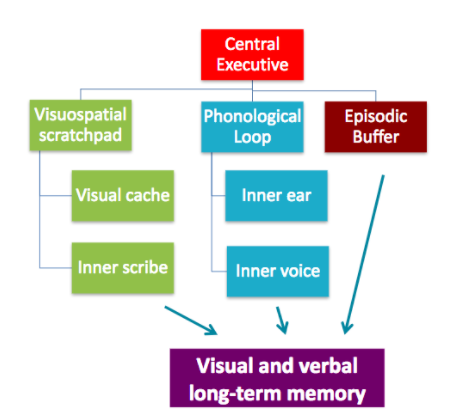
- limited capacity system for temporary storage and manipulation of info for complex tasks like comprehension, learning and reasoning Concluded that working memory must be DYNAMIC and must consist of a number of COMPONENTS THAT CAN FUNCTION SEPARATELY (3 components
- Phonoligcal loop
- two parts →, dedicated to temporary storage of spoken and written materials, VERBAL short term memory - holds verbal info for 1-2 seconds - rehearses verbal info to maintain it in emory
- articulatory rehearsal process ACTIVE
- inner voice, ACTIVE, keeps items in phonological store from decaying, linked to speech production, used to rehearse and maintain verbal information from phonological store and keep it refreshed, as long as we repeat it we can retain the info in working memory (no sound is actually made)
- phonologcal store PASSIVE inner ear
- PASSIVE (inner ear)limited capacity and holds info for only a few seconds, holds verbal and auditory info
- Visiospatial Scratch Pad INNER EYE
- Visual cache
- temporarily stores visual info that comes from perceptual experience and contains information about the form and color of what we perceive, visual equivalent of phonological store
- VSTM capacity views (2)
- can hold about 3-4 items simultaneously while being at least 75% accurate detecting whether there is a change
- SLOT MODEL
- items retained in working memory are held in ¾ independent object slots, one for each item stored, WM is all or none → object either gets into memory slow or it does not (eg. is remembered accurately or not remembered at all)
- BOUNCER MODEl
- Vogel et al. VSTM capacity is limited (3-4 objects simultaneously) → efficient mechanisms are required to select only most relevant object from environment to be represented in memory Claims that high VSTM capacity individuals filter out irrelevant information so it does not enter working memory (snobby bouncer) Low VSTM capacity individuals let everything in (democratic bouncer) STUDY: task - same or different number and types of distractors in test array, DV → correct identification of change, ERPs RESULTS: high capacity individuals filter out irrelevant information so it does no enter working memory, low capacity individuals DON’T filter out distractors so WM is holding a higher load INDIVIDUAL DIFFERENCES IN WORKING MEMORY RESULT FROM INDIVIDUAL DIFFERENCES IN SELECTIVE ATTENTION Restrict irrelevant items from taking up capacity Neural marker of individual differences in VSTM: Contralateral Delay activity (CDA) → the more objects in memory the bigger the CDA until you hit the limit of items you can hold in VSTM
- Vogel et al
- Inner scribe
- refreshes all of the stored information contained in the visuospatial scratchpad (Computer screen), producing it over and over again so it doesn’t fade out, visual equivalent of the articulatory control process
- Visual cache
- Central executive
- - GUIDES ATTENTION and allocates resources to maximize performance - coordinates activities of all other subsystems (control system - NOT a memory store) major work of memory occurs here, pulls info from LTM and coordinates activity of PL and VSP by focusing on specific parts of a task and deciding how to divide attention b/w different tasks (traffic cop) Eg when someone is trying to drive and use cell phone, executive would be controlling phonological loop processes (talking/understanding convo) and sketchpad processes (visualizing landmarks and layout/navigating car)
- frontal lobe patients and perseveration
- repeatedly performing same action or though even though it is not achieving desired goal, breakdown in the CE’s ability to control attention
- event Related potential VOGEL ET AL
- indicates how much space used in working memory, adding blue bars (should have no effect as attention focused on red bars) caused increase in the response of high capacity group but caused much larger increase in the response of low capacity group → small effect of adding blue bars for high capacity group means these subjects were efficient at ignoring distractors
- Visual short term memory
- Episodic Buffer
- proposed by Baddeley that it can store info (Adding capacity), connected to ltm (making interchange b/w working memory and LTM possible),→ increases storage and communication with LTM Puts the element of TIME or temporal order into working memory model → a 3rd assistant in the Baddeley model, combines information from other subsystems and LTM into sequences or episodes (binding process)
- Integrative system
- places events occurring in the sketchpad and loop into coherent sequence - keeps track of episodes
- Hippocampus
- Integrations of information in space and time → key for laying down long term memory
- WM and Stress
- WM gets worse above a certain level of stress Effective management include meditation, exercise and sleep
- Prior knowledge
- Memory span is influenced by preexisting knowledge → TOP DOWN
- chunking
- grouping things together to aid recall, collection of elements that are strongly associated with one another by weakly associated with elements of other chunks, for words/pictures to be a chunk they need to be familiar/available in LTM → thus the STM overlaps with and relies upon LTM to function
- Interference
- Retroactive
- what you know now makes it difficult to recall something you learnt previously
- Proactive
- something you have already learnt interferes with you ability to recall more recent information (old interfering with the new)
- Luck and Vogel
- concluded that subjects were able to retain about 3-4 items in their STM (like the slot model) Greater CDA for 4 relevant items relative to 2 relevant items Selective attention differentiates high capacity VSTM from low capacity VSTM Demonstrates the important of central executive in working memory
- CHANGE DETECTION
- AlvareZ & cavanaugh
- Retroactive
- WM and the BRAIN
- Brain damage
- damage/removal of PFC affects ability to remember for short periods of time
- Delayed response task
- Neurons
- how neurons in monkeys PFC hold onto info during brief delay Funahashi → found neurons that responded only when the square was flashed in a particular location and these neurons continued responding during delay, firing of these neurons indicate that an object was presented at a particular place and this info was available for as long as these neurons continued firing (see “CODING”
- Brain activity
- areas of the brain activated by working memory tasks → holding info in the VISUAL CORTEX information regarding most of the fine details of objects is found at the beginning of the system where signals are arriving at the visual area of the cortex Harrison/Kamitani and Tong → neural mind reading; information about the orientation a person is remembering is being held in the visual cortex during the deal and that the visual cortex is therefore involved in working memory, thus although the PFC may be brain area most closely associated with working memory, other areas are also involve
- VISUAL CORTEX
- Brain damage
- Duration
- Peterson & Peterson
- varied the time b/w when they said a number and when the subject began recalling the letters - found their subjects remembered about 80% of the 3 letter groups if they began their recall after counting for just 3 seconds but remembered only about 12 percept in the 3 letter groups after counting for 18 seconds --> subjects forgot letters because their memory had decayed
- decay?
- Keppel & Underwood - drop in memory due to proactive interference
- Peterson & Peterson
4 Stages of memory
- Encoding
- initial perception of the event (includes attn and pattern recog)
- CODING
- form in which stimuli are represented, determining how much a stimulus is represented by the firing of neurons → physiological approach to coding
- Visual coding in STM/LTM
- if you remembered a pattern by representing it visually in your mind, use it in LTM when you visualize person/place from the past
- Auditory coding STM
- STM → Conrad’s demonstration of the phonological similarity effect eg. ppl most often misidentify target letters as another letter that sounds like the target, LTM → when you “play” a song in your head, listen to a playlist and theres a short pause between songs and you hear the beginning of the next son, (happens because auditory representation from LTM is triggered by the end of the previous song
- Semantic coding STM
- Wickens ET AL
- created proactive interferences - the decrease in memory that occurs when previously learned information interferes with learning new info by presenting words from the same category on a series of trials
- Proactive interference
- decrease in memory that occurs when previously learned information interferes with learning new info by presenting words from the same category on a series of trials
- release from proactive interference
- increase in performance, in Wickens experiment depends on the word categories because placing words into categories involves the meaning of the words and b/c subjects were recalling words 15 seconds after hearing them → representing an effect of semantic coding in STM
- Auditory coding most likely
- Wickens ET AL
- semantic coding LTM
- Sachs experiment
- semantic coding in LTM, subjects listen to tape recording of a passage and measured their recognition memory to determine whether they remembered the exact wording, or just general meaning → specific word forgotten but general meaning remembered for long time → semantic memor
- Sachs experiment
- rehearsal
- thinking about meaningful relationships among the items you’re encoding, mind mapping
- maintenance
- rote rehearsal that maintains items in STM repeating it over and over
- Elaborative rehearsal
- thinking about meaningful relationships among the items you’re encoding, mind mapping
- Levels of processing
- Shallow
- little attention to meaning, eg repeating phone number over and over
- Deep Processing (Study)
- close attention, focus on meaning and relating to something else → eg. focusing on physical features vs. meaning EXPERIMENT: physical features = shallow processing, rhyming = deeper processing, fill in the blanks = deepestDeepest processing results in better memoryBUT meaning not always associated with better encoding (transfer appropriate processing, Morris et al study, see below)
- Shallow
- AIDS to encoding
- Self reference effect
- memory is better if you are asked to relate a word to yourself
- Generation effect
- generating material yourself rather than passively receiving it, enhances learning and retention
- Relating to survival value
- Forming visual images
- Bower and Winzenz
- paired associate learning: list of word pairs presented, later first word of each pair is presented and subject remembers which word it was paired with, subjects that created images remembered twice as many words
- Bower and Winzenz
- Self reference effect
- Encoding specificity
- matching physical context in which encoding and retrieval occur
- state dependent learning/memory
- matching internal mood
- Physical state as context
- intoxicated learners did worse than sober learners, but intoxicated learning ONLY and sober on test did worse than intoxicate during learning AND test
- Transfer appropriate processing
- matching the task involved in coding and retrieval
- Morris eet al RHYMING/MEANING CONDITIOn
- retrieval is better if same cognitive tasks are involved during encoding and retrieval, meaning condition and rhyming/sound condition, asked to process words differently, retrieval performance depended on whether retrieval task matched the encoding task Levels of processing theory would predict that subjects in meaning condition would experience deeper processing so they should perform better, BUT, rhyming group did better → thus deeper processing at encoding does not always result in better retrieval
- Consolidation
- laying down and strengthening over time → short term & long term
- Synaptic consolidation
- fast, minutes/hours, involves structural changes at synapses
- Hebb - learning/memory represented by changes in the synapse
- Long Term Potentiation
- enhanced firing of neurons after repeated stimulation, eg. first time neuron A is stimulated, neuron B fires slowly, after repeated stimulation neuron B fires much more rapidly to same stimulus → indicates how experiences cause changes at synapse → similar to idea of population coding
- Systems consolidation
- standard model of consolidation
- incoming info activates a number of areas in the cortex, activation distributed across the cortex because memory involves many sensory and cognitive areas, to deal with distribution the cortex communicates with the hippocampus which coordinates the activity of different cortical areas
- Reactivation
- process in which HIPPOCAMPUS replays the neural activity associated with memory, activity occurs in the network connecting the hippocampus and the cortex, this activity helps form direct connections b/w cortical areas, hippocampus acts like glue that binds together representations of memory, demonstrated by retrograde amnesia →
- Graded amnesia
- characteristic of retrograde amnesia, tends to be most severe for events that happened JUST BEFORE THE INJURY and to become less severe for earlier events, gradual decrease in mnesia corresponds to changes in connections b/w hippocampal and cortical areas (consolidation connections)
- Multiple trace model of consolidation
- hippocampus is involved in retrieval of episodic memories even if they originated long ago, hippo’s response decreased over time (same as standard model) but only for stimuli that have lost their episodic character and are more semantic in nature
- standard model of consolidation
- Retrieval
- calling it back up later
- Retrieval practice
- making up ad answering practice test questions result in better memory than rereading information, by creating and recreating material, increases richess of representation in memory by providing connections between the material to be remembered and other material in memory
- Retrieval Cues
- words or other stimuli that help us remember info stored in our memory (Eg. location, smell, music)
- Cue recall
- STUDY: free recall vs. cued recall → subjects remembered 91% of the words but when other-person-generated retrieval cues presented subjects remembered only 55% of the words
- Reconsolidation
- consolidation AND retrieval When memory retrieved it becomes fragile, (as when it was originally formed) and needs to be consolidated again when it is in this fragile state → opens the door for modification or forgettingadaptive update mechanism that allows new info to be integrated into the initial memory representation
- Nader et al - RATS tone-shock pairing
- Rats - 3 conditions, rat receives a tone-shock pairing and is injected with an antibiotic that prevents formation of new memories, if injected before consolidation occurs it eliminates memory but if injected after it has no effect, results = original memory is fragile until it is consolidated for the first time, a reactivated memory becomes fragile until it is reconsolidated
- Encoding
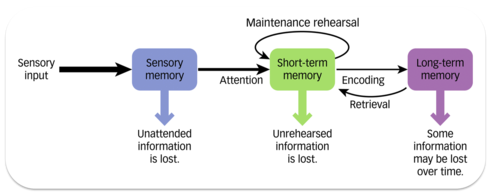
Attkinson and Shiffrin Modal Model of memory
- 3 types of memory- sensory, STM, LTM
AMNESIA
- Retrograde
- cannot recall events that occurred prior to critical event that affected their brain
- Anterograde
- failure to add to memory after critical event
- Intact STM/no new LTM
- HM
- CLIVE WEARING
- parts of medial temporal lobe (hippo, temporal lobes - medial on right, medial and lateral on left, Ventral Prefrontal Cortex, Amygdala, Fornix - white matter connectivity b/w regions key for memory) 1-2 minute memory, separation of short and long term memory Has procedural, semantic and some episodic memories Retrograde: NO episodic recall but some SEMANTIC recall Anterograde (laying down new memories): NO encoding of episodic memory, some slight encoding of new semantic information, appears to be able to acquire procedural memory
- Medial temporal lobe damage
- hippo, temporal lobes - medial on right, medial and lateral on left, Ventral Prefrontal Cortex, Amygdala, Fornix - white matter connectivity b/w regions key for memory)
- Hippocampus
- Brain imaging
- Activity in HIPPOCAMPUS increases as subjects are holding novel faces in memory during 7 second delay → hippo involved in both LTM and STM
- Brain imaging
- Amygdala
- more amygdala activity in ppl remembering higher emotional words, emotions may trigger mechanisms in the amygdala that help us remember events that are associated with emotion
- Intact LTM/no new STM
- KF
- parietal lobe damage
- KF
- Retrograde
Memory Errors
- EMOTION and memory
- Studies show better memory for arousing words and emotional pictures
- Cortisol
- released during and after emotionally arousing stimuli enhances consolidation/increased amygdala activity
- Flashbulb memories
- specifically how they heard about the event, not memory for the event itself, detailed seemingly perfect memories of a distinctive, surprising or significant event, experienced as if someone had taken photograph of event and stored it away in LTM, eg. 9/11,
- New print mechanism
- these memories are like photographs that resist fading, vivid and detailed
- Repeated recall
- technique of comparing later memories to memories collected immediately after the event *as time goes on, recollection of event gets worse but belief in the memory gets higher/stays constant *emotions enhance the subjective sense of remembering (vividness, confidence)
- Narrative rehearsal hypothesis
- we remember events like 911 because we rehearsed these events after they occurred (eg. images of planes crashing)
- Eyewitness memories
- Often associated with emotional events such as crime
- leading questions
- can influence eyewitness recollections, can also affect how ppl guess when unsure
- Misleading Postevent Information MPI
- presented after a person witnesses an event, can change how that person describes the event later (see modification/creation of memory by suggestion)
- STUDY: more likely to say they saw car stopped at yeild sign (not true)
- MPI group more likely to say they had seen the picture of a car stopped at a yield sign (had never seen) than were those subjects that had not been exposed to MPI
- 2 Theories
- MPI Causing interference
- retroactive interference occurs when more recent learning (Eg. misinformation) interferes with memory for something that happened in the past (actual event)
- Retroactive interference
- MPI causing source monitoring errors
- person incorrectly concludes something about the source of memory for incorrect event
- STUDY: 27% subjects in difficult condition correspond to incorrect info in midleasing narrative
- 27% of responses of subjects in difficult condition corresponded to the incorrect information in the misleading narrative, response to the misled items were source monitoring errors because the subjects were confusing information in the misleading narrative story with the info from the slide show
- MPI Causing interference
- EYEWITNESS TESTIMONIES
- acceptance based on 2 things: eyewitness was able to clearly see what happened, 2) the EW was able to remember observations and translate them into an accurate description IMPLICATIONS OF ERRORS: ppl serve for crimes they did not commit, based on misconceptions that memory works like a camera or video
- Perception and attention errors
- emotions running high during crime can affect what a person pays attention to and what they remember
- WEAPONS STUDY
- tendency to focus attention on a weapon that results in narrowing of attention, in condition with gun present but not fired subjects were more likely to recall details of the perp, victim and weapon → firing of the weapon distracted attention from other things
- Misidentification due to familiarity
- bystanders add another dimension to testimonies because there is a chance the bystander could be mistakenly identified as the perp just because they are familiar
- Errors due to suggestion
- Post identification feedback effect
- Post identification feedback effect: increase in confidence due to confirming feedback after making an identification
- Post identification feedback effect
- Cognitive interview (3 components)
- Interview observers at the crime scene
- Have witness report everything they can recall
- Have observer recount events in diff. sequence
- Constructive nature of memory
- Bartlerr's war of the ghosts study
- asked ppl to read story war of the ghosts, then asked them to recall it accurately, then used repeated reproduction, recall tended to reflect subjects own culture subjects created memories from 2 sources (original story & what they knew about similar stories in their own culture)
- source monitoring
- process of determining origins of our memories/beliefs/knowledge, difficulties can lead to false recollections when someone is forced by an interviewer to give false info
- Source misattributions/source monitoring error
- misidentifying source, primary source is information from the actual event, other sources are ppls knowledge about the world/things that happened before/after the event
- Jacoby et al
- tested subjects between famous/non-famous names, biggest effect in the DELAYED TEST GROUP, after 24 hours some non famous names were misidentified as famous, some non famous names were familiar and the participants misattributed the source of the familiarity (Source familiarity)
- Bartlerr's war of the ghosts study
- Making inferences
- Pragmatic inference
- occurs when reading a sentence leads a person to expect something that is not explicitly stated or implied by the sentence, based on knowledge gained through experience
- Schemas
- persons knowledge about some aspect of the environment, developed through experiences
- Scripts
- conception of the sequence of actions that usually occurs during experience,
- Bower - dentist
- study on influence of scripts, subjects asked to remember short passages, knowledge of dentist script caused the subjects to add additional info
- Pragmatic inference
- Suggestion
- Misinformation effect
- misleading info presented after a person witnessed an event can change how the person describes that event later
- Misinformation effect
- False memories
- False recall and recognition
- ppl create false memories for things that aren’t present because they associate these things with what is usually found in this setting (Eg. office furniture in an office), These memories arise from the same constructive processes that produces true memories
- false memories for early memories
- Hymen: longitudinal study, false memories/true memories from parents
- created false memories for long ago events, contacted parents of subjects and asked them to provide descriptions of actual events that happened when the subjects were children, also created descriptions of false events RESULTS: subjects recalled and described in detail 20% of the false events, hearing the event then waiting caused the event to emerge as false memory
- Hymen: longitudinal study, false memories/true memories from parents
- False recall and recognition
- EMOTION and memory
Images and files in the map
Information
- Description
- Mind Map on MEMORY, created by Tori Wood on 03/05/2018.
- Created by
- Tori Wood
- Views
- 0
- Rating