
Mind map
Threats to the Weimar Republic
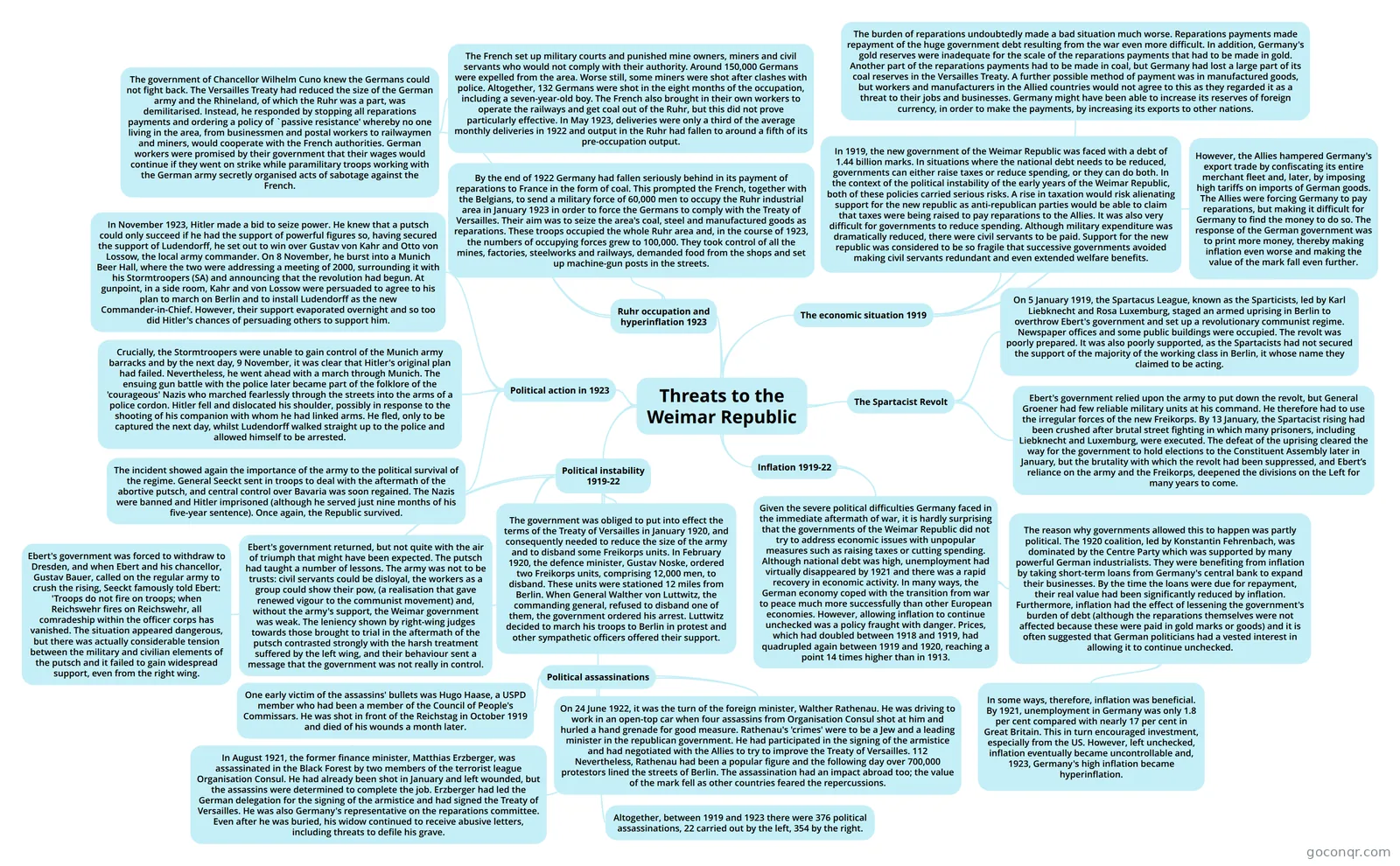
Mind map: Threats to the Weimar Republic
Map content
Threats to the Weimar Republic
The economic situation 1919
- The burden of reparations undoubtedly made a bad situation much worse. Reparations payments made repayment of the huge government debt resulting from the war even more difficult. In addition, Germany's gold reserves were inadequate for the scale of the reparations payments that had to be made in gold. Another part of the reparations payments had to be made in coal, but Germany had lost a large part of its coal reserves in the Versailles Treaty. A further possible method of payment was in manufactured goods, but workers and manufacturers in the Allied countries would not agree to this as they regarded it as a threat to their jobs and businesses. Germany might have been able to increase its reserves of foreign currency, in order to make the payments, by increasing its exports to other nations.
- However, the Allies hampered Germany's export trade by confiscating its entire merchant fleet and, later, by imposing high tariffs on imports of German goods. The Allies were forcing Germany to pay reparations, but making it difficult for Germany to find the money to do so. The response of the German government was to print more money, thereby making inflation even worse and making the value of the mark fall even further.
- In 1919, the new government of the Weimar Republic was faced with a debt of 1.44 billion marks. In situations where the national debt needs to be reduced, governments can either raise taxes or reduce spending, or they can do both. In the context of the political instability of the early years of the Weimar Republic, both of these policies carried serious risks. A rise in taxation would risk alienating support for the new republic as anti-republican parties would be able to claim that taxes were being raised to pay reparations to the Allies. It was also very difficult for governments to reduce spending. Although military expenditure was dramatically reduced, there were civil servants to be paid. Support for the new republic was considered to be so fragile that successive governments avoided making civil servants redundant and even extended welfare benefits.
The Spartacist Revolt
- On 5 January 1919, the Spartacus League, known as the Sparticists, led by Karl Liebknecht and Rosa Luxemburg, staged an armed uprising in Berlin to overthrow Ebert's government and set up a revolutionary communist regime. Newspaper offices and some public buildings were occupied. The revolt was poorly prepared. It was also poorly supported, as the Spartacists had not secured the support of the majority of the working class in Berlin, it whose name they claimed to be acting.
- Ebert's government relied upon the army to put down the revolt, but General Groener had few reliable military units at his command. He therefore had to use the irregular forces of the new Freikorps. By 13 January, the Spartacist rising had been crushed after brutal street fighting in which many prisoners, including Liebknecht and Luxemburg, were executed. The defeat of the uprising cleared the way for the government to hold elections to the Constituent Assembly later in January, but the brutality with which the revolt had been suppressed, and Ebert’s reliance on the army and the Freikorps, deepened the divisions on the Left for many years to come.
Inflation 1919-22
- Given the severe political difficulties Germany faced in the immediate aftermath of war, it is hardly surprising that the governments of the Weimar Republic did not try to address economic issues with unpopular measures such as raising taxes or cutting spending. Although national debt was high, unemployment had virtually disappeared by 1921 and there was a rapid recovery in economic activity. In many ways, the German economy coped with the transition from war to peace much more successfully than other European economies. However, allowing inflation to continue unchecked was a policy fraught with danger. Prices, which had doubled between 1918 and 1919, had quadrupled again between 1919 and 1920, reaching a point 14 times higher than in 1913.
- The reason why governments allowed this to happen was partly political. The 1920 coalition, led by Konstantin Fehrenbach, was dominated by the Centre Party which was supported by many powerful German industrialists. They were benefiting from inflation by taking short-term loans from Germany's central bank to expand their businesses. By the time the loans were due for repayment, their real value had been significantly reduced by inflation. Furthermore, inflation had the effect of lessening the government's burden of debt (although the reparations themselves were not affected because these were paid in gold marks or goods) and it is often suggested that German politicians had a vested interest in allowing it to continue unchecked.
- In some ways, therefore, inflation was beneficial. By 1921, unemployment in Germany was only 1.8 per cent compared with nearly 17 per cent in Great Britain. This in turn encouraged investment, especially from the US. However, left unchecked, inflation eventually became uncontrollable and, 1923, Germany's high inflation became hyperinflation.
- The reason why governments allowed this to happen was partly political. The 1920 coalition, led by Konstantin Fehrenbach, was dominated by the Centre Party which was supported by many powerful German industrialists. They were benefiting from inflation by taking short-term loans from Germany's central bank to expand their businesses. By the time the loans were due for repayment, their real value had been significantly reduced by inflation. Furthermore, inflation had the effect of lessening the government's burden of debt (although the reparations themselves were not affected because these were paid in gold marks or goods) and it is often suggested that German politicians had a vested interest in allowing it to continue unchecked.
- Given the severe political difficulties Germany faced in the immediate aftermath of war, it is hardly surprising that the governments of the Weimar Republic did not try to address economic issues with unpopular measures such as raising taxes or cutting spending. Although national debt was high, unemployment had virtually disappeared by 1921 and there was a rapid recovery in economic activity. In many ways, the German economy coped with the transition from war to peace much more successfully than other European economies. However, allowing inflation to continue unchecked was a policy fraught with danger. Prices, which had doubled between 1918 and 1919, had quadrupled again between 1919 and 1920, reaching a point 14 times higher than in 1913.
Political action in 1923
- In November 1923, Hitler made a bid to seize power. He knew that a putsch could only succeed if he had the support of powerful figures so, having secured the support of Ludendorff, he set out to win over Gustav von Kahr and Otto von Lossow, the local army commander. On 8 November, he burst into a Munich Beer Hall, where the two were addressing a meeting of 2000, surrounding it with his Stormtroopers (SA) and announcing that the revolution had begun. At gunpoint, in a side room, Kahr and von Lossow were persuaded to agree to his plan to march on Berlin and to install Ludendorff as the new Commander-in-Chief. However, their support evaporated overnight and so too did Hitler's chances of persuading others to support him.
- Crucially, the Stormtroopers were unable to gain control of the Munich army barracks and by the next day, 9 November, it was clear that Hitler's original plan had failed. Nevertheless, he went ahead with a march through Munich. The ensuing gun battle with the police later became part of the folklore of the 'courageous' Nazis who marched fearlessly through the streets into the arms of a police cordon. Hitler fell and dislocated his shoulder, possibly in response to the shooting of his companion with whom he had linked arms. He fled, only to be captured the next day, whilst Ludendorff walked straight up to the police and allowed himself to be arrested.
- The incident showed again the importance of the army to the political survival of the regime. General Seeckt sent in troops to deal with the aftermath of the abortive putsch, and central control over Bavaria was soon regained. The Nazis were banned and Hitler imprisoned (although he served just nine months of his five-year sentence). Once again, the Republic survived.
Ruhr occupation and hyperinflation 1923
- By the end of 1922 Germany had fallen seriously behind in its payment of reparations to France in the form of coal. This prompted the French, together with the Belgians, to send a military force of 60,000 men to occupy the Ruhr industrial area in January 1923 in order to force the Germans to comply with the Treaty of Versailles. Their aim was to seize the area's coal, steel and manufactured goods as reparations. These troops occupied the whole Ruhr area and, in the course of 1923, the numbers of occupying forces grew to 100,000. They took control of all the mines, factories, steelworks and railways, demanded food from the shops and set up machine-gun posts in the streets.
- The government of Chancellor Wilhelm Cuno knew the Germans could not fight back. The Versailles Treaty had reduced the size of the German army and the Rhineland, of which the Ruhr was a part, was demilitarised. Instead, he responded by stopping all reparations payments and ordering a policy of `passive resistance' whereby no one living in the area, from businessmen and postal workers to railwaymen and miners, would cooperate with the French authorities. German workers were promised by their government that their wages would continue if they went on strike while paramilitary troops working with the German army secretly organised acts of sabotage against the French.
- The French set up military courts and punished mine owners, miners and civil servants who would not comply with their authority. Around 150,000 Germans were expelled from the area. Worse still, some miners were shot after clashes with police. Altogether, 132 Germans were shot in the eight months of the occupation, including a seven-year-old boy. The French also brought in their own workers to operate the railways and get coal out of the Ruhr, but this did not prove particularly effective. In May 1923, deliveries were only a third of the average monthly deliveries in 1922 and output in the Ruhr had fallen to around a fifth of its pre-occupation output.
Political instability 1919-22
- The government was obliged to put into effect the terms of the Treaty of Versailles in January 1920, and consequently needed to reduce the size of the army and to disband some Freikorps units. In February 1920, the defence minister, Gustav Noske, ordered two Freikorps units, comprising 12,000 men, to disband. These units were stationed 12 miles from Berlin. When General Walther von Luttwitz, the commanding general, refused to disband one of them, the government ordered his arrest. Luttwitz decided to march his troops to Berlin in protest and other sympathetic officers offered their support.
- Ebert's government was forced to withdraw to Dresden, and when Ebert and his chancellor, Gustav Bauer, called on the regular army to crush the rising, Seeckt famously told Ebert: 'Troops do not fire on troops; when Reichswehr fires on Reichswehr, all comradeship within the officer corps has vanished. The situation appeared dangerous, but there was actually considerable tension between the military and civilian elements of the putsch and it failed to gain widespread support, even from the right wing.
- Ebert's government returned, but not quite with the air of triumph that might have been expected. The putsch had taught a number of lessons. The army was not to be trusts: civil servants could be disloyal, the workers as a group could show their pow, (a realisation that gave renewed vigour to the communist movement) and, without the army's support, the Weimar government was weak. The leniency shown by right-wing judges towards those brought to trial in the aftermath of the putsch contrasted strongly with the harsh treatment suffered by the left wing, and their behaviour sent a message that the government was not really in control.
- Political assassinations
- One early victim of the assassins' bullets was Hugo Haase, a USPD member who had been a member of the Council of People's Commissars. He was shot in front of the Reichstag in October 1919 and died of his wounds a month later.
- In August 1921, the former finance minister, Matthias Erzberger, was assassinated in the Black Forest by two members of the terrorist league Organisation Consul. He had already been shot in January and left wounded, but the assassins were determined to complete the job. Erzberger had led the German delegation for the signing of the armistice and had signed the Treaty of Versailles. He was also Germany's representative on the reparations committee. Even after he was buried, his widow continued to receive abusive letters, including threats to defile his grave.
- On 24 June 1922, it was the turn of the foreign minister, Walther Rathenau. He was driving to work in an open-top car when four assassins from Organisation Consul shot at him and hurled a hand grenade for good measure. Rathenau's 'crimes' were to be a Jew and a leading minister in the republican government. He had participated in the signing of the armistice and had negotiated with the Allies to try to improve the Treaty of Versailles. 112 Nevertheless, Rathenau had been a popular figure and the following day over 700,000 protestors lined the streets of Berlin. The assassination had an impact abroad too; the value of the mark fell as other countries feared the repercussions.
- Altogether, between 1919 and 1923 there were 376 political assassinations, 22 carried out by the left, 354 by the right.
Information
- Description
- AS level History (Nazi Germany AS level) Mind Map on Threats to the Weimar Republic, created by Lily Duffy on 21/03/2018.
- Created by
- Lily Duffy
- Views
- 0
- Rating
More on Early Problems and Opposition to the Weimar Republic