
Mind map
Article 6: Right to a fair trial
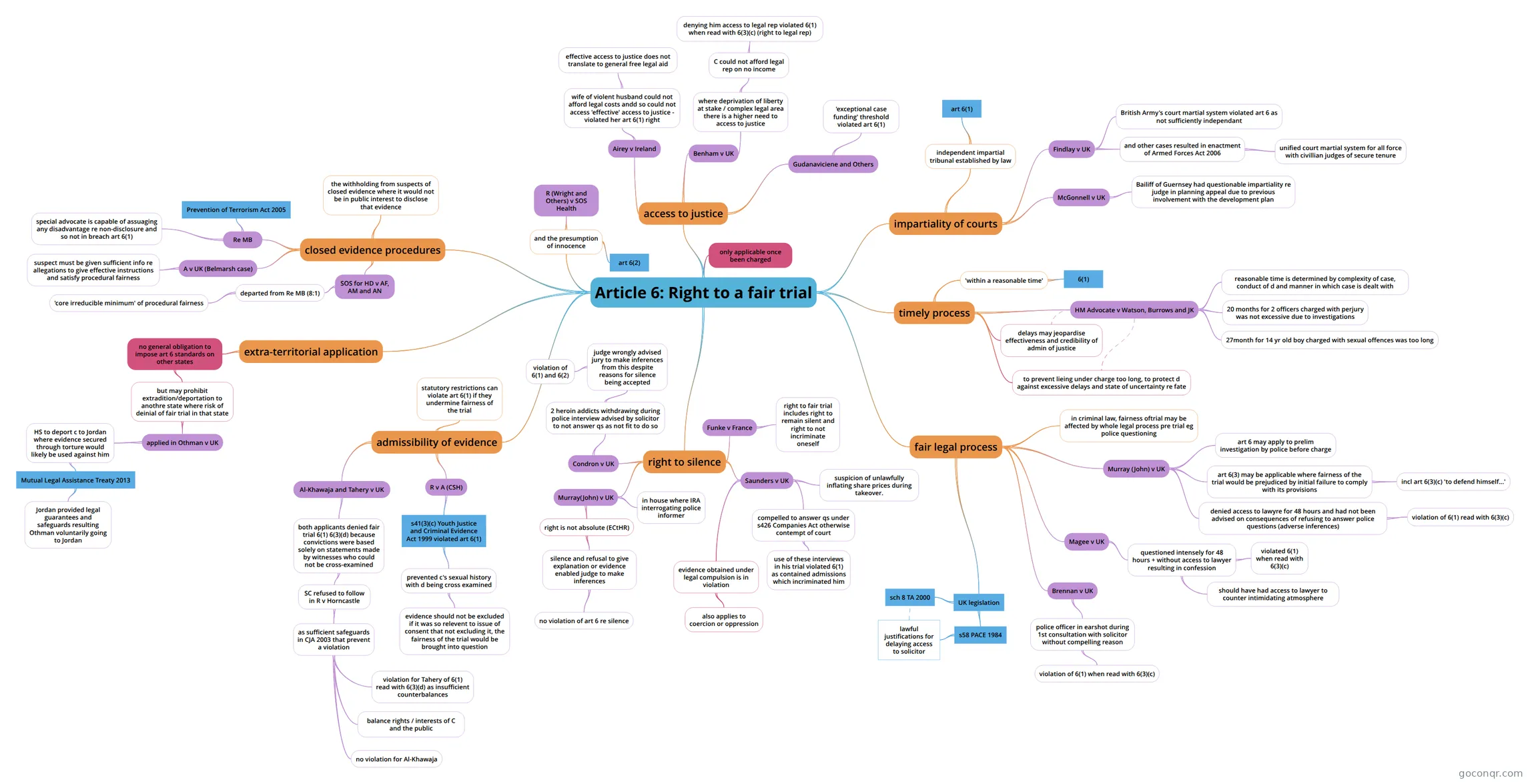
Mind map: Article 6: right to a fair trial
Map content
Article 6: Right to a fair trial
and the presumption of innocence
- art 6(2)
- R (Wright and Others) v SOS Health
only applicable once been charged
access to justice
- Airey v Ireland
- wife of violent husband could not afford legal costs andd so could not access 'effective' access to justice - violated her art 6(1) right
- effective access to justice does not translate to general free legal aid
- wife of violent husband could not afford legal costs andd so could not access 'effective' access to justice - violated her art 6(1) right
- Benham v UK
- where deprivation of liberty at stake / complex legal area there is a higher need to access to justice
- C could not afford legal rep on no income
- denying him access to legal rep violated 6(1) when read with 6(3)(c) (right to legal rep)
- C could not afford legal rep on no income
- where deprivation of liberty at stake / complex legal area there is a higher need to access to justice
- Gudanaviciene and Others
- 'exceptional case funding' threshold violated art 6(1)
- Airey v Ireland
impartiality of courts
- independent impartial tribunal established by law
- art 6(1)
- Findlay v UK
- British Army's court martial system violated art 6 as not sufficiently independant
- and other cases resulted in enactment of Armed Forces Act 2006
- unified court martial system for all force with civillian judges of secure tenure
- McGonnell v UK
- Bailiff of Guernsey had questionable impartiality re judge in planning appeal due to previous involvement with the development plan
- independent impartial tribunal established by law
timely process
- 'within a reasonable time'
- 6(1)
- HM Advocate v Watson, Burrows and JK
- reasonable time is determined by complexity of case, conduct of d and manner in which case is dealt with
- 20 months for 2 officers charged with perjury was not excessive due to investigations
- 27month for 14 yr old boy charged with sexual offences was too long
- to prevent lieing under charge too long, to protect d against excessive delays and state of uncertainty re fate
- delays may jeopardise effectiveness and credibility of admin of justice
- 'within a reasonable time'
fair legal process
- in criminal law, fairness oftrial may be affected by whole legal process pre trial eg police questioning
- Murray (John) v UK
- art 6 may apply to prelim investigation by police before charge
- art 6(3) may be applicable where fairness of the trial would be prejudiced by initial failure to comply with its provisions
- incl art 6(3)(c) 'to defend himself...'
- denied access to lawyre for 48 hours and had not been advised on consequences of refusing to answer police questions (adverse inferences)
- violation of 6(1) read with 6(3)(c)
- Magee v UK
- questioned intensely for 48 hours + without access to lawyer resulting in confession
- should have had access to lawyer to counter intimidating atmosphere
- violated 6(1) when read with 6(3)(c)
- questioned intensely for 48 hours + without access to lawyer resulting in confession
- Brennan v UK
- police officer in earshot during 1st consultation with solicitor without compelling reason
- violation of 6(1) when read with 6(3)(c)
- police officer in earshot during 1st consultation with solicitor without compelling reason
- UK legislation
- s58 PACE 1984
- lawful justifications for delaying access to solicitor
- sch 8 TA 2000
- s58 PACE 1984
right to silence
- Funke v France
- right to fair trial includes right to remain silent and right to not incriminate oneself
- Murray(John) v UK
- right is not absolute (ECtHR)
- silence and refusal to give explanation or evidence enabled judge to make inferences
- no violation of art 6 re silence
- silence and refusal to give explanation or evidence enabled judge to make inferences
- in house where IRA interrogating police informer
- right is not absolute (ECtHR)
- Condron v UK
- 2 heroin addicts withdrawing during police interview advised by solicitor to not answer qs as not fit to do so
- judge wrongly advised jury to make inferences from this despite reasons for silence being accepted
- violation of 6(1) and 6(2)
- judge wrongly advised jury to make inferences from this despite reasons for silence being accepted
- 2 heroin addicts withdrawing during police interview advised by solicitor to not answer qs as not fit to do so
- Saunders v UK
- evidence obtained under legal compulsion is in violation
- also applies to coercion or oppression
- suspicion of unlawfully inflating share prices during takeover.
- compelled to answer qs under s426 Companies Act otherwise contempt of court
- use of these interviews in his trial violated 6(1) as contained admissions which incriminated him
- evidence obtained under legal compulsion is in violation
- Funke v France
admissibility of evidence
- statutory restrictions can violate art 6(1) if they undermine fairness of the trial
- R v A (CSH)
- s41(3)(c) Youth Justice and Criminal Evidence Act 1999 violated art 6(1)
- prevented c's sexual history with d being cross examined
- evidence should not be excluded if it was so relevent to issue of consent that not excluding it, the fairness of the trial would be brought into question
- prevented c's sexual history with d being cross examined
- s41(3)(c) Youth Justice and Criminal Evidence Act 1999 violated art 6(1)
- Al-Khawaja and Tahery v UK
- both applicants denied fair trial 6(1) 6(3)(d) because convictions were based solely on statements made by witnesses who could not be cross-examined
- SC refused to follow in R v Horncastle
- as sufficient safeguards in CJA 2003 that prevent a violation
- balance rights / interests of C and the public
- no violation for Al-Khawaja
- violation for Tahery of 6(1) read with 6(3)(d) as insufficient counterbalances
- as sufficient safeguards in CJA 2003 that prevent a violation
- SC refused to follow in R v Horncastle
- both applicants denied fair trial 6(1) 6(3)(d) because convictions were based solely on statements made by witnesses who could not be cross-examined
extra-territorial application
- no general obligation to impose art 6 standards on other states
- but may prohibit extradition/deportation to anothre state where risk of deinial of fair trial in that state
- applied in Othman v UK
- HS to deport c to Jordan where evidence secured through torture would likely be used against him
- Mutual Legal Assistance Treaty 2013
- Jordan provided legal guarantees and safeguards resulting Othman voluntarily going to Jordan
- Mutual Legal Assistance Treaty 2013
- HS to deport c to Jordan where evidence secured through torture would likely be used against him
- applied in Othman v UK
- but may prohibit extradition/deportation to anothre state where risk of deinial of fair trial in that state
- no general obligation to impose art 6 standards on other states
closed evidence procedures
- the withholding from suspects of closed evidence where it would not be in public interest to disclose that evidence
- Re MB
- special advocate is capable of assuaging any disadvantage re non-disclosure and so not in breach art 6(1)
- Prevention of Terrorism Act 2005
- A v UK (Belmarsh case)
- suspect must be given sufficient info re allegations to give effective instructions and satisfy procedural fairness
- SOS for HD v AF, AM and AN
- departed from Re MB (8:1)
- 'core irreducible minimum' of procedural fairness
- departed from Re MB (8:1)
Information
- Description
- Con & Ad (Human Rights) Mind Map on Article 6: Right to a fair trial, created by Tan Nah on 04/06/2018.
- Created by
- Tan Nah
- Views
- 4
- Rating
More on Right to Life, Liberty and Fair Trial