
Mind map
India After Independence
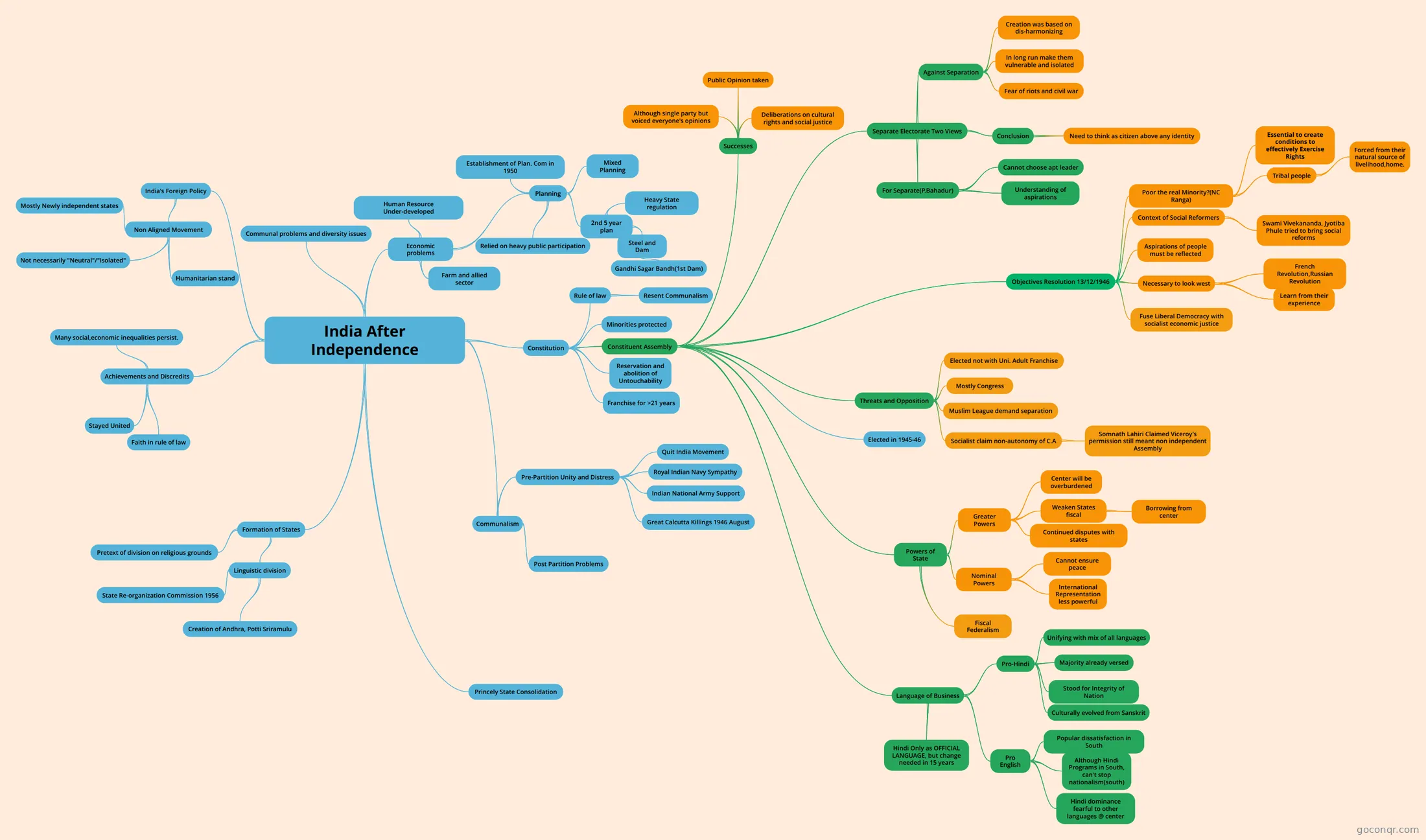
Mind map: India after independence
Map content
India After Independence
Economic problems
- Farm and allied sector
- Human Resource Under-developed
- Planning
- Establishment of Plan. Com in 1950
- Mixed Planning
- 2nd 5 year plan
- Steel and Dam
- Gandhi Sagar Bandh(1st Dam)
- Heavy State regulation
- Steel and Dam
- Relied on heavy public participation
Communal problems and diversity issues
Constitution
- Franchise for >21 years
- Rule of law
- Resent Communalism
- Minorities protected
- Reservation and abolition of Untouchability
- Constituent Assembly
- Elected in 1945-46
- Threats and Opposition
- Socialist claim non-autonomy of C.A
- Somnath Lahiri Claimed Viceroy's permission still meant non independent Assembly
- Muslim League demand separation
- Mostly Congress
- Elected not with Uni. Adult Franchise
- Socialist claim non-autonomy of C.A
- Successes
- Although single party but voiced everyone's opinions
- Public Opinion taken
- Deliberations on cultural rights and social justice
- Objectives Resolution 13/12/1946
- Necessary to look west
- French Revolution,Russian Revolution
- Learn from their experience
- Fuse Liberal Democracy with socialist economic justice
- Context of Social Reformers
- Swami Vivekananda, Jyotiba Phule tried to bring social reforms
- Aspirations of people must be reflected
- Poor the real Minority?(NC Ranga)
- Essential to create conditions to effectively Exercise Rights
- Tribal people
- Forced from their natural source of livelihood,home.
- Necessary to look west
- Separate Electorate Two Views
- For Separate(P.Bahadur)
- Understanding of aspirations
- Cannot choose apt leader
- Against Separation
- Creation was based on dis-harmonizing
- Fear of riots and civil war
- In long run make them vulnerable and isolated
- Conclusion
- Need to think as citizen above any identity
- For Separate(P.Bahadur)
- Powers of State
- Greater Powers
- Center will be overburdened
- Weaken States fiscal
- Borrowing from center
- Continued disputes with states
- Nominal Powers
- Cannot ensure peace
- International Representation less powerful
- Fiscal Federalism
- Greater Powers
- Language of Business
- Pro-Hindi
- Unifying with mix of all languages
- Majority already versed
- Stood for Integrity of Nation
- Culturally evolved from Sanskrit
- Pro English
- Popular dissatisfaction in South
- Although Hindi Programs in South, can't stop nationalism(south)
- Hindi dominance fearful to other languages @ center
- Hindi Only as OFFICIAL LANGUAGE, but change needed in 15 years
- Pro-Hindi
Formation of States
- Pretext of division on religious grounds
- Linguistic division
- Creation of Andhra, Potti Sriramulu
- State Re-organization Commission 1956
India's Foreign Policy
- Non Aligned Movement
- Not necessarily "Neutral"/"Isolated"
- Humanitarian stand
- Mostly Newly independent states
- Non Aligned Movement
Achievements and Discredits
- Stayed United
- Faith in rule of law
- Many social,economic inequalities persist.
Communalism
- Pre-Partition Unity and Distress
- Quit India Movement
- Indian National Army Support
- Royal Indian Navy Sympathy
- Great Calcutta Killings 1946 August
- Post Partition Problems
- Pre-Partition Unity and Distress
Princely State Consolidation
Information
- Description
- UPSC CSE History Mind Map on India After Independence, created by Ameya Virkud on 28/06/2018.
- Created by
- Ameya Virkud
- Views
- 145
- Tags
- Rating