
Mind map
Methods of studying the Nervous system
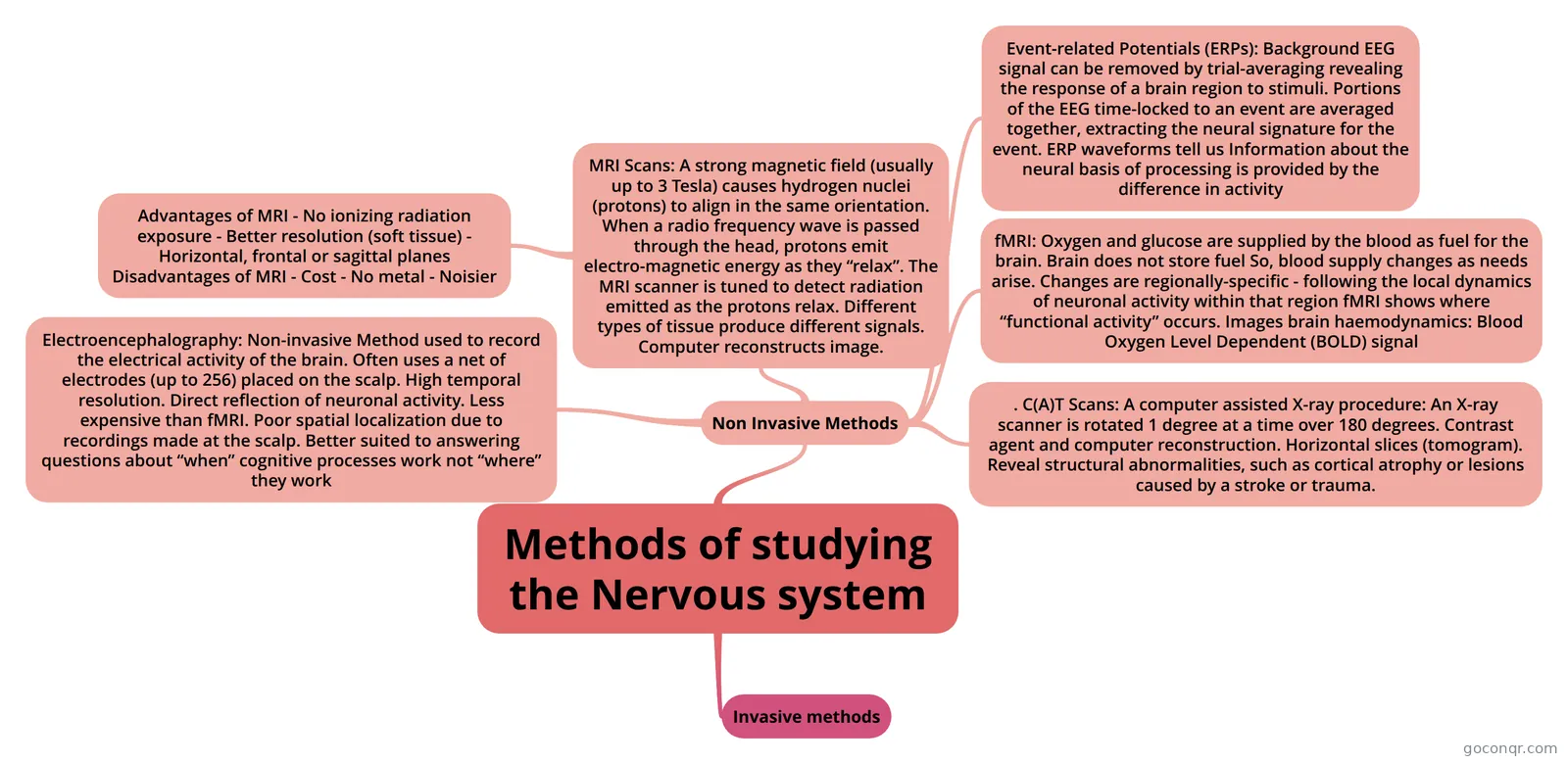
Mind map: Methods of studying the nervous system
Map content
Methods of studying the Nervous system
Invasive methods
Non Invasive Methods
- . C(A)T Scans: A computer assisted X-ray procedure: An X-ray scanner is rotated 1 degree at a time over 180 degrees. Contrast agent and computer reconstruction. Horizontal slices (tomogram). Reveal structural abnormalities, such as cortical atrophy or lesions caused by a stroke or trauma.
- MRI Scans: A strong magnetic field (usually up to 3 Tesla) causes hydrogen nuclei (protons) to align in the same orientation. When a radio frequency wave is passed through the head, protons emit electro-magnetic energy as they “relax”. The MRI scanner is tuned to detect radiation emitted as the protons relax. Different types of tissue produce different signals. Computer reconstructs image.
- Advantages of MRI - No ionizing radiation exposure - Better resolution (soft tissue) - Horizontal, frontal or sagittal planes Disadvantages of MRI - Cost - No metal - Noisier
- fMRI: Oxygen and glucose are supplied by the blood as fuel for the brain. Brain does not store fuel So, blood supply changes as needs arise. Changes are regionally-specific - following the local dynamics of neuronal activity within that region fMRI shows where “functional activity” occurs. Images brain haemodynamics: Blood Oxygen Level Dependent (BOLD) signal
- Electroencephalography: Non-invasive Method used to record the electrical activity of the brain. Often uses a net of electrodes (up to 256) placed on the scalp. High temporal resolution. Direct reflection of neuronal activity. Less expensive than fMRI. Poor spatial localization due to recordings made at the scalp. Better suited to answering questions about “when” cognitive processes work not “where” they work
- Event-related Potentials (ERPs): Background EEG signal can be removed by trial-averaging revealing the response of a brain region to stimuli. Portions of the EEG time-locked to an event are averaged together, extracting the neural signature for the event. ERP waveforms tell us Information about the neural basis of processing is provided by the difference in activity
Information
- Description
- Degree Psychology Mind Map on Methods of studying the Nervous system, created by Jess Wakefield-Boyd on 10/01/2019.
- Created by
- Jess Wakefield-Boyd
- Views
- 1
- Rating