
Mind map
Caregiver-infant interactions
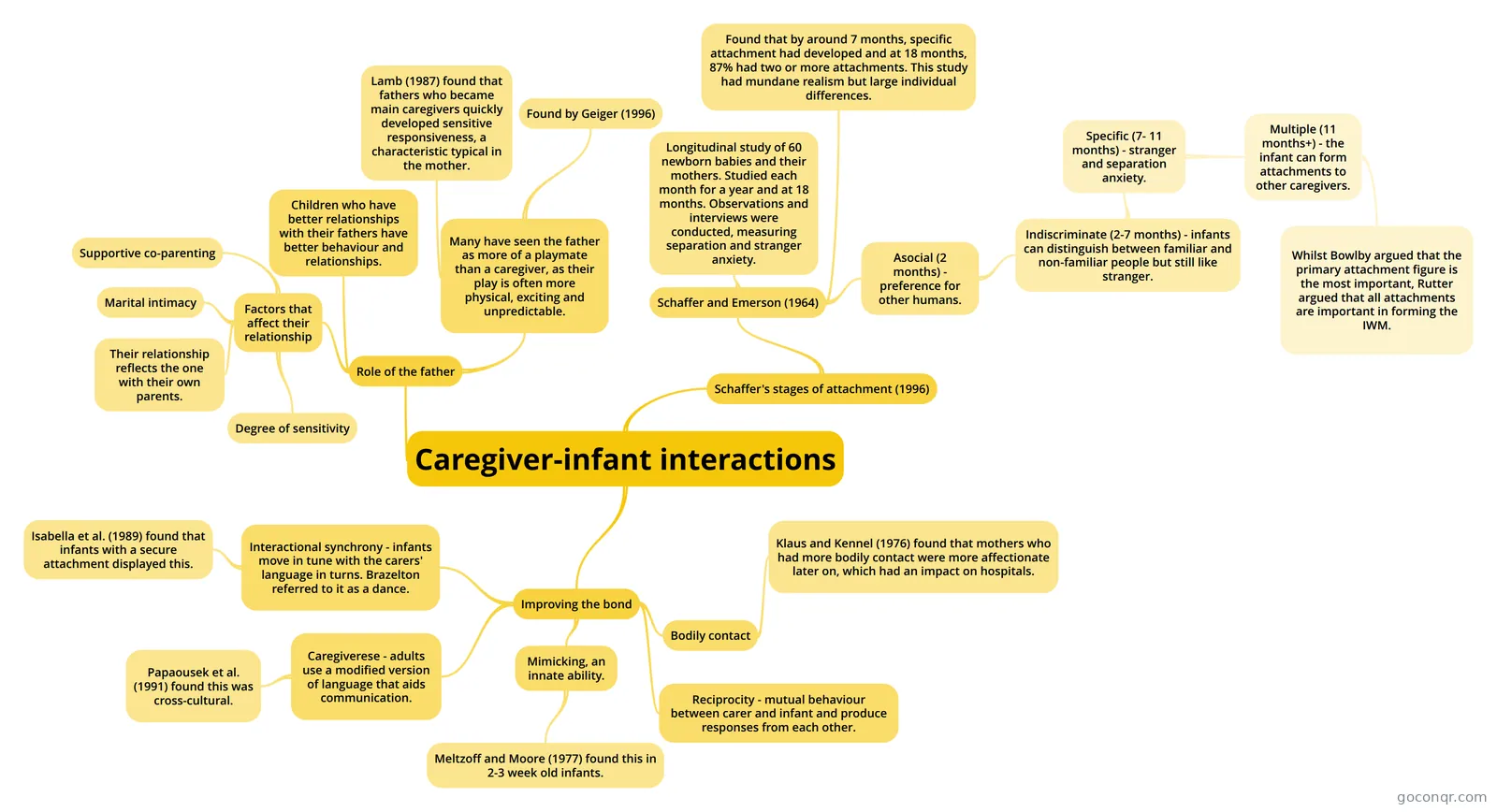
Mind map: Caregiver-infant interactions
Map content
Caregiver-infant interactions
Improving the bond
- Bodily contact
- Klaus and Kennel (1976) found that mothers who had more bodily contact were more affectionate later on, which had an impact on hospitals.
- Mimicking, an innate ability.
- Meltzoff and Moore (1977) found this in 2-3 week old infants.
- Caregiverese - adults use a modified version of language that aids communication.
- Papaousek et al. (1991) found this was cross-cultural.
- Interactional synchrony - infants move in tune with the carers' language in turns. Brazelton referred to it as a dance.
- Isabella et al. (1989) found that infants with a secure attachment displayed this.
- Reciprocity - mutual behaviour between carer and infant and produce responses from each other.
- Bodily contact
Role of the father
- Many have seen the father as more of a playmate than a caregiver, as their play is often more physical, exciting and unpredictable.
- Found by Geiger (1996)
- Lamb (1987) found that fathers who became main caregivers quickly developed sensitive responsiveness, a characteristic typical in the mother.
- Factors that affect their relationship
- Degree of sensitivity
- Their relationship reflects the one with their own parents.
- Marital intimacy
- Supportive co-parenting
- Children who have better relationships with their fathers have better behaviour and relationships.
- Many have seen the father as more of a playmate than a caregiver, as their play is often more physical, exciting and unpredictable.
Schaffer's stages of attachment (1996)
- Schaffer and Emerson (1964)
- Longitudinal study of 60 newborn babies and their mothers. Studied each month for a year and at 18 months. Observations and interviews were conducted, measuring separation and stranger anxiety.
- Found that by around 7 months, specific attachment had developed and at 18 months, 87% had two or more attachments. This study had mundane realism but large individual differences.
- Asocial (2 months) - preference for other humans.
- Indiscriminate (2-7 months) - infants can distinguish between familiar and non-familiar people but still like stranger.
- Specific (7- 11 months) - stranger and separation anxiety.
- Multiple (11 months+) - the infant can form attachments to other caregivers.
- Whilst Bowlby argued that the primary attachment figure is the most important, Rutter argued that all attachments are important in forming the IWM.
- Multiple (11 months+) - the infant can form attachments to other caregivers.
- Specific (7- 11 months) - stranger and separation anxiety.
- Indiscriminate (2-7 months) - infants can distinguish between familiar and non-familiar people but still like stranger.
- Schaffer and Emerson (1964)
Information
- Description
- A level Psychology (Attachment) Mind Map on Caregiver-infant interactions, created by Bethany Barnes on 24/06/2019.
- Created by
- Bethany Barnes
- Views
- 3
- Rating