
Mind map
Psychology: Memory
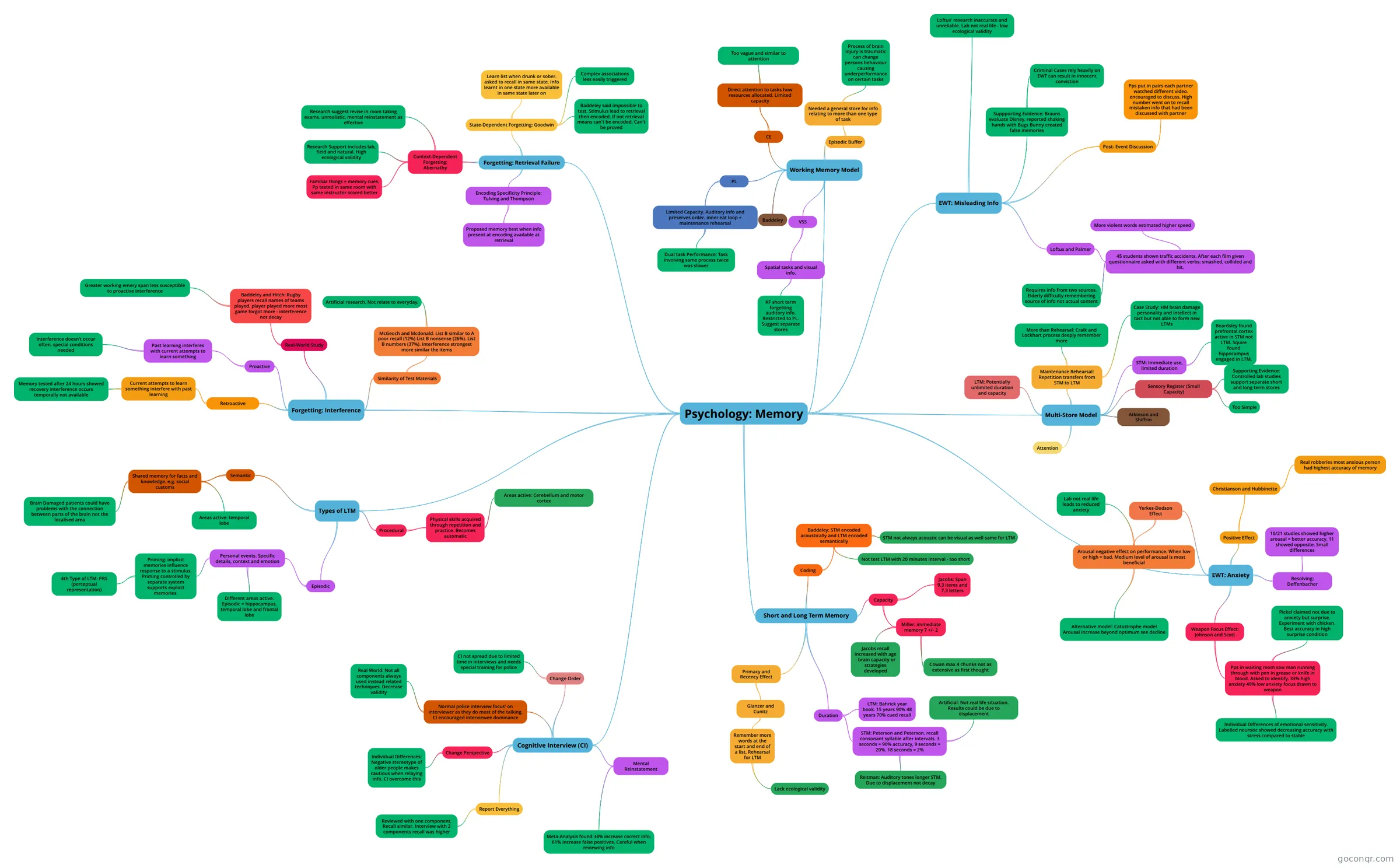
Mind map: Psychology memory
Map content
Psychology: Memory
Short and Long Term Memory
- Capacity
- Jacobs: Span 9.3 items and 7.3 letters
- Miller: immediate memory 7 +/- 2
- Cowan max 4 chunks not as extensive as first thought
- Jacobs recall increased with age - brain capacity or strategies developed
- Duration
- STM: Peterson and Peterson. recall consonant syllable after intervals. 3 seconds = 90% accuracy, 9 seconds = 20%. 18 seconds = 2%
- Artificial: Not real life situation. Results could be due to displacement
- Reitman: Auditory tones longer STM. Due to displacement not decay
- LTM: Bahrick year book. 15 years 90% 48 years 70% cued recall
- STM: Peterson and Peterson. recall consonant syllable after intervals. 3 seconds = 90% accuracy, 9 seconds = 20%. 18 seconds = 2%
- Coding
- Baddeley: STM encoded acoustically and LTM encoded semantically
- Not test LTM with 20 minutes interval - too short
- STM not always acoustic can be visual as well same for LTM
- Baddeley: STM encoded acoustically and LTM encoded semantically
- Primacy and Recency Effect
- Glanzer and Cunitz
- Remember more words at the start and end of a list. Rehearsal for LTM
- Lack ecological validity
- Remember more words at the start and end of a list. Rehearsal for LTM
- Glanzer and Cunitz
- Capacity
Multi-Store Model
- Atkinson and Shiffrin
- Sensory Register (Small Capacity)
- Supporting Evidence: Controlled lab studies support separate short and long term stores
- Too Simple
- Attention
- STM: Immediate use, limited duration
- Beardsley found prefrontal cortex active in STM not LTM. Squire found hippocampus engaged in LTM.
- Maintenance Rehearsal: Repetition transfers from STM to LTM
- Case Study: HM brain damage personality and intellect in tact but not able to form new LTMs
- More than Rehearsal: Craik and Lockhart process deeply remember more
- LTM: Potentially unlimited duration and capacity
Working Memory Model
- Baddeley
- CE
- Direct attention to tasks how resources allocated. Limited capacity
- Too vague and similar to attention
- Direct attention to tasks how resources allocated. Limited capacity
- PL
- Limited Capacity. Auditory info and preserves order. inner eat loop = maintenance rehearsal
- Dual task Performance: Task involving same process twice was slower
- Limited Capacity. Auditory info and preserves order. inner eat loop = maintenance rehearsal
- VSS
- Spatial tasks and visual info.
- KF short term forgetting auditory info. Restricted to PL. Suggest separate stores
- Spatial tasks and visual info.
- Episodic Buffer
- Needed a general store for info relating to more than one type of task
- Process of brain injury is traumatic can change persons behaviour causing underperformance on certain tasks
- Needed a general store for info relating to more than one type of task
Types of LTM
- Episodic
- Personal events. Specific details, context and emotion
- Different areas active. Episodic = hippocampus, temporal lobe and frontal lobe
- Priming: implicit memories influence response to a stimulus. Priming controlled by separate system supports explicit memories.
- 4th Type of LTM: PRS (perceptual representation)
- Personal events. Specific details, context and emotion
- Semantic
- Shared memory for facts and knowledge. e.g. social customs
- Areas active: temporal lobe
- Brain Damaged patients could have problems with the connection between parts of the brain not the localised area
- Shared memory for facts and knowledge. e.g. social customs
- Procedural
- Physical skills acquired through repetition and practice. Becomes automatic
- Areas active: Cerebellum and motor cortex
- Physical skills acquired through repetition and practice. Becomes automatic
- Episodic
Forgetting: Interference
- Retroactive
- Current attempts to learn something interfere with past learning
- Memory tested after 24 hours showed recovery interference occurs temporally not available
- Current attempts to learn something interfere with past learning
- Proactive
- Past learning interferes with current attempts to learn something
- Interference doesn't occur often. special conditions needed
- Past learning interferes with current attempts to learn something
- Similarity of Test Materials
- McGeoch and Mcdonald. List B similar to A poor recall (12%) List B nonsense (26%). List B numbers (37%). Interference strongest more similar the items
- Artificial research. Not relate to everyday.
- McGeoch and Mcdonald. List B similar to A poor recall (12%) List B nonsense (26%). List B numbers (37%). Interference strongest more similar the items
- Real-World Study
- Baddeley and Hitch: Rugby players recall names of teams played. player played more most game forgot more - interference not decay
- Greater working emery span less susceptible to proactive interference
- Baddeley and Hitch: Rugby players recall names of teams played. player played more most game forgot more - interference not decay
- Retroactive
Forgetting: Retrieval Failure
- Encoding Specificity Principle: Tulving and Thompson
- Proposed memory best when info present at encoding available at retrieval
- Context-Dependent Forgetting: Abernathy
- Familiar things = memory cues. Pp tested in same room with same instructor scored better
- Research Support includes lab, field and natural. High ecological validity
- Research suggest revise in room taking exams. unrealistic. mental reinstatement as effective
- State-Dependent Forgetting: Goodwin
- Learn list when drunk or sober. asked to recall in same state. Info learnt in one state more available in same state later on
- Complex associations less easily triggered
- Baddeley said impossible to test. Stimulus lead to retrieval then encoded. If not retrieval means can't be encoded. Can't be proved
- Encoding Specificity Principle: Tulving and Thompson
EWT: Misleading Info
- Loftus and Palmer
- 45 students shown traffic accidents. After each film given questionnaire asked with different verbs: smashed, collided and hit.
- More violent words estimated higher speed
- Requires info from two sources. Elderly difficulty remembering source of info not actual content
- 45 students shown traffic accidents. After each film given questionnaire asked with different verbs: smashed, collided and hit.
- Post- Event Discussion
- Pps put in pairs each partner watched different video. encouraged to discuss. High number went on to recall mistaken info that had been discussed with partner
- Suppporting Evidence: Brauns evaluate Disney. reported shaking hands with Bugs Bunny created false memories
- Criminal Cases rely heavily on EWT can result in innocent conviction
- Loftus' research inaccurate and unreliable. Lab not real life - low ecological validity
- Loftus and Palmer
EWT: Anxiety
- Yerkes-Dodson Effect
- Arousal negative effect on performance. When low or high = bad. Medium level of arousal is most beneficial
- Alternative model: Catastrophe model Arousal increase beyond optimum see decline
- Lab not real life leads to reduced anxiety
- Arousal negative effect on performance. When low or high = bad. Medium level of arousal is most beneficial
- Weapon Focus Effect: Johnson and Scott
- Pps in waiting room saw man running through with pen in grease or knife in blood. Asked to identify. 33% high anxiety 49% low anxiety focus drawn to weapon
- Pickel claimed not due to anxiety but surprise. Experiment with chicken. Best accuracy in high surprise condition
- Individual Differences of emotional sensitivity. Labelled neurotic showed decreasing accuracy with stress compared to stable
- Pps in waiting room saw man running through with pen in grease or knife in blood. Asked to identify. 33% high anxiety 49% low anxiety focus drawn to weapon
- Resolving: Deffenbacher
- 10/21 studies showed higher arousal = better accuracy. 11 showed opposite. Small differences
- Positive Effect
- Christianson and Hubbinette
- Real robberies most anxious person had highest accuracy of memory
- Christianson and Hubbinette
- Yerkes-Dodson Effect
Cognitive Interview (CI)
- Normal police interview focus' on interviewer as they do most of the talking. CI encouraged interviewee dominance
- Real World: Not all components always used instead related techniques. Decrease validity
- Mental Reinstatement
- Meta-Analysis found 34% increase correct info. 61% increase false positives. Careful when reviewing info
- Report Everything
- Reviewed with one component. Recall similar. Interview with 2 components recall was higher
- Change Order
- CI not spread due to limited time in interviews and needs special training for police
- Change Perspective
- Individual Differences: Negative stereotype of older people makes cautious when relaying info. CI overcome this
- Normal police interview focus' on interviewer as they do most of the talking. CI encouraged interviewee dominance
Information
- Description
- Mindmap on the memory content for the AQA AS and A level exam.
- Created by
- Charlotte Deamer
- Views
- 3
- Tags
- History
-
- Created by Emilia Leydon · May 21, 2018
- Copied by Charlotte Deamer · Oct 15, 2019
- Rating