
Mind map
How to Evaluate a Psychological Study
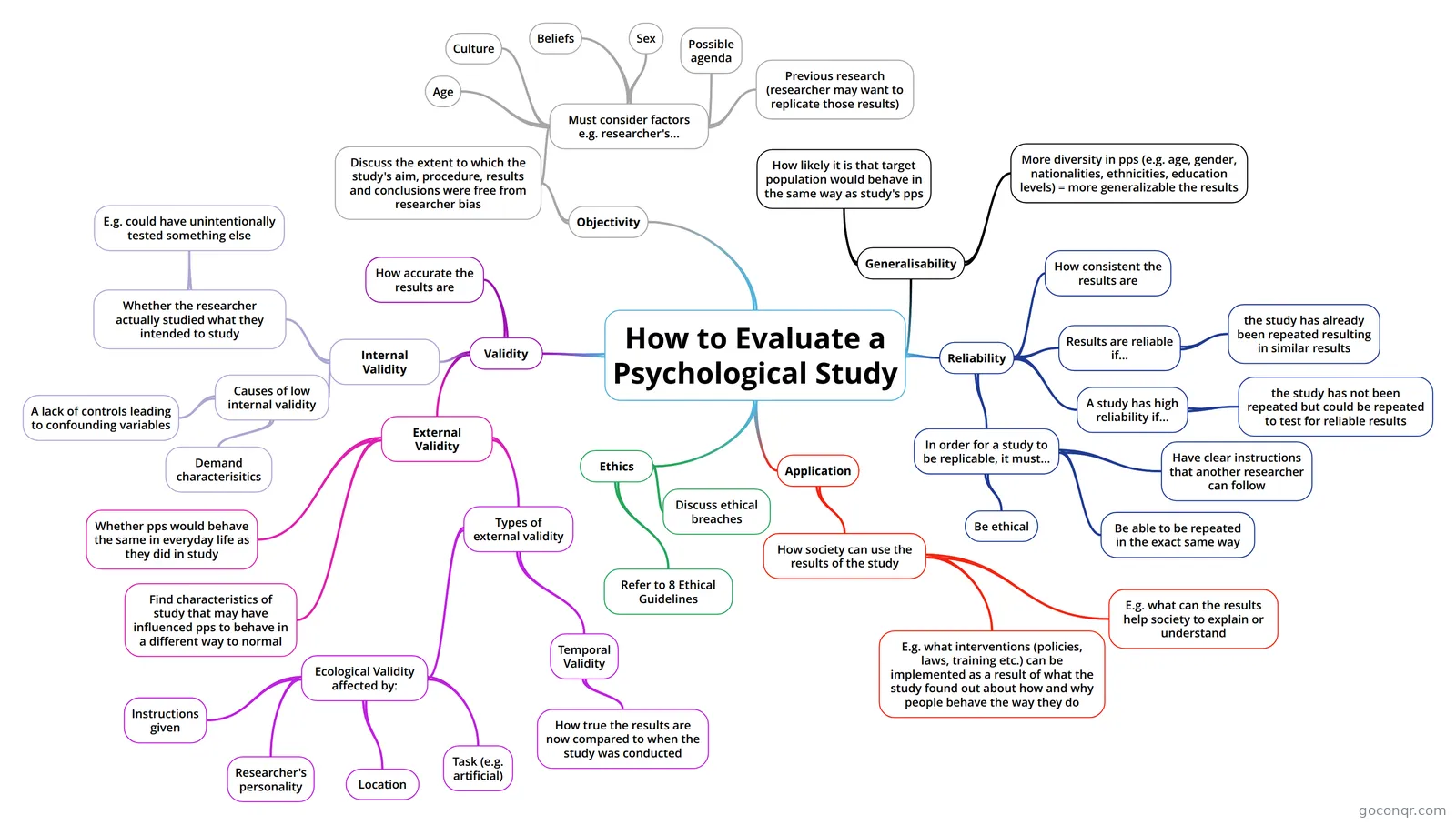
Mind map: How to evaluate a psychological study
Map content
How to Evaluate a Psychological Study
Generalisability
- How likely it is that target population would behave in the same way as study's pps
- More diversity in pps (e.g. age, gender, nationalities, ethnicities, education levels) = more generalizable the results
Reliability
- How consistent the results are
- Results are reliable if...
- the study has already been repeated resulting in similar results
- A study has high reliability if...
- the study has not been repeated but could be repeated to test for reliable results
- In order for a study to be replicable, it must...
- Have clear instructions that another researcher can follow
- Be able to be repeated in the exact same way
- Be ethical
Application
- How society can use the results of the study
- E.g. what can the results help society to explain or understand
- E.g. what interventions (policies, laws, training etc.) can be implemented as a result of what the study found out about how and why people behave the way they do
- How society can use the results of the study
Validity
- How accurate the results are
- Internal Validity
- Whether the researcher actually studied what they intended to study
- E.g. could have unintentionally tested something else
- Causes of low internal validity
- A lack of controls leading to confounding variables
- Demand characterisitics
- Whether the researcher actually studied what they intended to study
- External Validity
- Whether pps would behave the same in everyday life as they did in study
- Find characteristics of study that may have influenced pps to behave in a different way to normal
- Types of external validity
- Ecological Validity affected by:
- Instructions given
- Researcher's personality
- Location
- Task (e.g. artificial)
- Temporal Validity
- How true the results are now compared to when the study was conducted
- Ecological Validity affected by:
Objectivity
- Discuss the extent to which the study's aim, procedure, results and conclusions were free from researcher bias
- Must consider factors e.g. researcher's...
- Age
- Culture
- Beliefs
- Sex
- Previous research (researcher may want to replicate those results)
- Possible agenda
- Must consider factors e.g. researcher's...
- Discuss the extent to which the study's aim, procedure, results and conclusions were free from researcher bias
Ethics
- Discuss ethical breaches
- Refer to 8 Ethical Guidelines
Information
- Description
- A level Psychology Mind Map on How to Evaluate a Psychological Study, created by Alex Nam on 05/11/2019.
- Created by
- Alex Nam
- Views
- 0
- Rating