
Mind map
Biodiversity
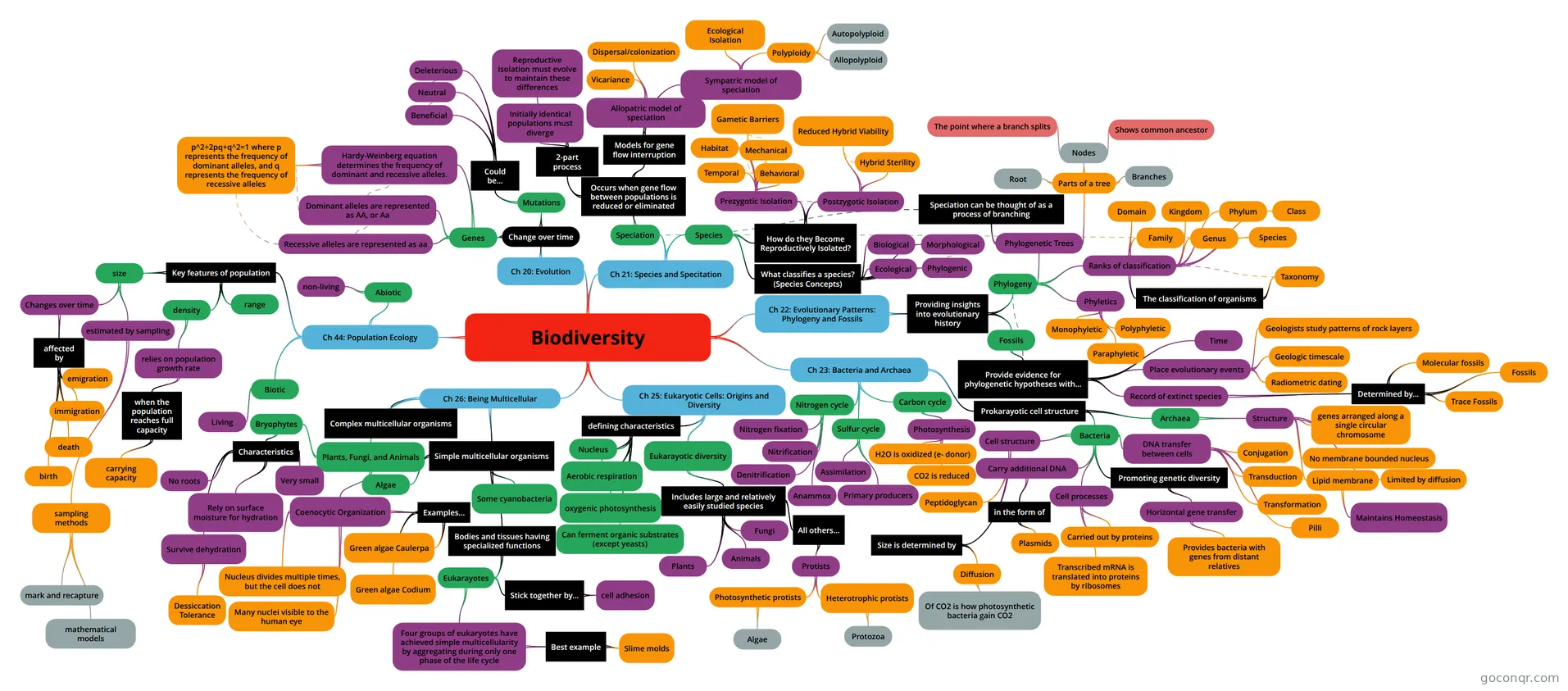
Mind map: Biodiversity
Map content
Biodiversity
Ch 20: Evolution
- Change over time
- Mutations
- Could be...
- Beneficial
- Neutral
- Deleterious
- Could be...
- Genes
- Hardy-Weinberg equation determines the frequency of dominant and recessive alleles.
- p^2+2pq+q^2=1 where p represents the frequency of dominant alleles, and q represents the frequency of recessive alleles
- Dominant alleles are represented as AA, or Aa
- Recessive alleles are represented as aa
- Hardy-Weinberg equation determines the frequency of dominant and recessive alleles.
- Mutations
- Change over time
Ch 21: Species and Specitation
- Species
- What classifies a species? (Species Concepts)
- Biological
- Morphological
- Phylogenic
- Ecological
- How do they Become Reproductively Isolated?
- Prezygotic Isolation
- Temporal
- Behavioral
- Habitat
- Mechanical
- Gametic Barriers
- Postzygotic Isolation
- Reduced Hybrid Viability
- Hybrid Sterility
- Prezygotic Isolation
- What classifies a species? (Species Concepts)
- Speciation
- Occurs when gene flow between populations is reduced or eliminated
- 2-part process
- Initially identical populations must diverge
- Reproductive isolation must evolve to maintain these differences
- Models for gene flow interruption
- Allopatric model of speciation
- Dispersal/colonization
- Vicariance
- Sympatric model of speciation
- Ecological Isolation
- Polyploidy
- Autopolyploid
- Allopolyploid
- Allopatric model of speciation
- 2-part process
- Occurs when gene flow between populations is reduced or eliminated
- Species
Ch 22: Evolutionary Patterns: Phylogeny and Fossils
- Providing insights into evolutionary history
- Phylogeny
- Phylogenetic Trees
- Speciation can be thought of as a process of branching
- Parts of a tree
- Root
- Nodes
- The point where a branch splits
- Shows common ancestor
- Branches
- Ranks of classification
- Domain
- Kingdom
- Phylum
- Class
- Family
- Genus
- Species
- The classification of organisms
- Taxonomy
- Phyletics
- Monophyletic
- Paraphyletic
- Polyphyletic
- Phylogenetic Trees
- Fossils
- Provide evidence for phylogenetic hypotheses with...
- Time
- Record of extinct species
- Determined by...
- Fossils
- Trace Fossils
- Molecular fossils
- Determined by...
- Place evolutionary events
- Geologists study patterns of rock layers
- Geologic timescale
- Radiometric dating
- Provide evidence for phylogenetic hypotheses with...
- Phylogeny
- Providing insights into evolutionary history
Ch 23: Bacteria and Archaea
- Prokarayotic cell structure
- Bacteria
- Carry additional DNA
- in the form of
- Plasmids
- in the form of
- Cell processes
- Carried out by proteins
- Transcribed mRNA is translated into proteins by ribosomes
- Cell structure
- Peptidoglycan
- Size is determined by
- Diffusion
- Of CO2 is how photosynthetic bacteria gain CO2
- Diffusion
- Promoting genetic diversity
- Horizontal gene transfer
- Provides bacteria with genes from distant relatives
- Horizontal gene transfer
- DNA transfer between cells
- Pilli
- Conjugation
- Transformation
- Transduction
- Carry additional DNA
- Archaea
- Structure
- No membrane bounded nucleus
- genes arranged along a single circular chromosome
- Limited by diffusion
- Lipid membrane
- Maintains Homeostasis
- Structure
- Bacteria
- Carbon cycle
- Photosynthesis
- CO2 is reduced
- H2O is oxidized (e- donor)
- Photosynthesis
- Sulfur cycle
- Primary producers
- Assimilation
- Nitrogen cycle
- Nitrogen fixation
- Nitrification
- Denitrification
- Anammox
- Prokarayotic cell structure
Ch 25: Eukaryotic Cells: Origins and Diversity
- defining characteristics
- Nucleus
- oxygenic photosynthesis
- Aerobic respiration
- Can ferment organic substrates (except yeasts)
- Eukarayotic diversity
- Includes large and relatively easily studied species
- Plants
- Animals
- Fungi
- All others...
- Protists
- Photosynthetic protists
- Algae
- Heterotrophic protists
- Protozoa
- Photosynthetic protists
- Protists
- Includes large and relatively easily studied species
- defining characteristics
Ch 26: Being Multicellular
- Plants, Fungi, and Animals
- Coenocytic Organization
- Nucleus divides multiple times, but the cell does not
- Many nuclei visible to the human eye
- Examples...
- Green algae Codium
- Green algae Caulerpa
- Bryophytes
- Characteristics
- Rely on surface moisture for hydration
- Very small
- No roots
- Survive dehydration
- Dessiccation Tolerance
- Characteristics
- Coenocytic Organization
- Simple multicellular organisms
- Some cyanobacteria
- Bodies and tissues having specialized functions
- Eukarayotes
- Stick together by...
- cell adhesion
- Four groups of eukaryotes have achieved simple multicellularity by aggregating during only one phase of the life cycle
- Best example
- Slime molds
- Best example
- Stick together by...
- Eukarayotes
- Algae
- Complex multicellular organisms
- Plants, Fungi, and Animals
Ch 44: Population Ecology
- Biotic
- Living
- Abiotic
- non-living
- Key features of population
- size
- estimated by sampling
- sampling methods
- mark and recapture
- mathematical models
- sampling methods
- Changes over time
- affected by
- birth
- death
- immigration
- emigration
- affected by
- estimated by sampling
- range
- density
- relies on population growth rate
- when the population reaches full capacity
- carrying capacity
- when the population reaches full capacity
- relies on population growth rate
- size
- Biotic
Information
- Description
- Mind Map on Biodiversity, created by Rachel Foster on 30/08/2020.
- Created by
- Rachel Foster
- Views
- 0
- Rating