
Mind map
Stages Of Development
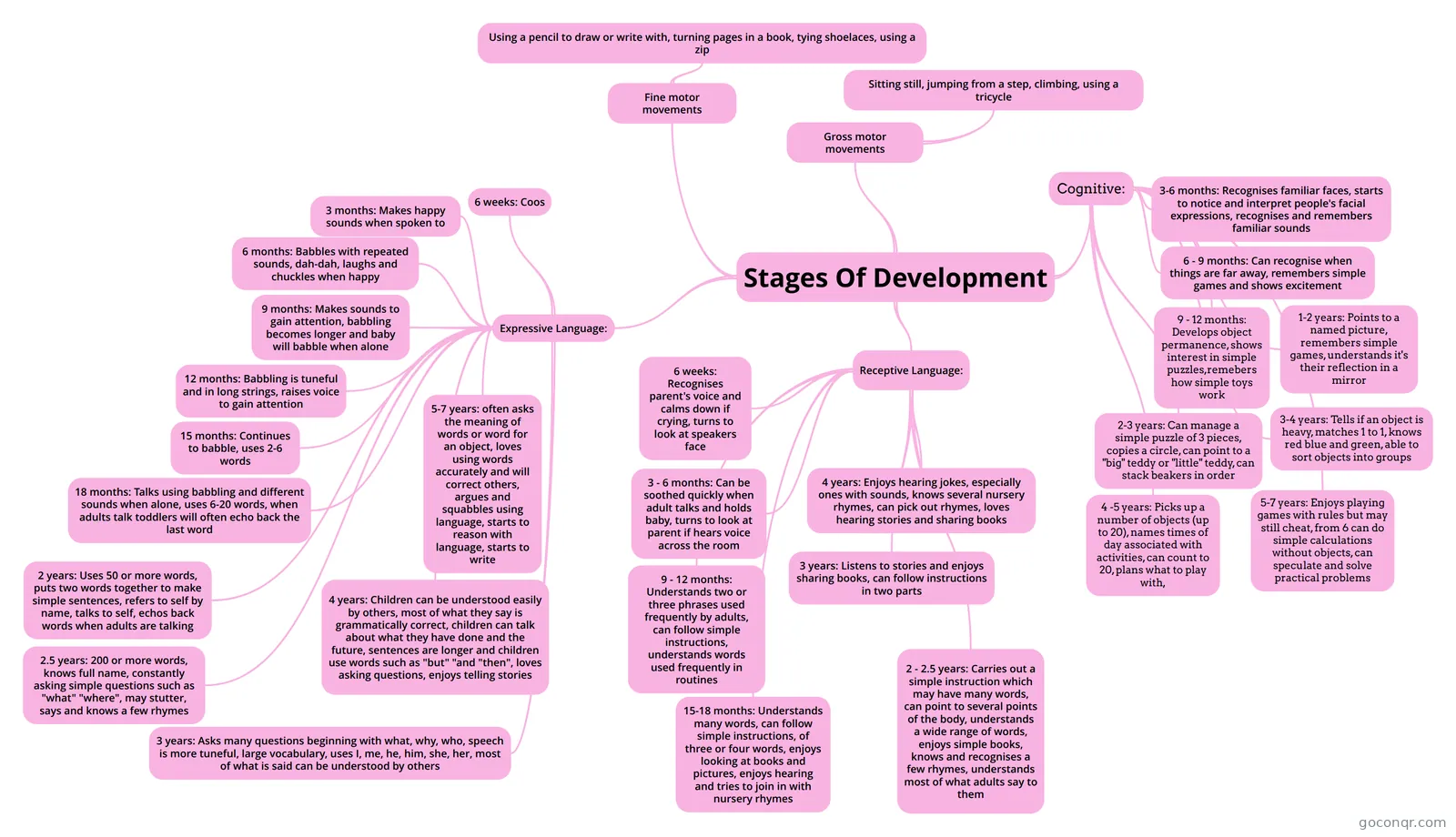
Mind map: Stages of development
Map content
Stages Of Development
Cognitive:
- 3-6 months: Recognises familiar faces, starts to notice and interpret people's facial expressions, recognises and remembers familiar sounds
- 6 - 9 months: Can recognise when things are far away, remembers simple games and shows excitement
- 9 - 12 months: Develops object permanence, shows interest in simple puzzles,remebers how simple toys work
- 1-2 years: Points to a named picture, remembers simple games, understands it's their reflection in a mirror
- 2-3 years: Can manage a simple puzzle of 3 pieces, copies a circle, can point to a "big" teddy or "little" teddy, can stack beakers in order
- 3-4 years: Tells if an object is heavy, matches 1 to 1, knows red blue and green, able to sort objects into groups
- 4 -5 years: Picks up a number of objects (up to 20), names times of day associated with activities, can count to 20, plans what to play with,
- 5-7 years: Enjoys playing games with rules but may still cheat, from 6 can do simple calculations without objects, can speculate and solve practical problems
Receptive Language:
- 6 weeks: Recognises parent's voice and calms down if crying, turns to look at speakers face
- 3 - 6 months: Can be soothed quickly when adult talks and holds baby, turns to look at parent if hears voice across the room
- 9 - 12 months: Understands two or three phrases used frequently by adults, can follow simple instructions, understands words used frequently in routines
- 15-18 months: Understands many words, can follow simple instructions, of three or four words, enjoys looking at books and pictures, enjoys hearing and tries to join in with nursery rhymes
- 2 - 2.5 years: Carries out a simple instruction which may have many words, can point to several points of the body, understands a wide range of words, enjoys simple books, knows and recognises a few rhymes, understands most of what adults say to them
- 3 years: Listens to stories and enjoys sharing books, can follow instructions in two parts
- 4 years: Enjoys hearing jokes, especially ones with sounds, knows several nursery rhymes, can pick out rhymes, loves hearing stories and sharing books
Expressive Language:
- 6 weeks: Coos
- 3 months: Makes happy sounds when spoken to
- 6 months: Babbles with repeated sounds, dah-dah, laughs and chuckles when happy
- 9 months: Makes sounds to gain attention, babbling becomes longer and baby will babble when alone
- 12 months: Babbling is tuneful and in long strings, raises voice to gain attention
- 15 months: Continues to babble, uses 2-6 words
- 18 months: Talks using babbling and different sounds when alone, uses 6-20 words, when adults talk toddlers will often echo back the last word
- 2 years: Uses 50 or more words, puts two words together to make simple sentences, refers to self by name, talks to self, echos back words when adults are talking
- 2.5 years: 200 or more words, knows full name, constantly asking simple questions such as "what" "where", may stutter, says and knows a few rhymes
- 3 years: Asks many questions beginning with what, why, who, speech is more tuneful, large vocabulary, uses I, me, he, him, she, her, most of what is said can be understood by others
- 4 years: Children can be understood easily by others, most of what they say is grammatically correct, children can talk about what they have done and the future, sentences are longer and children use words such as "but" "and "then", loves asking questions, enjoys telling stories
- 5-7 years: often asks the meaning of words or word for an object, loves using words accurately and will correct others, argues and squabbles using language, starts to reason with language, starts to write
Fine motor movements
- Using a pencil to draw or write with, turning pages in a book, tying shoelaces, using a zip
Gross motor movements
- Sitting still, jumping from a step, climbing, using a tricycle
Information
- Description
- CACHE Early Years Mind Map on Stages Of Development, created by Ellie Lockyer on 30/11/2020.
- Created by
- Ellie Lockyer
- Views
- 0
- Rating