
Mind map
Alexander II
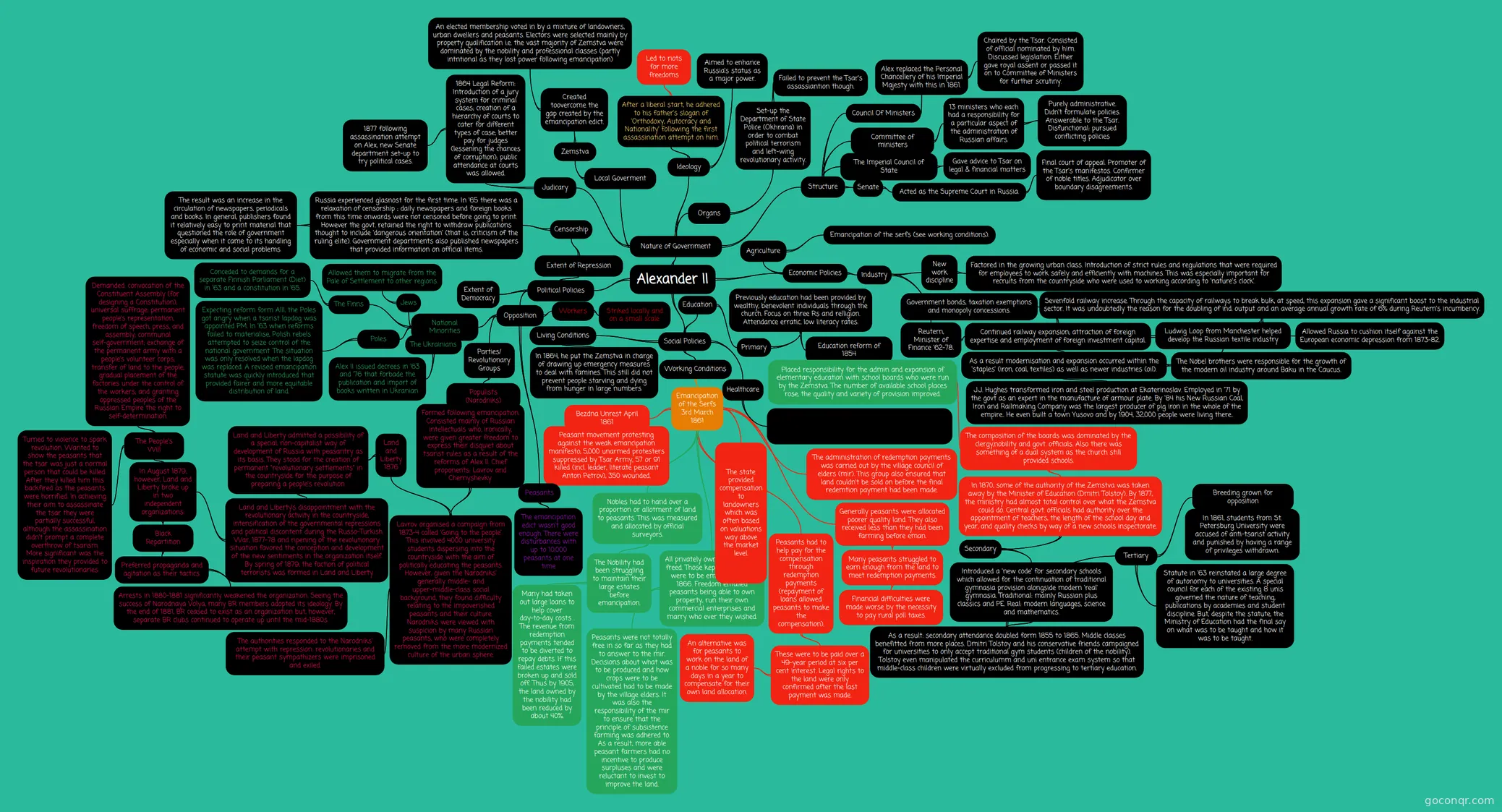
Mind map: Alexander II
Map content
Alexander II
Nature of Government
- Structure
- Council Of Ministers
- Alex replaced the Personal Chancellery of his Imperial Majesty with this in 1861.
- Chaired by the Tsar. Consisted of official nominated by him. Discussed legislation. Either gave royal assent or passed it on to Committee of Ministers for further scrutiny.
- Alex replaced the Personal Chancellery of his Imperial Majesty with this in 1861.
- Committee of ministers
- 13 ministers who each had a responsibility for a particular aspect of the administration of Russian affairs.
- Purely administrative. Didn't formulate policies. Answerable to the Tsar. Disfunctional: pursued conflicting policies
- 13 ministers who each had a responsibility for a particular aspect of the administration of Russian affairs.
- The Imperial Council of State
- Gave advice to Tsar on legal & financial matters
- Senate
- Acted as the Supreme Court in Russia.
- Final court of appeal. Promoter of the Tsar's manifestos. Confirmer of noble titles. Adjudicator over boundary disagreements.
- Acted as the Supreme Court in Russia.
- Council Of Ministers
- Organs
- Set-up the Department of State Police (Okhrana) in order to combat political terrorism and left-wing revolutionary activity.
- Failed to prevent the Tsar's assassiantion though.
- Set-up the Department of State Police (Okhrana) in order to combat political terrorism and left-wing revolutionary activity.
- Local Goverment
- Zemstva
- Created toovercome the gap created by the emancipation edict.
- An elected membership voted in by a mixture of landowners, urban dwellers and peasants. Electors were selected mainly by property qualification i.e. the vast majority of Zemstva were dominated by the nobility and professional classes (partly intntional as they lost power following emancipation)
- Created toovercome the gap created by the emancipation edict.
- Zemstva
- Judicary
- 1864 Legal Reform: Introduction of a jury system for criminal cases; creation of a hierarchy of courts to cater for different types of case; better pay for judges (lessening the chances of corruption); public attendance at courts was allowed.
- 1877 following assassination attempt on Alex, new Senate department set-up to try political cases.
- 1864 Legal Reform: Introduction of a jury system for criminal cases; creation of a hierarchy of courts to cater for different types of case; better pay for judges (lessening the chances of corruption); public attendance at courts was allowed.
- Ideology
- After a liberal start, he adhered to his father's slogan of 'Orthodoxy, Autocracy and Nationality' following the first assassination attempt on him.
- Led to riots for more freedoms
- Aimed to enhance Russia's status as a major power.
- After a liberal start, he adhered to his father's slogan of 'Orthodoxy, Autocracy and Nationality' following the first assassination attempt on him.
- Structure
Economic Policies
- Agriculture
- Emancipation of the serfs (see working conditions).
- Industry
- New work discipline
- Factored in the growing urban class. Introduction of strict rules and regulations that were required for employees to work safely and efficiently with machines. This was especially important for recruits from the countryside who were used to working according to 'nature's clock'.
- Reutern, Minister of Finance '62-78.
- Continued railway expansion; attraction of foreign expertise and employment of foreign investment capital.
- As a result modernisation and expansion occurred within the 'staples' (iron, coal, textiles) as well as newer industries (oil).
- J.J. Hughes transformed iron and steel production at Ekaterinoslav. Employed in '71 by the govt as an expert in the manufacture of armour plate. By '84 his New Russian Coal, Iron and Railmaking Company was the largest producer of pig iron in the whole of the empire.. He even built a town Yusovo and by 1904, 32,000 people were living there..
- Ludwig Loop from Manchester helped develop the Russian textile industry
- The Nobel brothers were responsible for the growth of the modern oil industry around Baku in the Caucus.
- Sevenfold railway increase. Through the capacity of railways to break bulk, at speed, this expansion gave a significant boost to the industrial sector. It was undoubtedly the reason for the doubling of ind. output and an average annual growth rate of 6% during Reutern's incumbency.
- Allowed Russia to cushion itself against the European economic depression from 1873-82.
- Government bonds, taxation exemptions and monopoly concessions.
- As a result modernisation and expansion occurred within the 'staples' (iron, coal, textiles) as well as newer industries (oil).
- Continued railway expansion; attraction of foreign expertise and employment of foreign investment capital.
- New work discipline
- Agriculture
Social Policies
- Working Conditions
- Emancipation of the Serfs 3rd March 1861
- Bezdna Unrest April 1861
- Peasant movement protesting against the weak emancipation manifesto, 5,000 unarmed protesters suppressed by Tsar Army, 57 or 91 killed (incl. leader, literate peasant Anton Petrov), 350 wounded.
- All privately owned serfs were freed. Those kept by the state were to be emancipated in 1866. Freedom entailed peasants being able to own property, run their own commercial enterprises and marry who ever they wished.
- Peasants were not totally free in so far as they had to answer to the mir. Decisions about what was to be produced and how crops were to be cultivated had to be made by the village elders. It was also the responsibility of the mir to ensure that the principle of subsistence farming was adhered to. As a result, more able peasant farmers had no incentive to produce surpluses and were reluctant to invest to improve the land.
- Nobles had to hand over a proportion or allotment of land to peasants. This was measured and allocated by official surveyors.
- The Nobility had been struggling to maintain their large estates before emancipation.
- Many had taken out large loans to help cover day-to-day costs . The revenue from redemption payments tended to be diverted to repay debts. If this failed estates were broken up and sold off. Thus by 1905, the land owned by the nobility had been reduced by about 40%.
- The Nobility had been struggling to maintain their large estates before emancipation.
- The state provided compensation to landowners which was often based on valuations way above the market level.
- Peasants had to help pay for the compensation through redemption payments (repayment of loans allowed peasants to make the compensation).
- These were to be paid over a 49-year period at six per cent interest. Legal rights to the land were only confirmed after the last payment was made.
- An alternative was for peasants to work on the land of a noble for so many days in a year to compensate for their own land allocation.
- These were to be paid over a 49-year period at six per cent interest. Legal rights to the land were only confirmed after the last payment was made.
- The administration of redemption payments was carried out by the village council of elders (mir). This group also ensured that land couldn't be sold on before the final redemtion payment had been made.
- Generally peasants were allocated poorer quality land. They also received less than they had been farming before eman.
- Many peasants struggled to earn enough from the land to meet redemption payments.
- Financial difficulties were made worse by the necessity to pay rural poll taxes.
- Many peasants struggled to earn enough from the land to meet redemption payments.
- Bezdna Unrest April 1861
- Emancipation of the Serfs 3rd March 1861
- Living Conditions
- In 1864, he put the Zemstva in charge of drawing up emergency measures to deal with famines. This still did not prevent people starving and dying from hunger in large numbers.
- Education
- Primary
- Previously education had been provided by wealthy, benevolent individuals through the church. Focus on three Rs and relligion. Attendance erratic, low literacy rates.
- Education reform of 1854
- Placed responsibility for the admin and expansion of elementary education with school boards who were run by the Zemstva. The number of available school places rose, the quality and variety of provision improved.
- The composition of the boards was dominated by the clergy,nobility and govt. officials. Also there was something of a dual system as the church still provided schools.
- In 1870, some of the authority of the Zemstva was taken away by the Minister of Education (Dmitri Tolstoy). By 1877, the ministry had almost total control over what the Zemstva could do. Central govt. officials had authority over the appointment of teachers, the length of the school day and year, and quality checks by way of a new schools inspectorate.
- Secondary
- Introduced a 'new code' for secondary schools which allowed for the continuation of traditional gymnasia provision alongside modern 'real' gymnasia. Traditional: mainly Russian plus classics and PE. Real: modern languages, science and mathematics.
- As a result: secondary attendance doubled form 1855 to 1865. Middle classes benefitted from more places. Dmitri Tolstoy and his conservative friends campaigned for universities to only accept traditional gym students (children of the nobility). Tolstoy even manipulated the curriculumm and uni entrance exam system so that middle-class children were virtually excluded from progressing to tertiary education.
- Tertiary
- Breeding grown for opposition
- In 1861, students from St. Petersburg University were accused of anti-tsarist activity and punished by having a range of privileges withdrawn.
- Statute in '63 reinstated a large degree of autonomy to universities. A special council for each of the existing 8 unis governed the nature of teaching, publications by academies and student discipline. But, despite the statute, the Ministry of Education had the final say on what was to be taught and how it was to be taught.
- Breeding grown for opposition
- Tertiary
- As a result: secondary attendance doubled form 1855 to 1865. Middle classes benefitted from more places. Dmitri Tolstoy and his conservative friends campaigned for universities to only accept traditional gym students (children of the nobility). Tolstoy even manipulated the curriculumm and uni entrance exam system so that middle-class children were virtually excluded from progressing to tertiary education.
- Introduced a 'new code' for secondary schools which allowed for the continuation of traditional gymnasia provision alongside modern 'real' gymnasia. Traditional: mainly Russian plus classics and PE. Real: modern languages, science and mathematics.
- Secondary
- In 1870, some of the authority of the Zemstva was taken away by the Minister of Education (Dmitri Tolstoy). By 1877, the ministry had almost total control over what the Zemstva could do. Central govt. officials had authority over the appointment of teachers, the length of the school day and year, and quality checks by way of a new schools inspectorate.
- The composition of the boards was dominated by the clergy,nobility and govt. officials. Also there was something of a dual system as the church still provided schools.
- Placed responsibility for the admin and expansion of elementary education with school boards who were run by the Zemstva. The number of available school places rose, the quality and variety of provision improved.
- Education reform of 1854
- Previously education had been provided by wealthy, benevolent individuals through the church. Focus on three Rs and relligion. Attendance erratic, low literacy rates.
- Primary
- Healthcare
- Working Conditions
Political Policies
- Opposition
- Parties/ Revolutionary Groups
- Populists (Narodniks)
- Formed following emancipation. Consisted mainly of Russian intellectuals who, ironically, were given greater freedom to express their disquiet about tsarist rules as a result of the reforms of Alex II. Chief proponents: Lavrov and Chernyshevky.
- Lavrov organised a campaign from 1873-4 called 'Going to the people'. This involved 4000 university students dispersing into the countryside with the aim of politically educating the peasants. However, given the Narodniks' generally middle- and upper-middle-class social background, they found difficulty relating to the impoverished peasants and their culture. Narodniks were viewed with suspicion by many Russian peasants, who were completely removed from the more modernized culture of the urban sphere.
- The authorities responded to the Narodniks' attempt with repression: revolutionaries and their peasant sympathizers were imprisoned and exiled.
- Land and Liberty 1876
- Land and Liberty admitted a possibility of a special, non-capitalist way of development of Russia with peasantry as its basis. They stood for the creation of permanent "revolutionary settlements" in the countryside for the purpose of preparing a people’s revolution.
- Land and Liberty’s disappointment with the revolutionary activity in the countryside, intensification of the governmental repressions and political discontent during the Russo-Turkish War, 1877-78 and ripening of the revolutionary situation favored the conception and development of the new sentiments in the organization itself. By spring of 1879, the faction of political terrorists was formed in Land and Liberty
- In August 1879, however, Land and Liberty broke up in two independent organizations:
- Black Repartition
- Preferred propaganda and agitation as their tactics.
- Arrests in 1880-1881 significantly weakened the organization. Seeing the success of Narodnaya Volya, many BR members adopted its ideology. By the end of 1881, BR ceased to exist as an organization but, however, separate BR clubs continued to operate up until the mid-1880s.
- Preferred propaganda and agitation as their tactics.
- The People's Will
- Demanded: convocation of the Constituent Assembly (for designing a Constitution); universal suffrage; permanent people’s representation, freedom of speech, press, and assembly; communal self-government; exchange of the permanent army with a people’s volunteer corps; transfer of land to the people; gradual placement of the factories under the control of the workers; and granting oppressed peoples of the Russian Empire the right to self-determination.
- Turned to violence to spark revolution. Wanted to show the peasants that the tsar was just a normal person that could be killed. After they killed him this backfired as the peasants were horrified. In achieving their aim to assassinate the tsar they were partially successful, although the assassination didn't prompt a complete overthrow of tsarism. More significant was the inspiration they provided to future revolutionaries.
- Black Repartition
- In August 1879, however, Land and Liberty broke up in two independent organizations:
- Land and Liberty’s disappointment with the revolutionary activity in the countryside, intensification of the governmental repressions and political discontent during the Russo-Turkish War, 1877-78 and ripening of the revolutionary situation favored the conception and development of the new sentiments in the organization itself. By spring of 1879, the faction of political terrorists was formed in Land and Liberty
- Land and Liberty admitted a possibility of a special, non-capitalist way of development of Russia with peasantry as its basis. They stood for the creation of permanent "revolutionary settlements" in the countryside for the purpose of preparing a people’s revolution.
- Lavrov organised a campaign from 1873-4 called 'Going to the people'. This involved 4000 university students dispersing into the countryside with the aim of politically educating the peasants. However, given the Narodniks' generally middle- and upper-middle-class social background, they found difficulty relating to the impoverished peasants and their culture. Narodniks were viewed with suspicion by many Russian peasants, who were completely removed from the more modernized culture of the urban sphere.
- Formed following emancipation. Consisted mainly of Russian intellectuals who, ironically, were given greater freedom to express their disquiet about tsarist rules as a result of the reforms of Alex II. Chief proponents: Lavrov and Chernyshevky.
- Populists (Narodniks)
- Peasants
- The emancipation edict wasn't good enough. There were disturbances with up to 10,000 peasants at one time
- Workers
- Striked locally and on a small scale.
- National Minorities
- Poles
- Expecting reform form AlII, the Poles got angry when a tsarist lapdog was appointed PM. In '63 when reforms failed to materialise, Polish rebels attempted to seize control of the national government. The situation was only resolved when the lapdog was replaced. A revised emancipation statute was quickly introduced that provided fairer and more equitable distribution of land.
- The Ukrainians
- Alex II issued decrees in '63 and '76 that forbade the publication and import of books written in Ukranian
- The Finns
- Conceded to demands for a separate Finnish Parliament (Diet) in '63 and a constitution in '65.
- Jews
- Allowed them to migrate from the Pale of Settlement to other regions.
- Poles
- Parties/ Revolutionary Groups
- Extent of Repression
- Censorship
- Russia experienced glasnost for the first time. In '65 there was a relaxation of censorship ; daily newspapers and foreign books from this time onwards were not censored before going to print. However the govt. retained the right to withdraw publications thought to include 'dangerous orientation' (that is, criticism of the ruling elite). Government departments also published newspapers that provided information on official items.
- The result was an increase in the circulation of newspapers, periodicals and books. In general, publishers found it relatively easy to print material that questioned the role of government especially when it came to its handling of economic and social problems.
- Russia experienced glasnost for the first time. In '65 there was a relaxation of censorship ; daily newspapers and foreign books from this time onwards were not censored before going to print. However the govt. retained the right to withdraw publications thought to include 'dangerous orientation' (that is, criticism of the ruling elite). Government departments also published newspapers that provided information on official items.
- Censorship
- Extent of Democracy
- Opposition
Information
- Description
- A2 History (Alexander II) Mind Map on Alexander II, created by rubymoulton on 24/05/2015.
- Created by
- rubymoulton
- Views
- 27
- Rating