
Mind map
Britain - Cradle to the Grave
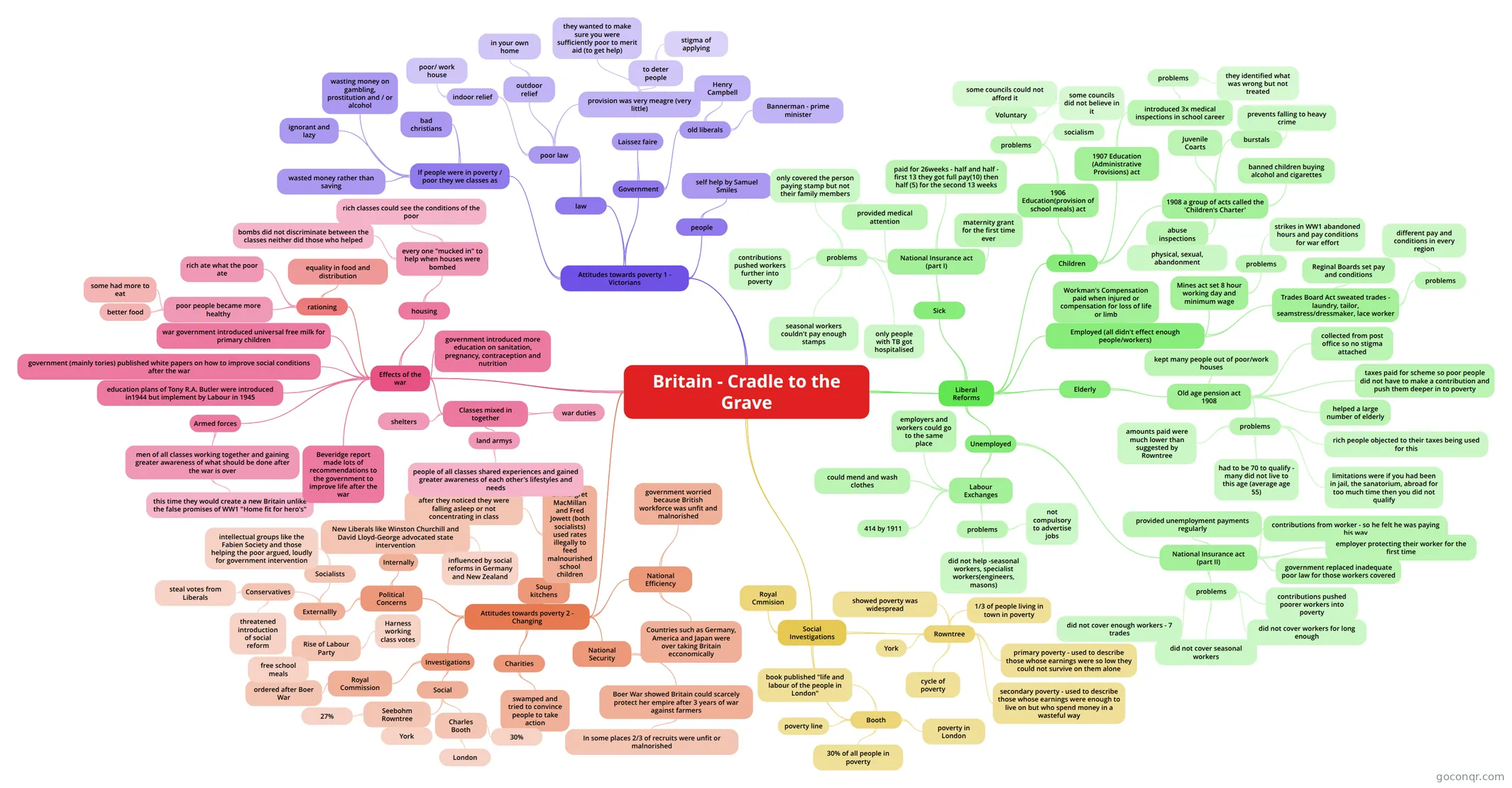
Mind map: Britain cradle to the grave
Map content
Britain - Cradle to the Grave
Attitudes towards poverty 1 - Victorians
- people
- self help by Samuel Smiles
- If people were in poverty / poor they we classes as
- bad christians
- wasting money on gambling, prostitution and / or alcohol
- ignorant and lazy
- wasted money rather than saving
- Government
- Laissez faire
- old liberals
- Henry Campbell
- Bannerman - prime minister
- law
- poor law
- indoor relief
- poor/ work house
- outdoor relief
- in your own home
- provision was very meagre (very little)
- they wanted to make sure you were sufficiently poor to merit aid (to get help)
- to deter people
- stigma of applying
- indoor relief
- poor law
- people
Attitudes towards poverty 2 - Changing
- Charities
- swamped and tried to convince people to take action
- National Security
- Boer War showed Britain could scarcely protect her empire after 3 years of war against farmers
- In some places 2/3 of recruits were unfit or malnorished
- Boer War showed Britain could scarcely protect her empire after 3 years of war against farmers
- National Efficiency
- government worried because British workforce was unfit and malnorished
- Countries such as Germany, America and Japan were over taking Britain ecconomically
- Soup kitchens
- Dr Margret MacMillan and Fred Jowett (both socialists) used rates illegally to feed malnourished school children
- after they noticed they were falling asleep or not concentrating in class
- Dr Margret MacMillan and Fred Jowett (both socialists) used rates illegally to feed malnourished school children
- Political Concerns
- Internally
- New Liberals like Winston Churchill and David Lloyd-George advocated state intervention
- influenced by social reforms in Germany and New Zealand
- New Liberals like Winston Churchill and David Lloyd-George advocated state intervention
- Externallly
- Rise of Labour Party
- Harness working class votes
- Conservatives
- threatened introduction of social reform
- steal votes from Liberals
- Socialists
- intellectual groups like the Fabien Society and those helping the poor argued, loudly for government intervention
- Rise of Labour Party
- Internally
- Investigations
- Social
- Charles Booth
- London
- 30%
- Seebohm Rowntree
- York
- 27%
- Charles Booth
- Royal Commission
- ordered after Boer War
- free school meals
- ordered after Boer War
- Social
- Charities
Liberal Reforms
- Children
- 1906 Education(provision of school meals) act
- problems
- Voluntary
- some councils could not afford it
- some councils did not believe in it
- socialism
- Voluntary
- problems
- 1907 Education (Administrative Provisions) act
- introduced 3x medical inspections in school career
- problems
- they identified what was wrong but not treated
- problems
- introduced 3x medical inspections in school career
- 1908 a group of acts called the 'Children's Charter'
- banned children buying alcohol and cigarettes
- Juvenile Coarts
- burstals
- prevents falling to heavy crime
- abuse inspections
- physical, sexual, abandonment
- 1906 Education(provision of school meals) act
- Employed (all didn't effect enough people/workers)
- Workman's Compensation paid when injured or compensation for loss of life or limb
- Mines act set 8 hour working day and minimum wage
- problems
- strikes in WW1 abandoned hours and pay conditions for war effort
- problems
- Trades Board Act sweated trades - laundry, tailor, seamstress/dressmaker, lace worker
- Reginal Boards set pay and conditions
- problems
- different pay and conditions in every region
- Elderly
- Old age pension act 1908
- kept many people out of poor/work houses
- collected from post office so no stigma attached
- helped a large number of elderly
- taxes paid for scheme so poor people did not have to make a contribution and push them deeper in to poverty
- problems
- had to be 70 to qualify - many did not live to this age (average age 55)
- rich people objected to their taxes being used for this
- limitations were if you had been in jail, the sanatorium, abroad for too much time then you did not qualify
- amounts paid were much lower than suggested by Rowntree
- Old age pension act 1908
- Sick
- National Insurance act (part I)
- provided medical attention
- paid for 26weeks - half and half - first 13 they got full pay(10) then half (5) for the second 13 weeks
- maternity grant for the first time ever
- problems
- only covered the person paying stamp but not their family members
- only people with TB got hospitalised
- seasonal workers couldn't pay enough stamps
- contributions pushed workers further into poverty
- National Insurance act (part I)
- Unemployed
- Labour Exchanges
- employers and workers could go to the same place
- could mend and wash clothes
- 414 by 1911
- problems
- not compulsory to advertise jobs
- did not help -seasonal workers, specialist workers(engineers, masons)
- National Insurance act (part II)
- provided unemployment payments regularly
- contributions from worker - so he felt he was paying his way
- employer protecting their worker for the first time
- government replaced inadequate poor law for those workers covered
- problems
- did not cover enough workers - 7 trades
- contributions pushed poorer workers into poverty
- did not cover seasonal workers
- did not cover workers for long enough
- Labour Exchanges
- Children
Effects of the war
- rationing
- equality in food and distribution
- poor people became more healthy
- some had more to eat
- better food
- rich ate what the poor ate
- government introduced more education on sanitation, pregnancy, contraception and nutrition
- housing
- every one "mucked in" to help when houses were bombed
- bombs did not discriminate between the classes neither did those who helped
- rich classes could see the conditions of the poor
- every one "mucked in" to help when houses were bombed
- war government introduced universal free milk for primary children
- Classes mixed in together
- war duties
- shelters
- land armys
- people of all classes shared experiences and gained greater awareness of each other's lifestyles and needs
- Armed forces
- men of all classes working together and gaining greater awareness of what should be done after the war is over
- this time they would create a new Britain unlike the false promises of WW1 "Home fit for hero's"
- men of all classes working together and gaining greater awareness of what should be done after the war is over
- Beveridge report made lots of recommendations to the government to improve life after the war
- government (mainly tories) published white papers on how to improve social conditions after the war
- education plans of Tony R.A. Butler were introduced in1944 but implement by Labour in 1945
- rationing
Social Investigations
- Booth
- book published "life and labour of the people in London"
- poverty line
- 30% of all people in poverty
- poverty in London
- Rowntree
- showed poverty was widespread
- primary poverty - used to describe those whose earnings were so low they could not survive on them alone
- 1/3 of people living in town in poverty
- York
- secondary poverty - used to describe those whose earnings were enough to live on but who spend money in a wasteful way
- cycle of poverty
- Royal Cmmision
- Booth
Information
- Description
- Higher History (S3/4) Mind Map on Britain - Cradle to the Grave, created by Katie Bryden on 09/04/2013.
- Created by
- Katie Bryden
- Views
- 379
- Tags
- Rating