
Mind map
Question 5 (1)
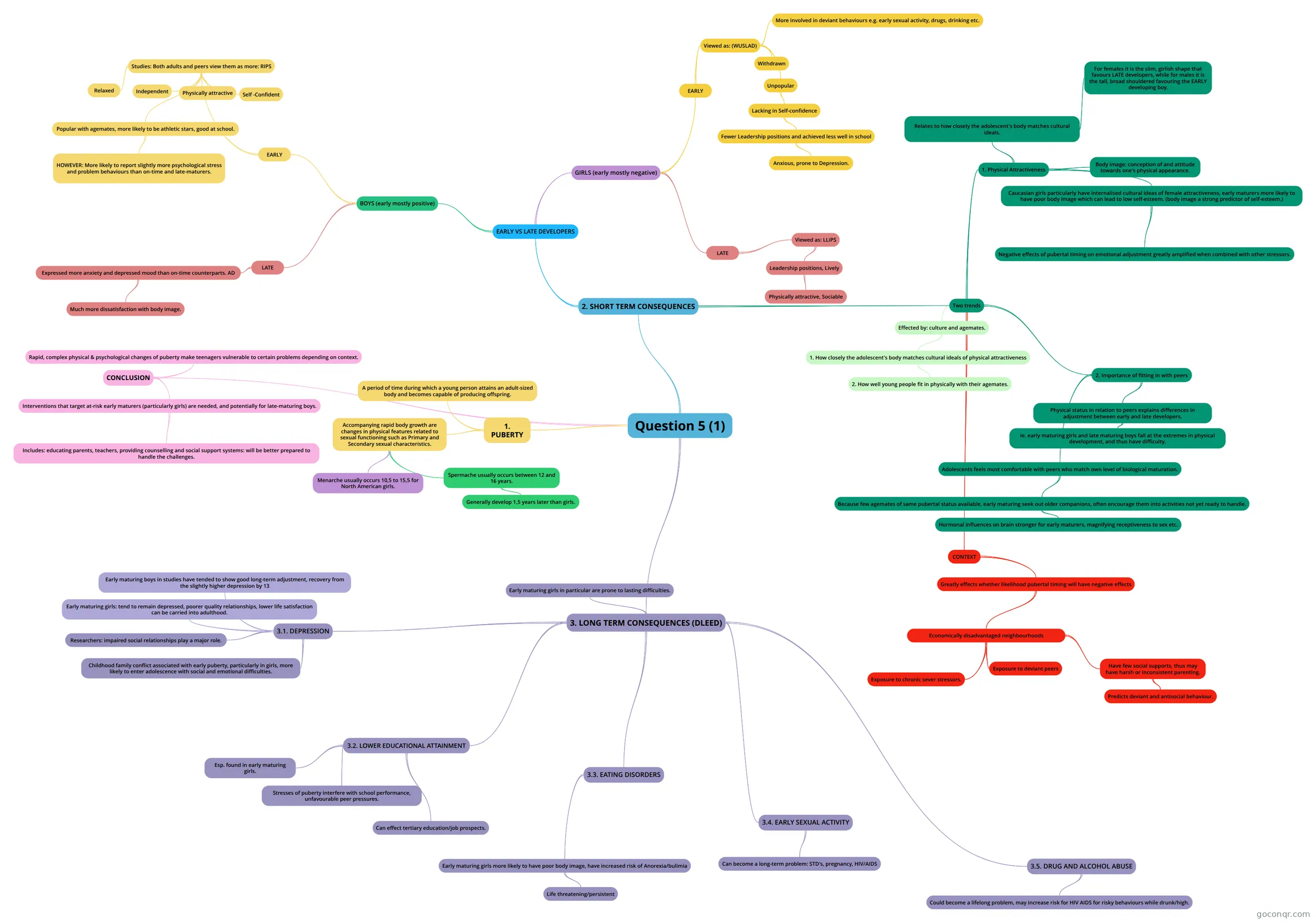
Mind map: Puberty and its consequences
Map content
Question 5 (1)
1. PUBERTY
- A period of time during which a young person attains an adult-sized body and becomes capable of producing offspring.
- Accompanying rapid body growth are changes in physical features related to sexual functioning such as Primary and Secondary sexual characteristics.
- Menarche usually occurs 10,5 to 15,5 for North American girls.
- Spermache usually occurs between 12 and 16 years.
- Generally develop 1,5 years later than girls.
2. SHORT TERM CONSEQUENCES
- EARLY VS LATE DEVELOPERS
- BOYS (early mostly positive)
- EARLY
- Studies: Both adults and peers view them as more: RIPS
- Relaxed
- Independent
- Self -Confident
- Physically attractive
- Popular with agemates, more likely to be athletic stars, good at school.
- HOWEVER: More likely to report slightly more psychological stress and problem behaviours than on-time and late-maturers.
- Studies: Both adults and peers view them as more: RIPS
- LATE
- Expressed more anxiety and depressed mood than on-time counterparts. AD
- Much more dissatisfaction with body image.
- Expressed more anxiety and depressed mood than on-time counterparts. AD
- EARLY
- GIRLS (early mostly negative)
- EARLY
- Viewed as: (WUSLAD)
- Withdrawn
- Unpopular
- Lacking in Self-confidence
- Fewer Leadership positions and achieved less well in school
- Anxious, prone to Depression.
- Fewer Leadership positions and achieved less well in school
- Lacking in Self-confidence
- More involved in deviant behaviours e.g. early sexual activity, drugs, drinking etc.
- Viewed as: (WUSLAD)
- LATE
- Viewed as: LLiPS
- Leadership positions, Lively
- Physically attractive, Sociable
- Leadership positions, Lively
- Viewed as: LLiPS
- EARLY
- BOYS (early mostly positive)
- Two trends
- Effected by: culture and agemates.
- 1. How closely the adolescent's body matches cultural ideals of physical attractiveness
- 2. How well young people fit in physically with their agemates.
- 1. How closely the adolescent's body matches cultural ideals of physical attractiveness
- 1. Physical Attractiveness
- Relates to how closely the adolescent's body matches cultural ideals.
- For females it is the slim, girlish shape that favours LATE developers, while for males it is the tall, broad shouldered favouring the EARLY developing boy.
- Body image: conception of and attitude towards one's physical appearance.
- Caucasian girls particularly have internalised cultural ideas of female attractiveness, early maturers more likely to have poor body image which can lead to low self-esteem. (body image a strong predictor of self-esteem.)
- Negative effects of pubertal timing on emotional adjustment greatly amplified when combined with other stressors.
- Relates to how closely the adolescent's body matches cultural ideals.
- 2. Importance of fitting in with peers
- Physical status in relation to peers explains differences in adjustment between early and late developers.
- ie. early maturing girls and late maturing boys fall at the extremes in physical development, and thus have difficulty.
- Adolescents feels most comfortable with peers who match own level of biological maturation.
- Because few agemates of same pubertal status available, early maturing seek out older companions, often encourage them into activities not yet ready to handle.
- Hormonal influences on brain stronger for early maturers, magnifying receptiveness to sex etc.
- Because few agemates of same pubertal status available, early maturing seek out older companions, often encourage them into activities not yet ready to handle.
- Physical status in relation to peers explains differences in adjustment between early and late developers.
- CONTEXT
- Greatly effects whether likelihood pubertal timing will have negative effects
- Economically disadvantaged neighbourhoods
- Exposure to deviant peers
- Exposure to chronic sever stressors.
- Have few social supports, thus may have harsh or inconsistent parenting.
- Predicts deviant and antisocial behaviour.
- Economically disadvantaged neighbourhoods
- Greatly effects whether likelihood pubertal timing will have negative effects
- Effected by: culture and agemates.
- EARLY VS LATE DEVELOPERS
3. LONG TERM CONSEQUENCES (DLEED)
- 3.1. DEPRESSION
- Early maturing boys in studies have tended to show good long-term adjustment, recovery from the slightly higher depression by 13
- Early maturing girls: tend to remain depressed, poorer quality relationships, lower life satisfaction can be carried into adulthood.
- Researchers: impaired social relationships play a major role.
- Childhood family conflict associated with early puberty, particularly in girls, more likely to enter adolescence with social and emotional difficulties.
- 3.2. LOWER EDUCATIONAL ATTAINMENT
- Esp. found in early maturing girls.
- Stresses of puberty interfere with school performance, unfavourable peer pressures.
- Can effect tertiary education/job prospects.
- 3.3. EATING DISORDERS
- Early maturing girls more likely to have poor body image, have increased risk of Anorexia/bulimia
- Life threatening/persistent
- Early maturing girls more likely to have poor body image, have increased risk of Anorexia/bulimia
- 3.4. EARLY SEXUAL ACTIVITY
- Can become a long-term problem: STD's, pregnancy, HIV/AIDS
- 3.5. DRUG AND ALCOHOL ABUSE
- Could become a lifelong problem, may increase risk for HIV AIDS for risky behaviours while drunk/high.
- Early maturing girls in particular are prone to lasting difficulties.
- 3.1. DEPRESSION
CONCLUSION
- Rapid, complex physical & psychological changes of puberty make teenagers vulnerable to certain problems depending on context.
- Interventions that target at-risk early maturers (particularly girls) are needed, and potentially for late-maturing boys.
- Includes: educating parents, teachers, providing counselling and social support systems: will be better prepared to handle the challenges.
Information
- Description
- Honours Psychology Mind Map on Question 5 (1), created by Debbie R on 28/01/2016.
- Created by
- Debbie R
- Views
- 0
- Rating
More on Puberty and physical development in adolescence