
Mind map
La Sorbonne 1253
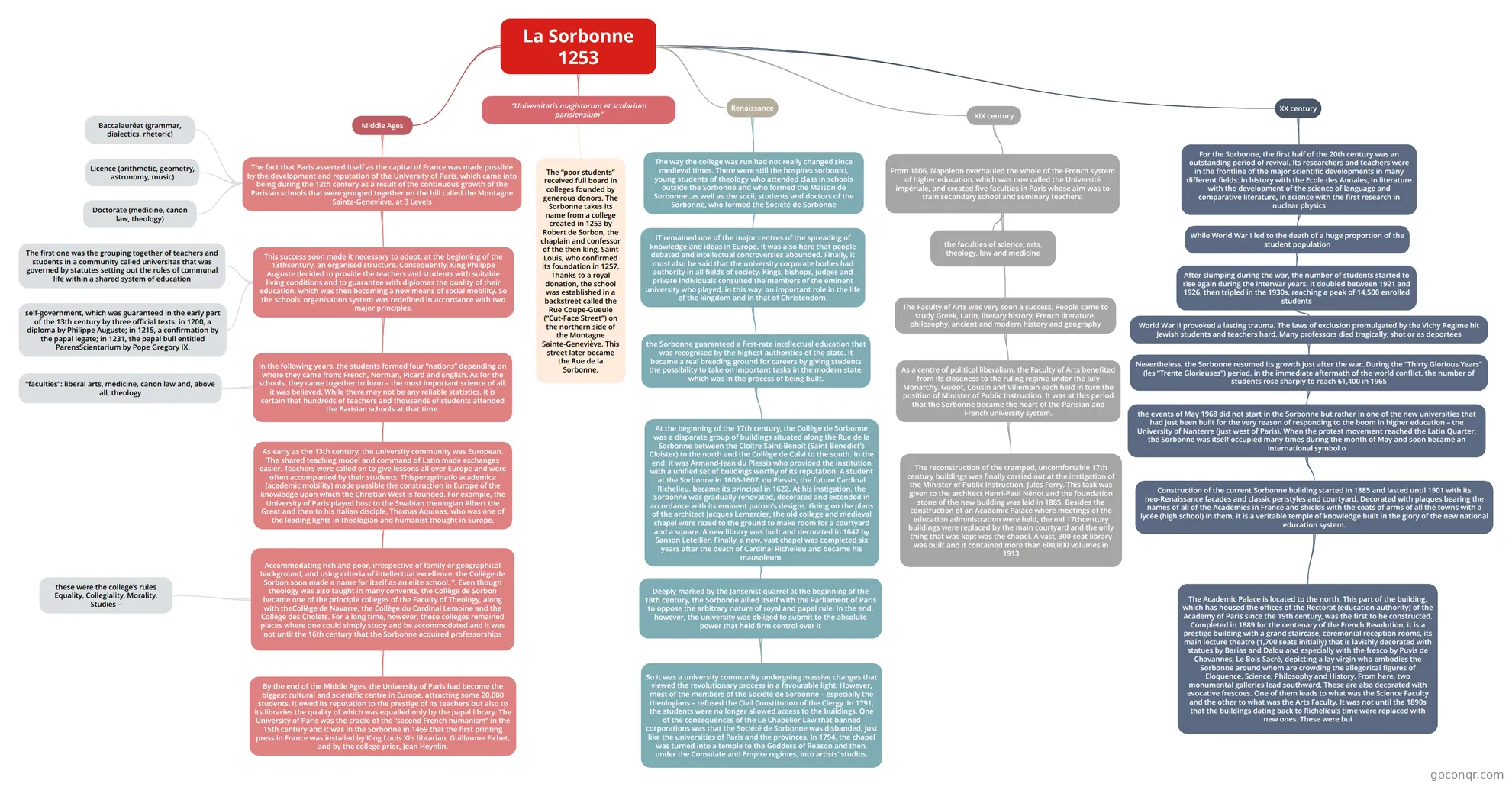
Mind map: La Sorbonne 1253
Map content
La Sorbonne 1253
Middle Ages
- The fact that Paris asserted itself as the capital of France was made possible by the development and reputation of the University of Paris, which came into being during the 12th century as a result of the continuous growth of the Parisian schools that were grouped together on the hill called the Montagne Sainte-Geneviève. at 3 Levels
- Baccalauréat (grammar, dialectics, rhetoric)
- This success soon made it necessary to adopt, at the beginning of the 13thcentury, an organised structure. Consequently, King Philippe Auguste decided to provide the teachers and students with suitable living conditions and to guarantee with diplomas the quality of their education, which was then becoming a new means of social mobility. So the schools’ organisation system was redefined in accordance with two major principles.
- The first one was the grouping together of teachers and students in a community called universitas that was governed by statutes setting out the rules of communal life within a shared system of education
- self-government, which was guaranteed in the early part of the 13th century by three official texts: in 1200, a diploma by Philippe Auguste; in 1215, a confirmation by the papal legate; in 1231, the papal bull entitled ParensScientarium by Pope Gregory IX.
- In the following years, the students formed four “nations” depending on where they came from: French, Norman, Picard and English. As for the schools, they came together to form – the most important science of all, it was believed. While there may not be any reliable statistics, it is certain that hundreds of teachers and thousands of students attended the Parisian schools at that time.
- “faculties”: liberal arts, medicine, canon law and, above all, theology
- As early as the 13th century, the university community was European. The shared teaching model and command of Latin made exchanges easier. Teachers were called on to give lessons all over Europe and were often accompanied by their students. Thisperegrinatio academica (academic mobility) made possible the construction in Europe of the knowledge upon which the Christian West is founded. For example, the University of Paris played host to the Swabian theologian Albert the Great and then to his Italian disciple, Thomas Aquinas, who was one of the leading lights in theologian and humanist thought in Europe.
- Accommodating rich and poor, irrespective of family or geographical background, and using criteria of intellectual excellence, the Collège de Sorbon soon made a name for itself as an elite school. ”. Even though theology was also taught in many convents, the Collège de Sorbon became one of the principle colleges of the Faculty of Theology, along with theCollège de Navarre, the Collège du Cardinal Lemoine and the Collège des Cholets. For a long time, however, these colleges remained places where one could simply study and be accommodated and it was not until the 16th century that the Sorbonne acquired professorships
- these were the college’s rules Equality, Collegiality, Morality, Studies –
- By the end of the Middle Ages, the University of Paris had become the biggest cultural and scientific centre in Europe, attracting some 20,000 students. It owed its reputation to the prestige of its teachers but also to its libraries the quality of which was equalled only by the papal library. The University of Paris was the cradle of the “second French humanism” in the 15th century and it was in the Sorbonne in 1469 that the first printing press in France was installed by King Louis XI’s librarian, Guillaume Fichet, and by the college prior, Jean Heynlin.
- Accommodating rich and poor, irrespective of family or geographical background, and using criteria of intellectual excellence, the Collège de Sorbon soon made a name for itself as an elite school. ”. Even though theology was also taught in many convents, the Collège de Sorbon became one of the principle colleges of the Faculty of Theology, along with theCollège de Navarre, the Collège du Cardinal Lemoine and the Collège des Cholets. For a long time, however, these colleges remained places where one could simply study and be accommodated and it was not until the 16th century that the Sorbonne acquired professorships
- Licence (arithmetic, geometry, astronomy, music)
- Doctorate (medicine, canon law, theology)
- The fact that Paris asserted itself as the capital of France was made possible by the development and reputation of the University of Paris, which came into being during the 12th century as a result of the continuous growth of the Parisian schools that were grouped together on the hill called the Montagne Sainte-Geneviève. at 3 Levels
“Universitatis magistorum et scolarium parisiensium”
- The “poor students” received full board in colleges founded by generous donors. The Sorbonne takes its name from a college created in 1253 by Robert de Sorbon, the chaplain and confessor of the then king, Saint Louis, who confirmed its foundation in 1257. Thanks to a royal donation, the school was established in a backstreet called the Rue Coupe-Gueule (“Cut-Face Street”) on the northern side of the Montagne Sainte-Geneviève. This street later became the Rue de la Sorbonne.
Renaissance
- The way the college was run had not really changed since medieval times. There were still the hospites sorbonici, young students of theology who attended class in schools outside the Sorbonne and who formed the Maison de Sorbonne .as well as the socii, students and doctors of the Sorbonne, who formed the Société de Sorbonne
- IT remained one of the major centres of the spreading of knowledge and ideas in Europe. It was also here that people debated and intellectual controversies abounded. Finally, it must also be said that the university corporate bodies had authority in all fields of society. Kings, bishops, judges and private individuals consulted the members of the eminent university who played, in this way, an important role in the life of the kingdom and in that of Christendom.
- the Sorbonne guaranteed a first-rate intellectual education that was recognised by the highest authorities of the state. It became a real breeding ground for careers by giving students the possibility to take on important tasks in the modern state, which was in the process of being built.
- At the beginning of the 17th century, the Collège de Sorbonne was a disparate group of buildings situated along the Rue de la Sorbonne between the Cloître Saint-Benoît (Saint Benedict’s Cloister) to the north and the Collège de Calvi to the south. In the end, it was Armand-Jean du Plessis who provided the institution with a unified set of buildings worthy of its reputation. A student at the Sorbonne in 1606-1607, du Plessis, the future Cardinal Richelieu, became its principal in 1622. At his instigation, the Sorbonne was gradually renovated, decorated and extended in accordance with its eminent patron’s designs. Going on the plans of the architect Jacques Lemercier, the old college and medieval chapel were razed to the ground to make room for a courtyard and a square. A new library was built and decorated in 1647 by Sanson Letellier. Finally, a new, vast chapel was completed six years after the death of Cardinal Richelieu and became his mausoleum.
- Deeply marked by the Jansenist quarrel at the beginning of the 18th century, the Sorbonne allied itself with the Parliament of Paris to oppose the arbitrary nature of royal and papal rule. In the end, however, the university was obliged to submit to the absolute power that held firm control over it
- So it was a university community undergoing massive changes that viewed the revolutionary process in a favourable light. However, most of the members of the Société de Sorbonne – especially the theologians – refused the Civil Constitution of the Clergy. In 1791, the students were no longer allowed access to the buildings. One of the consequences of the Le Chapelier Law that banned corporations was that the Société de Sorbonne was disbanded, just like the universities of Paris and the provinces. In 1794, the chapel was turned into a temple to the Goddess of Reason and then, under the Consulate and Empire regimes, into artists’ studios.
- Deeply marked by the Jansenist quarrel at the beginning of the 18th century, the Sorbonne allied itself with the Parliament of Paris to oppose the arbitrary nature of royal and papal rule. In the end, however, the university was obliged to submit to the absolute power that held firm control over it
- At the beginning of the 17th century, the Collège de Sorbonne was a disparate group of buildings situated along the Rue de la Sorbonne between the Cloître Saint-Benoît (Saint Benedict’s Cloister) to the north and the Collège de Calvi to the south. In the end, it was Armand-Jean du Plessis who provided the institution with a unified set of buildings worthy of its reputation. A student at the Sorbonne in 1606-1607, du Plessis, the future Cardinal Richelieu, became its principal in 1622. At his instigation, the Sorbonne was gradually renovated, decorated and extended in accordance with its eminent patron’s designs. Going on the plans of the architect Jacques Lemercier, the old college and medieval chapel were razed to the ground to make room for a courtyard and a square. A new library was built and decorated in 1647 by Sanson Letellier. Finally, a new, vast chapel was completed six years after the death of Cardinal Richelieu and became his mausoleum.
- the Sorbonne guaranteed a first-rate intellectual education that was recognised by the highest authorities of the state. It became a real breeding ground for careers by giving students the possibility to take on important tasks in the modern state, which was in the process of being built.
- IT remained one of the major centres of the spreading of knowledge and ideas in Europe. It was also here that people debated and intellectual controversies abounded. Finally, it must also be said that the university corporate bodies had authority in all fields of society. Kings, bishops, judges and private individuals consulted the members of the eminent university who played, in this way, an important role in the life of the kingdom and in that of Christendom.
- The way the college was run had not really changed since medieval times. There were still the hospites sorbonici, young students of theology who attended class in schools outside the Sorbonne and who formed the Maison de Sorbonne .as well as the socii, students and doctors of the Sorbonne, who formed the Société de Sorbonne
XIX century
- From 1806, Napoleon overhauled the whole of the French system of higher education, which was now called the Université impériale, and created five faculties in Paris whose aim was to train secondary school and seminary teachers:
- the faculties of science, arts, theology, law and medicine
- The Faculty of Arts was very soon a success. People came to study Greek, Latin, literary history, French literature, philosophy, ancient and modern history and geography
- As a centre of political liberalism, the Faculty of Arts benefited from its closeness to the ruling regime under the July Monarchy. Guizot, Cousin and Villemain each held in turn the position of Minister of Public Instruction. It was at this period that the Sorbonne became the heart of the Parisian and French university system.
- The reconstruction of the cramped, uncomfortable 17th century buildings was finally carried out at the instigation of the Minister of Public Instruction, Jules Ferry. This task was given to the architect Henri-Paul Nénot and the foundation stone of the new building was laid in 1885. Besides the construction of an Academic Palace where meetings of the education administration were held, the old 17thcentury buildings were replaced by the main courtyard and the only thing that was kept was the chapel. A vast, 300-seat library was built and it contained more than 600,000 volumes in 1913
- As a centre of political liberalism, the Faculty of Arts benefited from its closeness to the ruling regime under the July Monarchy. Guizot, Cousin and Villemain each held in turn the position of Minister of Public Instruction. It was at this period that the Sorbonne became the heart of the Parisian and French university system.
- From 1806, Napoleon overhauled the whole of the French system of higher education, which was now called the Université impériale, and created five faculties in Paris whose aim was to train secondary school and seminary teachers:
XX century
- For the Sorbonne, the first half of the 20th century was an outstanding period of revival. Its researchers and teachers were in the frontline of the major scientific developments in many different fields: in history with the Ecole des Annales, in literature with the development of the science of language and comparative literature, in science with the first research in nuclear physics
- While World War I led to the death of a huge proportion of the student population
- After slumping during the war, the number of students started to rise again during the interwar years. It doubled between 1921 and 1926, then tripled in the 1930s, reaching a peak of 14,500 enrolled students
- World War II provoked a lasting trauma. The laws of exclusion promulgated by the Vichy Regime hit Jewish students and teachers hard. Many professors died tragically, shot or as deportees
- Nevertheless, the Sorbonne resumed its growth just after the war. During the “Thirty Glorious Years” (les “Trente Glorieuses”) period, in the immediate aftermath of the world conflict, the number of students rose sharply to reach 61,400 in 1965
- the events of May 1968 did not start in the Sorbonne but rather in one of the new universities that had just been built for the very reason of responding to the boom in higher education – the University of Nanterre (just west of Paris). When the protest movement reached the Latin Quarter, the Sorbonne was itself occupied many times during the month of May and soon became an international symbol o
- Construction of the current Sorbonne building started in 1885 and lasted until 1901 with its neo-Renaissance facades and classic peristyles and courtyard. Decorated with plaques bearing the names of all of the Academies in France and shields with the coats of arms of all the towns with a lycée (high school) in them, it is a veritable temple of knowledge built in the glory of the new national education system.
- The Academic Palace is located to the north. This part of the building, which has housed the offices of the Rectorat (education authority) of the Academy of Paris since the 19th century, was the first to be constructed. Completed in 1889 for the centenary of the French Revolution, it is a prestige building with a grand staircase, ceremonial reception rooms, its main lecture theatre (1,700 seats initially) that is lavishly decorated with statues by Barias and Dalou and especially with the fresco by Puvis de Chavannes, Le Bois Sacré, depicting a lay virgin who embodies the Sorbonne around whom are crowding the allegorical figures of Eloquence, Science, Philosophy and History. From here, two monumental galleries lead southward. These are also decorated with evocative frescoes. One of them leads to what was the Science Faculty and the other to what was the Arts Faculty. It was not until the 1890s that the buildings dating back to Richelieu’s time were replaced with new ones. These were bui
- Construction of the current Sorbonne building started in 1885 and lasted until 1901 with its neo-Renaissance facades and classic peristyles and courtyard. Decorated with plaques bearing the names of all of the Academies in France and shields with the coats of arms of all the towns with a lycée (high school) in them, it is a veritable temple of knowledge built in the glory of the new national education system.
- the events of May 1968 did not start in the Sorbonne but rather in one of the new universities that had just been built for the very reason of responding to the boom in higher education – the University of Nanterre (just west of Paris). When the protest movement reached the Latin Quarter, the Sorbonne was itself occupied many times during the month of May and soon became an international symbol o
- Nevertheless, the Sorbonne resumed its growth just after the war. During the “Thirty Glorious Years” (les “Trente Glorieuses”) period, in the immediate aftermath of the world conflict, the number of students rose sharply to reach 61,400 in 1965
- World War II provoked a lasting trauma. The laws of exclusion promulgated by the Vichy Regime hit Jewish students and teachers hard. Many professors died tragically, shot or as deportees
- After slumping during the war, the number of students started to rise again during the interwar years. It doubled between 1921 and 1926, then tripled in the 1930s, reaching a peak of 14,500 enrolled students
- While World War I led to the death of a huge proportion of the student population
- For the Sorbonne, the first half of the 20th century was an outstanding period of revival. Its researchers and teachers were in the frontline of the major scientific developments in many different fields: in history with the Ecole des Annales, in literature with the development of the science of language and comparative literature, in science with the first research in nuclear physics
Information
- Description
- Professional History Mind Map on La Sorbonne 1253, created by CECILIA SAAVEDRA on 01/28/2016.
- Created by
- CECILIA SAAVEDRA
- Views
- 2
- Rating