
Mind map
Self-Awareness (Me, Myself and I)
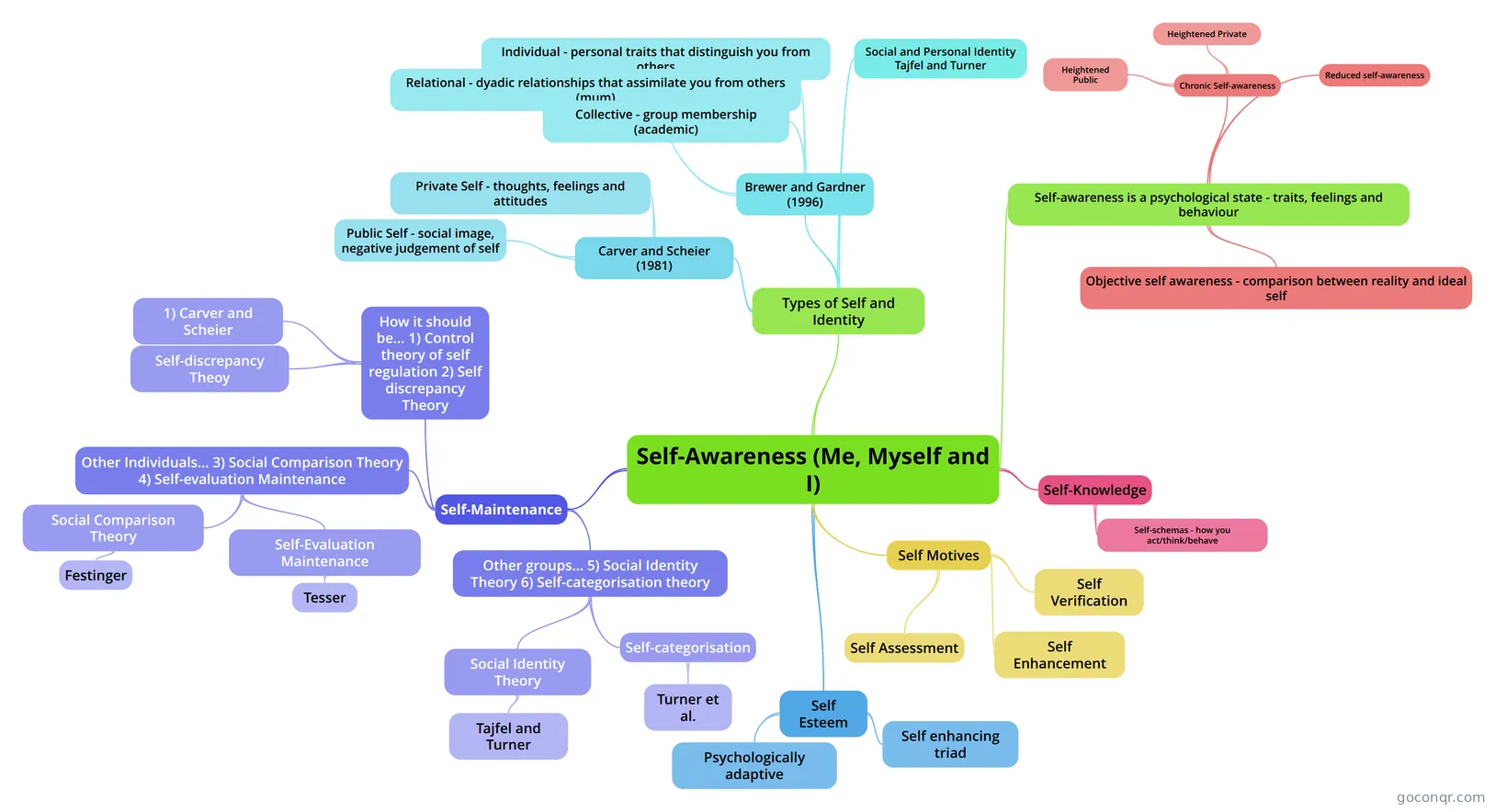
Mind map: self-awareness
Map content
Self-Awareness (Me, Myself and I)
Types of Self and Identity
- Social and Personal Identity Tajfel and Turner
- Brewer and Gardner (1996)
- Individual - personal traits that distinguish you from others
- Relational - dyadic relationships that assimilate you from others (mum)
- Collective - group membership (academic)
- Carver and Scheier (1981)
- Private Self - thoughts, feelings and attitudes
- Public Self - social image, negative judgement of self
Self-awareness is a psychological state - traits, feelings and behaviour
- Objective self awareness - comparison between reality and ideal self
- Chronic Self-awareness
- Constantly aware of shortcomings Avoidance behaviour = drinking/suicide
- Heightened Private
- More intense emotion Accurate self-perception Adhere to personal beliefs Constant monitoring
- Heightened Public
- Focus on perception by others Nervousness Loss of self-esteem Adhere to group norms to avoid embarrassment Follow others' social norms/group traits
- Reduced self-awareness
- De-individualisation No-monitoring of own behaviour (e.g.impulsive)
Self-Knowledge
- Self-schemas - how you act/think/behave
Self-Maintenance
- How it should be... 1) Control theory of self regulation 2) Self discrepancy Theory
- 1) Carver and Scheier
- Assesses whether goals are met. Test - operate to change, test, exit. Contintually change self and identity and change it until it fits with ideal image.
- Self-discrepancy Theoy
- Higgins' Self-doscrepancy theory 1) Actual Self - if different to ideal then disappointment. If different to ought self then agitation/anxiety 2) Ideal Self 3) Ought self - how we think we should be
- 1) Carver and Scheier
- Other groups... 5) Social Identity Theory 6) Self-categorisation theory
- Social Identity Theory
- Tajfel and Turner
- Personal Identity: Unique Social Identity: Defined by group norms. Associated with intergroup behaviour
- Tajfel and Turner
- Self-categorisation
- Turner et al.
- Self-categorisation into groups, internalise group attributes, collective self identity If group categorisation becomes too salient then perception of self and others n=becomes depersonalised
- Turner et al.
- Social Identity Theory
- Other Individuals... 3) Social Comparison Theory 4) Self-evaluation Maintenance
- Social Comparison Theory
- Festinger
- Objective benchmark in similar people, for performance generally downward comparison
- Festinger
- Self-Evaluation Maintenance
- Tesser
- Upward social comparison e.g. gold, silver and bronze Social reflection: 'Basking in reflected glory'
- Tesser
- Social Comparison Theory
- How it should be... 1) Control theory of self regulation 2) Self discrepancy Theory
Self Motives
- Self Assessment
- Desire for accurate and valid information to seek the truth about ones self
- Self Verification
- Desire to confirm what they know and seek favourable information about ones self
- Self Enhancement
- Desire to maintain a good image and seek favourable information about self
- Self Assessment
Self Esteem
- Self enhancing triad
- 1) Overestimate positive aspects 2) Overestimate control over events 3) Unrealistic Optimism
- Psychologically adaptive
- Low self esteem association with mental health issues e.g. depression High self esteem if volatile problematic
- Self enhancing triad
Information
- Description
- Psychology (Self Awareness (Me, Myself and I)) Mind Map on Self-Awareness (Me, Myself and I), created by emilystewart15 on 08/01/2014.
- Created by
- emilystewart15
- Views
- 29
- Tags
- Rating
More on Self-Awareness and Self-Knowledge