
Mind map
Life in the FRG
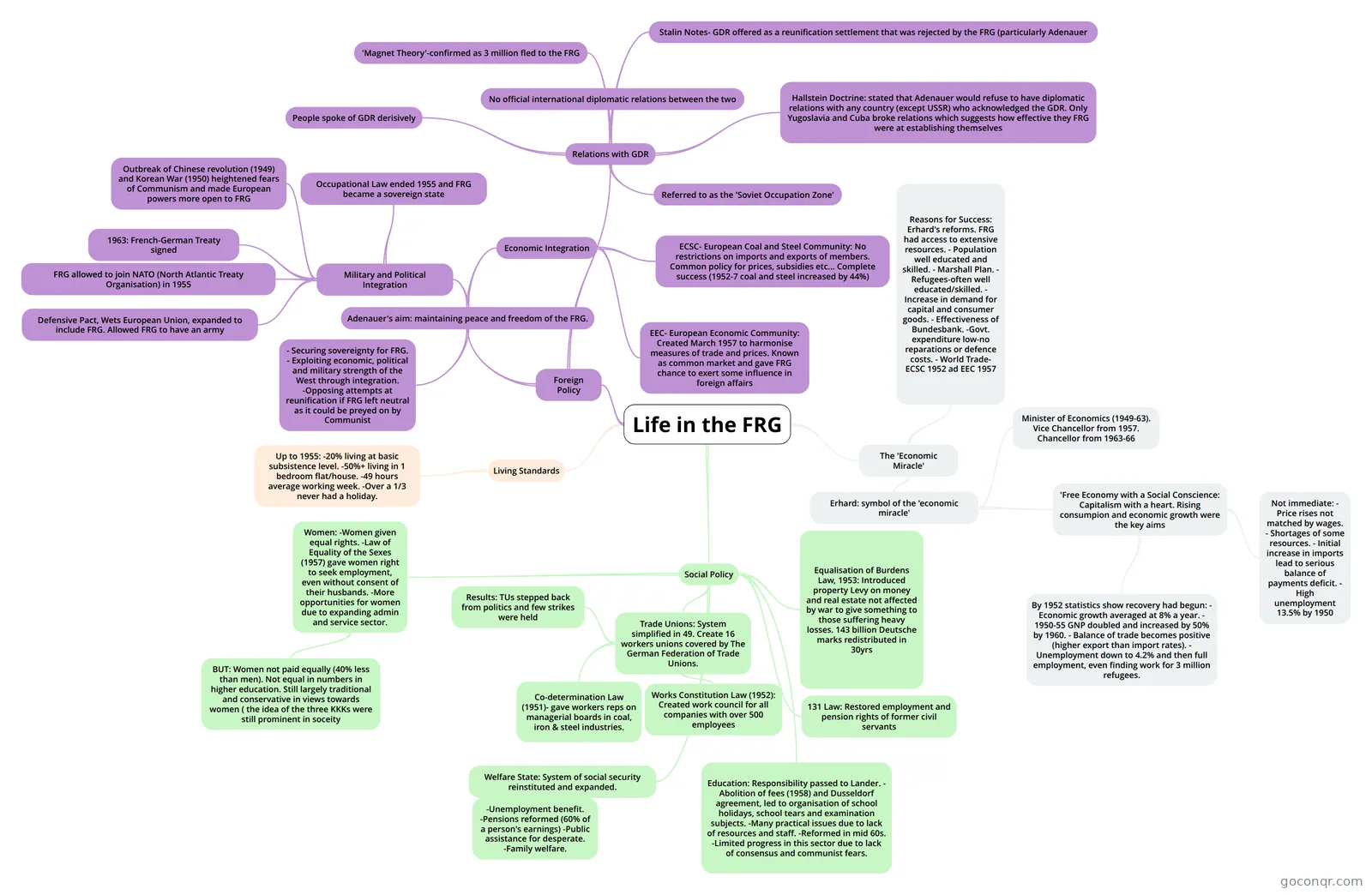
Mind map: Life in the FRG
Map content
Life in the FRG
Social Policy
- Equalisation of Burdens Law, 1953: Introduced property Levy on money and real estate not affected by war to give something to those suffering heavy losses. 143 billion Deutsche marks redistributed in 30yrs
- 131 Law: Restored employment and pension rights of former civil servants
- Trade Unions: System simplified in 49. Create 16 workers unions covered by The German Federation of Trade Unions.
- Co-determination Law (1951)- gave workers reps on managerial boards in coal, iron & steel industries.
- Works Constitution Law (1952): Created work council for all companies with over 500 employees
- Results: TUs stepped back from politics and few strikes were held
- Welfare State: System of social security reinstituted and expanded.
- -Unemployment benefit. -Pensions reformed (60% of a person's earnings) -Public assistance for desperate. -Family welfare.
- Education: Responsibility passed to Lander. - Abolition of fees (1958) and Dusseldorf agreement, led to organisation of school holidays, school tears and examination subjects. -Many practical issues due to lack of resources and staff. -Reformed in mid 60s. -Limited progress in this sector due to lack of consensus and communist fears.
- Women: -Women given equal rights. -Law of Equality of the Sexes (1957) gave women right to seek employment, even without consent of their husbands. -More opportunities for women due to expanding admin and service sector.
- BUT: Women not paid equally (40% less than men). Not equal in numbers in higher education. Still largely traditional and conservative in views towards women ( the idea of the three KKKs were still prominent in soceity
Foreign Policy
- Adenauer's aim: maintaining peace and freedom of the FRG.
- - Securing sovereignty for FRG. - Exploiting economic, political and military strength of the West through integration. -Opposing attempts at reunification if FRG left neutral as it could be preyed on by Communist
- Economic Integration
- ECSC- European Coal and Steel Community: No restrictions on imports and exports of members. Common policy for prices, subsidies etc... Complete success (1952-7 coal and steel increased by 44%)
- EEC- European Economic Community: Created March 1957 to harmonise measures of trade and prices. Known as common market and gave FRG chance to exert some influence in foreign affairs
- Military and Political Integration
- Outbreak of Chinese revolution (1949) and Korean War (1950) heightened fears of Communism and made European powers more open to FRG
- Occupational Law ended 1955 and FRG became a sovereign state
- Defensive Pact, Wets European Union, expanded to include FRG. Allowed FRG to have an army
- FRG allowed to join NATO (North Atlantic Treaty Organisation) in 1955
- 1963: French-German Treaty signed
- Relations with GDR
- No official international diplomatic relations between the two
- Referred to as the 'Soviet Occupation Zone'
- People spoke of GDR derisively
- 'Magnet Theory'-confirmed as 3 million fled to the FRG
- Stalin Notes- GDR offered as a reunification settlement that was rejected by the FRG (particularly Adenauer
- Hallstein Doctrine: stated that Adenauer would refuse to have diplomatic relations with any country (except USSR) who acknowledged the GDR. Only Yugoslavia and Cuba broke relations which suggests how effective they FRG were at establishing themselves
- Adenauer's aim: maintaining peace and freedom of the FRG.
The 'Economic Miracle'
- Erhard: symbol of the 'economic miracle'
- Minister of Economics (1949-63). Vice Chancellor from 1957. Chancellor from 1963-66
- 'Free Economy with a Social Conscience: Capitalism with a heart. Rising consumpion and economic growth were the key aims
- Not immediate: - Price rises not matched by wages. - Shortages of some resources. - Initial increase in imports lead to serious balance of payments deficit. - High unemployment 13.5% by 1950
- By 1952 statistics show recovery had begun: - Economic growth averaged at 8% a year. - 1950-55 GNP doubled and increased by 50% by 1960. - Balance of trade becomes positive (higher export than import rates). - Unemployment down to 4.2% and then full employment, even finding work for 3 million refugees.
- Reasons for Success: Erhard's reforms. FRG had access to extensive resources. - Population well educated and skilled. - Marshall Plan. - Refugees-often well educated/skilled. - Increase in demand for capital and consumer goods. - Effectiveness of Bundesbank. -Govt. expenditure low-no reparations or defence costs. - World Trade- ECSC 1952 ad EEC 1957
- Erhard: symbol of the 'economic miracle'
Living Standards
- Up to 1955: -20% living at basic subsistence level. -50%+ living in 1 bedroom flat/house. -49 hours average working week. -Over a 1/3 never had a holiday.
Information
- Description
- AS - Level History (Nazi Germany) Mind Map on Life in the FRG, created by Kira Sirrell on 29/03/2016.
- Created by
- Kira Sirrell
- Views
- 2
- Rating