
Mind map
Life in the FRG
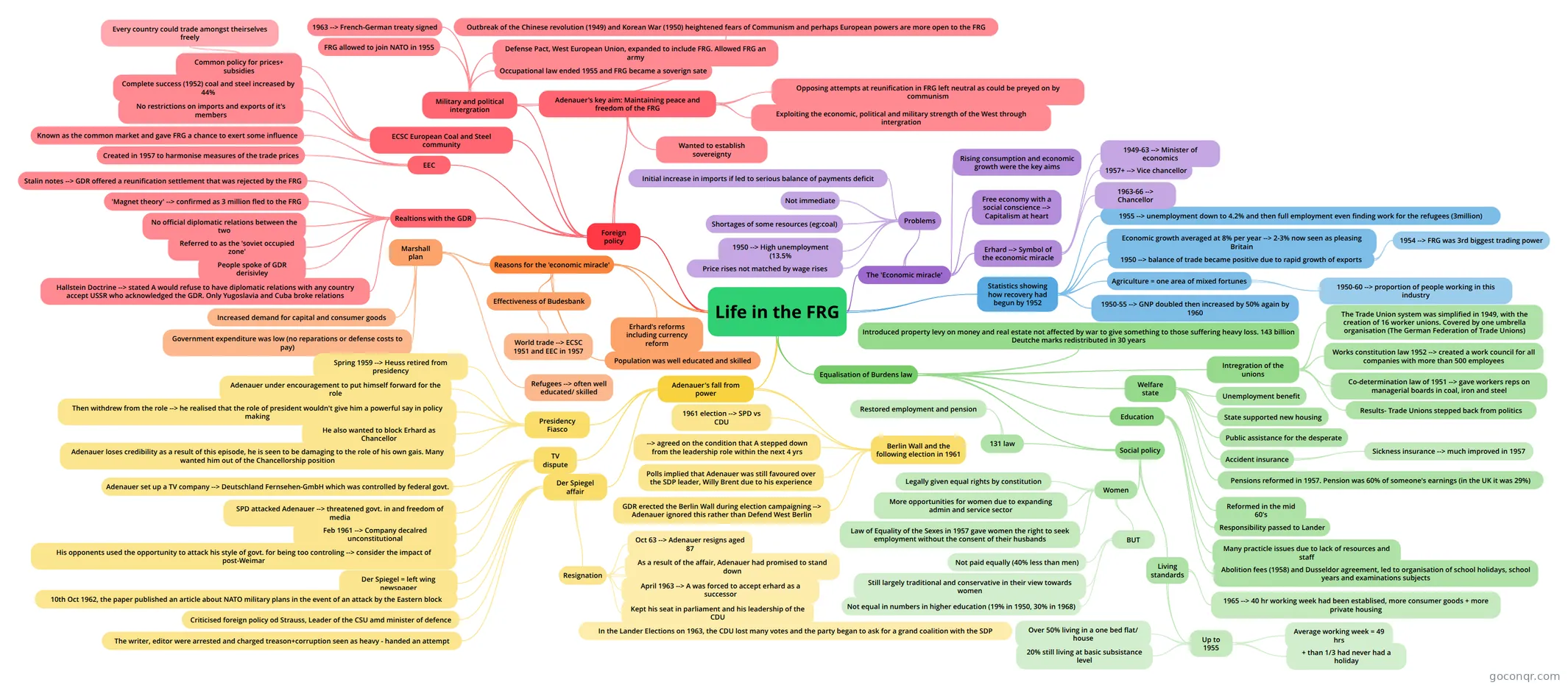
Mind map: Life in the FRG
Map content
Life in the FRG
The 'Economic miracle'
- Free economy with a social conscience --> Capitalism at heart
- Erhard --> Symbol of the economic miracle
- 1949-63 --> Minister of economics
- 1957+ --> Vice chancellor
- 1963-66 --> Chancellor
- Rising consumption and economic growth were the key aims
- Problems
- Not immediate
- Price rises not matched by wage rises
- Shortages of some resources (eg:coal)
- Initial increase in imports if led to serious balance of payments deficit
- 1950 --> High unemployment (13.5%
Statistics showing how recovery had begun by 1952
- 1950-55 --> GNP doubled then increased by 50% again by 1960
- Economic growth averaged at 8% per year --> 2-3% now seen as pleasing Britain
- 1955 --> unemployment down to 4.2% and then full employment even finding work for the refugees (3million)
- 1950 --> balance of trade became positive due to rapid growth of exports
- 1954 --> FRG was 3rd biggest trading power
- Agriculture = one area of mixed fortunes
- 1950-60 --> proportion of people working in this industry
Reasons for the 'economic miracle'
- Erhard's reforms including currency reform
- Population was well educated and skilled
- Marshall plan
- Refugees --> often well educated/ skilled
- Government expenditure was low (no reparations or defense costs to pay)
- Increased demand for capital and consumer goods
- Effectiveness of Budesbank
- World trade --> ECSC 1951 and EEC in 1957
Equalisation of Burdens law
- Social policy
- 131 law
- Restored employment and pension
- Women
- Legally given equal rights by constitution
- Law of Equality of the Sexes in 1957 gave women the right to seek employment without the consent of their husbands
- More opportunities for women due to expanding admin and service sector
- BUT
- Not paid equally (40% less than men)
- Not equal in numbers in higher education (19% in 1950, 30% in 1968)
- Still largely traditional and conservative in their view towards women
- Living standards
- Up to 1955
- 20% still living at basic subsistance level
- Over 50% living in a one bed flat/ house
- Average working week = 49 hrs
- + than 1/3 had never had a holiday
- 1965 --> 40 hr working week had been establised, more consumer goods + more private housing
- Up to 1955
- 131 law
- Intregration of the unions
- Results- Trade Unions stepped back from politics
- Works constitution law 1952 --> created a work council for all companies with more than 500 employees
- The Trade Union system was simplified in 1949, with the creation of 16 worker unions. Covered by one umbrella organisation (The German Federation of Trade Unions)
- Co-determination law of 1951 --> gave workers reps on managerial boards in coal, iron and steel
- Welfare state
- State supported new housing
- Public assistance for the desperate
- Pensions reformed in 1957. Pension was 60% of someone's earnings (in the UK it was 29%)
- Unemployment benefit
- Accident insurance
- Sickness insurance --> much improved in 1957
- Education
- Abolition fees (1958) and Dusseldor agreement, led to organisation of school holidays, school years and examinations subjects
- Many practicle issues due to lack of resources and staff
- Responsibility passed to Lander
- Reformed in the mid 60's
- Introduced property levy on money and real estate not affected by war to give something to those suffering heavy loss. 143 billion Deutche marks redistributed in 30 years
- Social policy
Foreign policy
- Adenauer's key aim: Maintaining peace and freedom of the FRG
- Wanted to establish sovereignty
- Exploiting the economic, political and military strength of the West through intergration
- Opposing attempts at reunification in FRG left neutral as could be preyed on by communism
- ECSC European Coal and Steel community
- No restrictions on imports and exports of it's members
- Common policy for prices+ subsidies
- Every country could trade amongst theirselves freely
- Complete success (1952) coal and steel increased by 44%
- EEC
- Created in 1957 to harmonise measures of the trade prices
- Known as the common market and gave FRG a chance to exert some influence
- Military and political intergration
- Outbreak of the Chinese revolution (1949) and Korean War (1950) heightened fears of Communism and perhaps European powers are more open to the FRG
- Occupational law ended 1955 and FRG became a soverign sate
- Defense Pact, West European Union, expanded to include FRG. Allowed FRG an army
- FRG allowed to join NATO in 1955
- 1963 --> French-German treaty signed
- Realtions with the GDR
- No official diplomatic relations between the two
- Referred to as the 'soviet occupied zone'
- People spoke of GDR derisivley
- 'Magnet theory' --> confirmed as 3 million fled to the FRG
- Stalin notes --> GDR offered a reunification settlement that was rejected by the FRG
- Hallstein Doctrine --> stated A would refuse to have diplomatic relations with any country accept USSR who acknowledged the GDR. Only Yugoslavia and Cuba broke relations
- Adenauer's key aim: Maintaining peace and freedom of the FRG
Adenauer's fall from power
- Presidency Fiasco
- Spring 1959 --> Heuss retired from presidency
- Adenauer under encouragement to put himself forward for the role
- Then withdrew from the role --> he realised that the role of president wouldn't give him a powerful say in policy making
- He also wanted to block Erhard as Chancellor
- Adenauer loses credibility as a result of this episode, he is seen to be damaging to the role of his own gais. Many wanted him out of the Chancellorship position
- TV dispute
- Adenauer set up a TV company --> Deutschland Fernsehen-GmbH which was controlled by federal govt.
- SPD attacked Adenauer --> threatened govt. in and freedom of media
- Feb 1961 --> Company decalred unconstitutional
- His opponents used the opportunity to attack his style of govt. for being too controling --> consider the impact of post-Weimar
- Berlin Wall and the following election in 1961
- 1961 election --> SPD vs CDU
- Polls implied that Adenauer was still favoured over the SDP leader, Willy Brent due to his experience
- GDR erected the Berlin Wall during election campaigning --> Adenauer ignored this rather than Defend West Berlin
- --> agreed on the condition that A stepped down from the leadership role within the next 4 yrs
- Der Spiegel affair
- Der Spiegel = left wing newspaper
- Criticised foreign policy od Strauss, Leader of the CSU amd minister of defence
- 10th Oct 1962, the paper published an article about NATO military plans in the event of an attack by the Eastern block
- The writer, editor were arrested and charged treason+corruption seen as heavy - handed an attempt
- Resignation
- As a result of the affair, Adenauer had promised to stand down
- In the Lander Elections on 1963, the CDU lost many votes and the party began to ask for a grand coalition with the SDP
- April 1963 --> A was forced to accept erhard as a successor
- Oct 63 --> Adenauer resigns aged 87
- Kept his seat in parliament and his leadership of the CDU
- Presidency Fiasco
Information
- Description
- AS - Level History (Post-war Germany) Mind Map on Life in the FRG, created by 10hastingsc on 29/03/2016.
- Created by
- 10hastingsc
- Views
- 0
- Rating