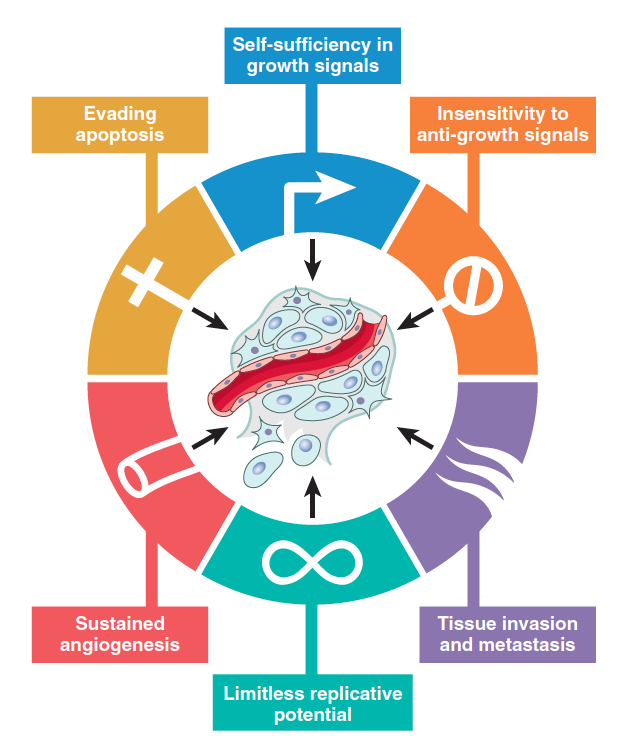
7 Fundamental Changes

Description

? Pathology (Chapter 6) Mind Map on 7 Fundamental Changes, created by Lindie Metz on 19/04/2016.
Lindie Metz
Mind Map by Lindie Metz, updated more than 1 year ago
Lindie Metz
Created by Lindie Metz almost 10 years ago
5
0

Resource summary

7 Fundamental Changes
  1. Insensitivity to growth inhibitory signals
    1. RB tumour suppressor
      1. RB enforces gap btw G0 and G1 – determines if cell can continue
        1. Recessive gene, so require homozygous allele mutation
          1. >> Retinoblastoma = interocular cancer (+ breast, bladder, lung)
            1. DNA viruses can render Rb non-functional (HPV, HBV, EBV)
              1. Binds to Rb and prevents functioning
            2. p53 gene
              1. Guardian of the genome!
                1. Tumour supressor gene STOP neoplasm
                  1. Activates quiescence (temp cell arrest)
                    1. Activates senescence (permanent)
                      1. Triggers apoptosis
                      2. Monitors cell stress and directs best response
                        1. Homozygous loss of p53
                          1. DNA damage unrepaired
                            1. Mutations remain in dividing cells
                              1. Malignant transformation
                              2. DNA viruses can render Rb non-functional (HPV, HBV, EBV)
                            2. Tissue invasion and apoptosis
                              1. Invasion of ECM
                                1. ECM = BM + interstitial CT
                                  1. 1. Detach tumour cells from oneathother
                                    1. 2. Degrade ECM and ICT
                                      1. 3. Change attachment of tumour cells to ECM proteins
                                        1. 4. Migration of tumour cells through degraded BM and ICT directed by tumor cell derived cytokines
                                          1. See diagram!
                                          2. Vascular dissemination and homing of tumour cells
                                            1. Tumour cells in circulation are vulnerable to host immunity
                                              1. 1. Attach to leuk/platelets > emboli > protected from anti tumour host cell
                                                1. 2. Extravasation – tumour cells/emboli attach to EN >> through BM >> into parenchyma
                                                  1. Predict site of extravasation/metastasis
                                                    1. Location of primary tumour
                                                      1. Vascular/lymph drainage of primary tumour
                                                  2. Self-sufficiency in growth signals
                                                    1. Oncogenes promote autonomous Ca cell growth
                                                      1. > Promoted out of quiescent stage with no add stimulus
                                                        1. > By synthesizing GF + generate constant mitotic signals to cell
                                                          1. > Autonomous and disregulated
                                                          2. Limitless replicative potential
                                                            1. Normal cells lose capacity to divide after 60/70 times
                                                              1. = sensence d/t shortened telomeres (p53/Rb)
                                                                1. p53/Rb checkpoints disabled so Ca must overcome mitotic catastrophe
                                                                  1. Tumour cell reactivates telomerase >> activates stem cells
                                                                  2. Telomerase maintenance in 85-95% Ca
                                                                    1. >> Break cycle of fusion and breakage
                                                                    2. >> Avoid cell death
                                                                    3. Sustained angiogenesis
                                                                      1. Tumour needs nutrients/O2 + waste removal bigger than 1-2mm > products can diffuse
                                                                        1. = neo-angiogenesis + vasculogenesis >> new vessels from capillaries + endothelial cells from bone marrow
                                                                          1. BUT vessels are abnormal and leaky
                                                                            1. Supports tumour growth
                                                                              1. O2/nutrient supply + waste removal
                                                                                1. EN cells stimulate new tumour cell growth by GF
                                                                                  1. >> supplies new channels for metastases
                                                                                2. Evading apoptosis
                                                                                  1. Inc in neoplastic cells + mutations in genes that regulate apoptosis
                                                                                    1. >> Inc in cells + << in apoptosis
                                                                                    Show full summary Hide full summary

                                                                                    Similar

                                                                                    Fluid and Electrolyte Imbalances
                                                                                    D R
                                                                                    Infectious diseases
                                                                                    Clare Yu
                                                                                    Malignancies
                                                                                    Mark George
                                                                                    General Pathoanatomy Final MCQs (401-519)- 3rd Year- PMU
                                                                                    Med Student
                                                                                    General Pathoanatomy Final MCQs (301-400)- 3rd Year- PMU
                                                                                    Med Student
                                                                                    General Pathoanatomy Final MCQs (201-300)- 3rd Year- PMU
                                                                                    Med Student
                                                                                    Clinical Pathology (301-400) MCQs- Year 4 PMU
                                                                                    Med Student
                                                                                    patho. practical slides
                                                                                    أطباء2020
                                                                                    Hydrocephalus
                                                                                    Matthew Coulson
                                                                                    Project Mngt Chapter 6
                                                                                    damimgd2u
                                                                                    Chapter 6 Homework
                                                                                    void pickle