
Mind map
In What Ways Did Communism Transform the GDR ?
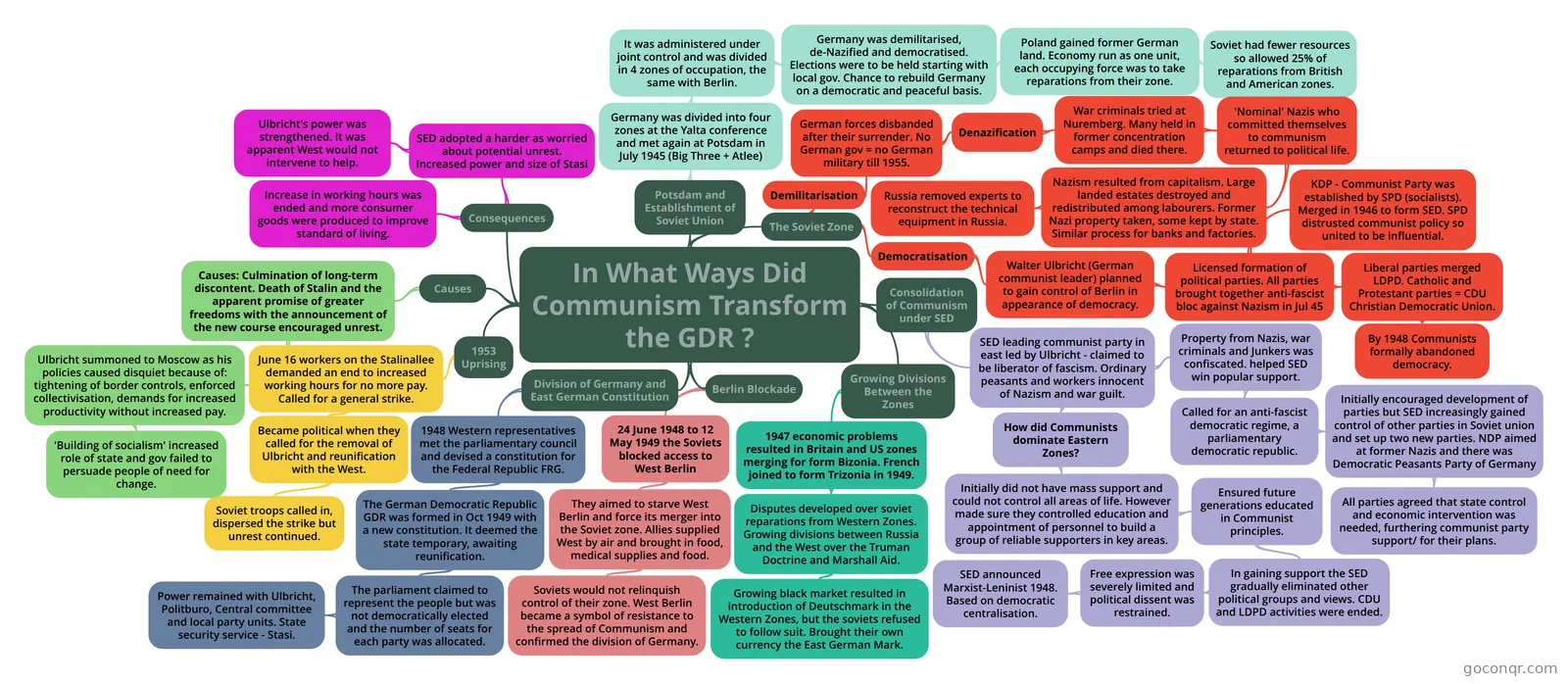
Mind map: communism in the GDR
Map content
In What Ways Did Communism Transform the GDR ?
Potsdam and Establishment of Soviet Union
- Germany was divided into four zones at the Yalta conference and met again at Potsdam in July 1945 (Big Three + Atlee)
- It was administered under joint control and was divided in 4 zones of occupation, the same with Berlin.
- Germany was demilitarised, de-Nazified and democratised. Elections were to be held starting with local gov. Chance to rebuild Germany on a democratic and peaceful basis.
- Poland gained former German land. Economy run as one unit, each occupying force was to take reparations from their zone.
- Soviet had fewer resources so allowed 25% of reparations from British and American zones.
- Poland gained former German land. Economy run as one unit, each occupying force was to take reparations from their zone.
- Germany was demilitarised, de-Nazified and democratised. Elections were to be held starting with local gov. Chance to rebuild Germany on a democratic and peaceful basis.
- It was administered under joint control and was divided in 4 zones of occupation, the same with Berlin.
- Germany was divided into four zones at the Yalta conference and met again at Potsdam in July 1945 (Big Three + Atlee)
The Soviet Zone
- Democratisation
- Walter Ulbricht (German communist leader) planned to gain control of Berlin in appearance of democracy.
- Licensed formation of political parties. All parties brought together anti-fascist bloc against Nazism in Jul 45
- KDP - Communist Party was established by SPD (socialists). Merged in 1946 to form SED. SPD distrusted communist policy so united to be influential.
- Liberal parties merged LDPD. Catholic and Protestant parties = CDU Christian Democratic Union.
- By 1948 Communists formally abandoned democracy.
- Licensed formation of political parties. All parties brought together anti-fascist bloc against Nazism in Jul 45
- Walter Ulbricht (German communist leader) planned to gain control of Berlin in appearance of democracy.
- Demilitarisation
- German forces disbanded after their surrender. No German gov = no German military till 1955.
- Denazification
- War criminals tried at Nuremberg. Many held in former concentration camps and died there.
- 'Nominal' Nazis who committed themselves to communism returned to political life.
- Nazism resulted from capitalism. Large landed estates destroyed and redistributed among labourers. Former Nazi property taken, some kept by state. Similar process for banks and factories.
- Russia removed experts to reconstruct the technical equipment in Russia.
- Nazism resulted from capitalism. Large landed estates destroyed and redistributed among labourers. Former Nazi property taken, some kept by state. Similar process for banks and factories.
- 'Nominal' Nazis who committed themselves to communism returned to political life.
- War criminals tried at Nuremberg. Many held in former concentration camps and died there.
- Denazification
- German forces disbanded after their surrender. No German gov = no German military till 1955.
- Democratisation
Consolidation of Communism under SED
- SED leading communist party in east led by Ulbricht - claimed to be liberator of fascism. Ordinary peasants and workers innocent of Nazism and war guilt.
- Property from Nazis, war criminals and Junkers was confiscated. helped SED win popular support.
- Called for an anti-fascist democratic regime, a parliamentary democratic republic.
- Initially encouraged development of parties but SED increasingly gained control of other parties in Soviet union and set up two new parties. NDP aimed at former Nazis and there was Democratic Peasants Party of Germany
- All parties agreed that state control and economic intervention was needed, furthering communist party support/ for their plans.
- Initially encouraged development of parties but SED increasingly gained control of other parties in Soviet union and set up two new parties. NDP aimed at former Nazis and there was Democratic Peasants Party of Germany
- Called for an anti-fascist democratic regime, a parliamentary democratic republic.
- How did Communists dominate Eastern Zones?
- Initially did not have mass support and could not control all areas of life. However made sure they controlled education and appointment of personnel to build a group of reliable supporters in key areas.
- Ensured future generations educated in Communist principles.
- In gaining support the SED gradually eliminated other political groups and views. CDU and LDPD activities were ended.
- Free expression was severely limited and political dissent was restrained.
- SED announced Marxist-Leninist 1948. Based on democratic centralisation.
- Free expression was severely limited and political dissent was restrained.
- In gaining support the SED gradually eliminated other political groups and views. CDU and LDPD activities were ended.
- Ensured future generations educated in Communist principles.
- Initially did not have mass support and could not control all areas of life. However made sure they controlled education and appointment of personnel to build a group of reliable supporters in key areas.
- Property from Nazis, war criminals and Junkers was confiscated. helped SED win popular support.
- SED leading communist party in east led by Ulbricht - claimed to be liberator of fascism. Ordinary peasants and workers innocent of Nazism and war guilt.
Growing Divisions Between the Zones
- 1947 economic problems resulted in Britain and US zones merging for form Bizonia. French joined to form Trizonia in 1949.
- Disputes developed over soviet reparations from Western Zones. Growing divisions between Russia and the West over the Truman Doctrine and Marshall Aid.
- Growing black market resulted in introduction of Deutschmark in the Western Zones, but the soviets refused to follow suit. Brought their own currency the East German Mark.
- Disputes developed over soviet reparations from Western Zones. Growing divisions between Russia and the West over the Truman Doctrine and Marshall Aid.
- 1947 economic problems resulted in Britain and US zones merging for form Bizonia. French joined to form Trizonia in 1949.
Berlin Blockade
- 24 June 1948 to 12 May 1949 the Soviets blocked access to West Berlin
- They aimed to starve West Berlin and force its merger into the Soviet zone. Allies supplied West by air and brought in food, medical supplies and food.
- Soviets would not relinquish control of their zone. West Berlin became a symbol of resistance to the spread of Communism and confirmed the division of Germany.
- They aimed to starve West Berlin and force its merger into the Soviet zone. Allies supplied West by air and brought in food, medical supplies and food.
- 24 June 1948 to 12 May 1949 the Soviets blocked access to West Berlin
Division of Germany and East German Constitution
- 1948 Western representatives met the parliamentary council and devised a constitution for the Federal Republic FRG.
- The German Democratic Republic GDR was formed in Oct 1949 with a new constitution. It deemed the state temporary, awaiting reunification.
- The parliament claimed to represent the people but was not democratically elected and the number of seats for each party was allocated.
- Power remained with Ulbricht, Politburo, Central committee and local party units. State security service - Stasi.
- The parliament claimed to represent the people but was not democratically elected and the number of seats for each party was allocated.
- The German Democratic Republic GDR was formed in Oct 1949 with a new constitution. It deemed the state temporary, awaiting reunification.
- 1948 Western representatives met the parliamentary council and devised a constitution for the Federal Republic FRG.
1953 Uprising
- June 16 workers on the Stalinallee demanded an end to increased working hours for no more pay. Called for a general strike.
- Became political when they called for the removal of Ulbricht and reunification with the West.
- Soviet troops called in, dispersed the strike but unrest continued.
- Became political when they called for the removal of Ulbricht and reunification with the West.
- June 16 workers on the Stalinallee demanded an end to increased working hours for no more pay. Called for a general strike.
Causes
- Causes: Culmination of long-term discontent. Death of Stalin and the apparent promise of greater freedoms with the announcement of the new course encouraged unrest.
- Ulbricht summoned to Moscow as his policies caused disquiet because of: tightening of border controls, enforced collectivisation, demands for increased productivity without increased pay.
- 'Building of socialism' increased role of state and gov failed to persuade people of need for change.
- Ulbricht summoned to Moscow as his policies caused disquiet because of: tightening of border controls, enforced collectivisation, demands for increased productivity without increased pay.
- Causes: Culmination of long-term discontent. Death of Stalin and the apparent promise of greater freedoms with the announcement of the new course encouraged unrest.
Consequences
- Increase in working hours was ended and more consumer goods were produced to improve standard of living.
- SED adopted a harder as worried about potential unrest. Increased power and size of Stasi
- Ulbricht's power was strengthened. It was apparent West would not intervene to help.
Information
- Description
- A-Level History (Retake) Mind Map on In What Ways Did Communism Transform the GDR ?, created by Rosie Evans on 12/05/2016.
- Created by
- Rosie Evans
- Views
- 0
- Rating
More on East German Government and Communism