
Mind map
Internal developments in the west 1961-1989 v2
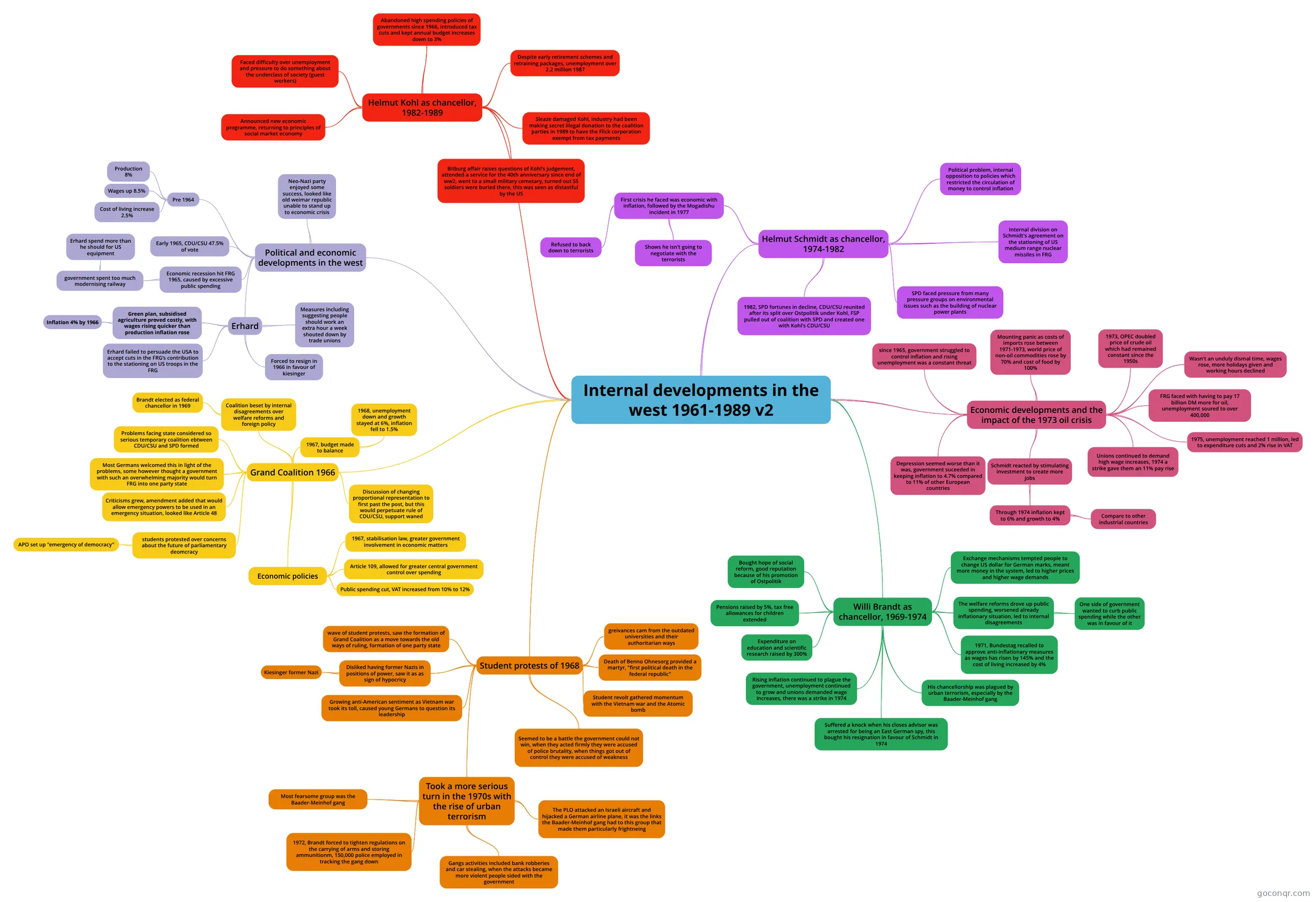
Mind map: Internal developments in the west 1961-1989
Map content
Internal developments in the west 1961-1989 v2
Political and economic developments in the west
- Pre 1964
- Production 8%
- Wages up 8.5%
- Cost of living increase 2.5%
- Early 1965, CDU/CSU 47.5% of vote
- Economic recession hit FRG 1965, caused by excessive public spending
- government spent too much modernising railway
- Erhard spend more than he should for US equipment
- government spent too much modernising railway
- Erhard
- Green plan, subsidised agriculture proved costly, with wages rising quicker than production inflation rose
- Inflation 4% by 1966
- Measures including suggesting people should work an extra hour a week shouted down by trade unions
- Erhard failed to persuade the USA to accept cuts in the FRG’s contribution to the stationing on US troops in the FRG
- Forced to resign in 1966 in favour of kiesinger
- Green plan, subsidised agriculture proved costly, with wages rising quicker than production inflation rose
- Neo-Nazi party enjoyed some success, looked like old weimar republic unable to stand up to economic crisis
- Pre 1964
Grand Coalition 1966
- Problems facing state considered so serious temporary coalition ebtween CDU/CSU and SPD formed
- Most Germans welcomed this in light of the problems, some however thought a government with such an overwhelming majority would turn FRG into one party state
- Criticisms grew, amendment added that would allow emergency powers to be used in an emergency situation, looked like Article 48
- students protested over concerns about the future of parliamentary deomcracy
- APO set up "emergency of democracy"
- Discussion of changing proportional representation to first past the post, but this would perpetuate rule of CDU/CSU, support waned
- Economic policies
- 1967, stabilisation law, greater government involvement in economic matters
- Article 109, allowed for greater central government control over spending
- Public spending cut, VAT increased from 10% to 12%
- 1967, budget made to balance
- 1968, unemployment down and growth stayed at 6%, inflation fell to 1.5%
- Coalition beset by internal disagreements over welfare reforms and foreign policy
- Brandt elected as federal chancellor in 1969
Student protests of 1968
- wave of student protests, saw the formation of Grand Coalition as a move towards the old ways of ruling, formation of one party state
- Disliked having former Nazis in positions of power, saw it as as sign of hypocricy
- Kiesinger former Nazi
- Growing anti-American sentiment as Vietnam war took its toll, caused young Germans to question its leadership
- greivances cam from the outdated universities and their authoritarian ways
- Death of Benno Ohnesorg provided a martyr, "first political death in the federal republic"
- Student revolt gathered momentum with the Vietnam war and the Atomic bomb
- Seemed to be a battle the government could not win, when they acted firmly they were accused of police brutality, when things got out of control they were accused of weakness
- Took a more serious turn in the 1970s with the rise of urban terrorism
- Most fearsome group was the Baader-Meinhof gang
- 1972, Brandt forced to tighten regulations on the carrying of arms and storing ammunitionm, 150,000 police employed in tracking the gang down
- The PLO attacked an Israeli aircraft and hijacked a German airline plane, it was the links the Baader-Meinhof gang had to this group that made them particularly frightneing
- Gangs activities included bank robberies and car stealing, when the attacks became more violent people sided with the government
Willi Brandt as chancellor, 1969-1974
- Bought hope of social reform, good reputation because of his promotion of Ostpolitik
- Pensions raised by 5%, tax free allowances for children extended
- Expenditure on education and scientific research raised by 300%
- Exchange mechanisms tempted people to change US dollar for German marks, meant more money in the system, led to higher prices and higher wage demands
- The welfare reforms drove up public spending, worsened already inflationary situation, led to internal disagreements
- One side of government wanted to curb public spending while the other was in favour of it
- 1971, Bundestag recalled to approve anti-inflationary measures as wages has risen by 145% and the cost of living increased by 4%
- His chancellorship was plagued by urban terrorism, especially by the Baader-Meinhof gang
- Rising inflation continued to plague the government, unemployment continued to grow and unions demanded wage increases, there was a strike in 1974
- Suffered a knock when his closes advisor was arrested for being an East German spy, this bought his resignation in favour of Schmidt in 1974
Economic developments and the impact of the 1973 oil crisis
- since 1965, government struggled to control inflation and rising unemployment was a constant threat
- Mounting panic as costs of imports rose between 1971-1973, world price of non-oil commodities rose by 70% and cost of food by 100%
- 1973, OPEC doubled price of crude oil which had remained constant since the 1950s
- FRG faced with having to pay 17 billion DM more for oil, unemployment soured to over 400,000
- Unions continued to demand high wage increases, 1974 a strike gave them an 11% pay rise
- Schmidt reacted by stimulating investment to create more jobs
- Through 1974 inflation kept to 6% and growth to 4%
- Compare to other industrial countries
- Through 1974 inflation kept to 6% and growth to 4%
- Depression seemed worse than it was, government suceeded in keeping inflation to 4.7% compared to 11% of other European countries
- 1975, unemployment reached 1 million, led to expenditure cuts and 2% rise in VAT
- Wasn't an unduly dismal time, wages rose, more holidays given and working hours declined
Helmut Schmidt as chancellor, 1974-1982
- First crisis he faced was economic with inflation, followed by the Mogadishu incident in 1977
- Refused to back down to terrorists
- Shows he isn't going to negotiate with the terrorists
- Political problem, internal opposition to policies which restricted the circulation of money to control inflation
- Internal division on Schmidt's agreement on the stationing of US medium range nuclear missiles in FRG
- SPD faced pressure from many pressure groups on environmental issues such as the building of nuclear power plants
- 1982, SPD fortunes in decline, CDU/CSU reunited after its split over Ostpolitik under Kohl, FSP pulled out of coalition with SPD and created one with Kohl's CDU/CSU
- First crisis he faced was economic with inflation, followed by the Mogadishu incident in 1977
Helmut Kohl as chancellor, 1982-1989
- Announced new economic programme, returning to principles of social market economy
- Faced difficulty over unemployment and pressure to do something about the underclass of society (guest workers)
- Abandoned high spending policies of governments since 1966, introduced tax cuts and kept annual budget increases down to 3%
- Despite early retirement schemes and retraining packages, unemployment over 2.2 million 1987
- Sleaze damaged Kohl, industry had been making secret illegal donation to the coalition parties in 1989 to have the Flick corporation exempt from tax payments
- Bitburg affair raises questions of Kohl's judgement, attended a service for the 40th anniversary since end of ww2, went to a small military cemetary, turned out SS soldiers were buried there, this was seen as distastful by the US
Information
- Description
- A-Level History Mind Map on Internal developments in the west 1961-1989 v2, created by afrodo98 on 04/06/2016.
- Created by
- afrodo98
- Views
- 1
- History
-
- Created by Joel Towner · Jun 3, 2016
- Copied by afrodo98 · Jun 4, 2016
- Rating
More on West German Politics and Government