
Mind map
History Questions
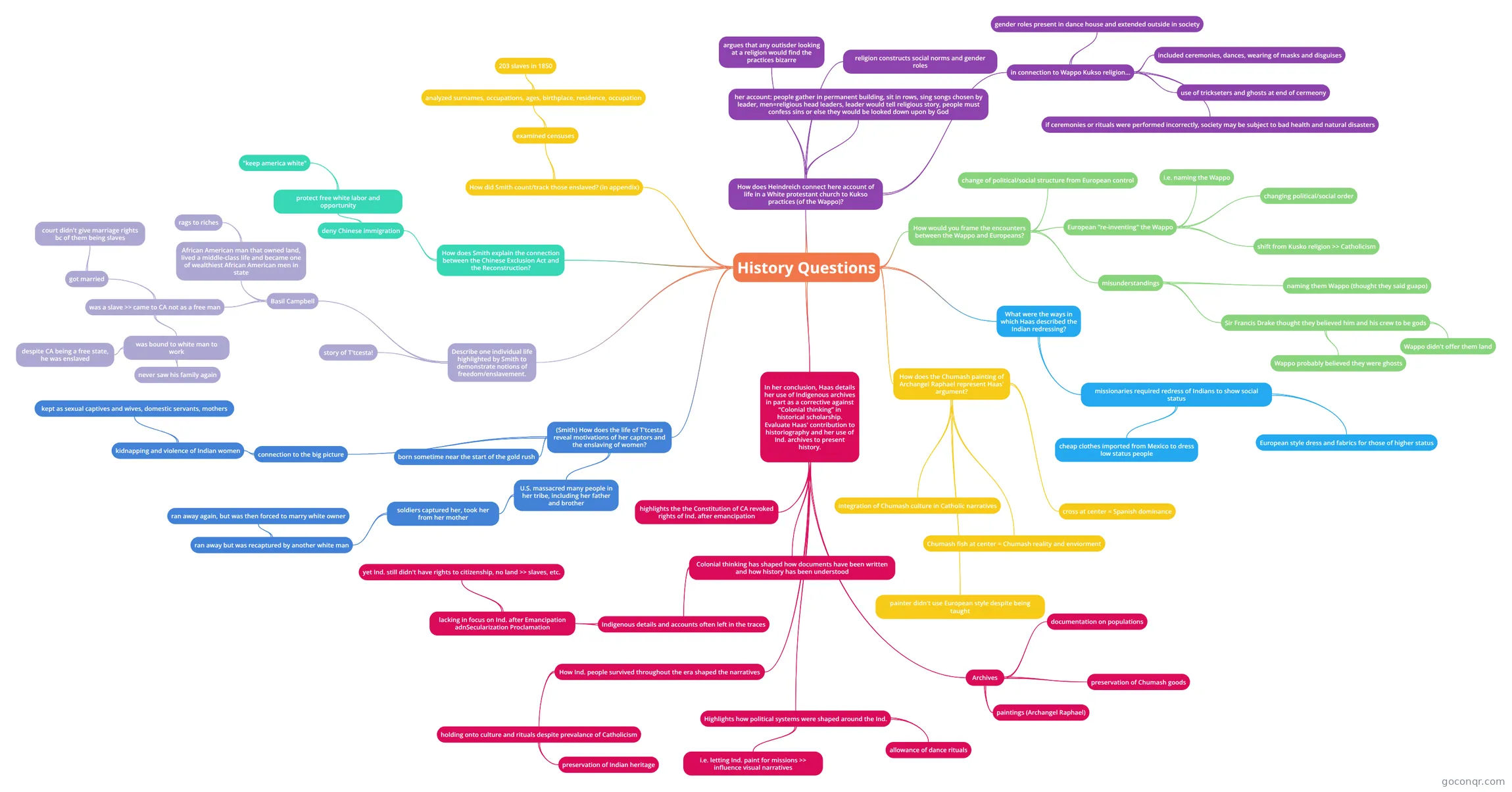
Mind map: Haas and Smith history questions
Map content
History Questions
How does Heindreich connect here account of life in a White protestant church to Kukso practices (of the Wappo)?
- her account: people gather in permanent building, sit in rows, sing songs chosen by leader, men=religious head leaders, leader would tell religious story, people must confess sins or else they would be looked down upon by God
- argues that any outisder looking at a religion would find the practices bizarre
- religion constructs social norms and gender roles
- in connection to Wappo Kukso religion...
- gender roles present in dance house and extended outside in society
- included ceremonies, dances, wearing of masks and disguises
- use of trickseters and ghosts at end of cermeony
- if ceremonies or rituals were performed incorrectly, society may be subject to bad health and natural disasters
How would you frame the encounters between the Wappo and Europeans?
- change of political/social structure from European control
- European "re-inventing" the Wappo
- i.e. naming the Wappo
- changing political/social order
- shift from Kusko religion >> Catholicism
- misunderstandings
- naming them Wappo (thought they said guapo)
- Sir Francis Drake thought they believed him and his crew to be gods
- Wappo probably believed they were ghosts
- Wappo didn't offer them land
What were the ways in which Haas described the Indian redressing?
- missionaries required redress of Indians to show social status
- cheap clothes imported from Mexico to dress low status people
- European style dress and fabrics for those of higher status
- missionaries required redress of Indians to show social status
How does the Chumash painting of Archangel Raphael represent Haas' argument?
- integration of Chumash culture in Catholic narratives
- cross at center = Spanish dominance
- Chumash fish at center = Chumash reality and enviorment
- painter didn't use European style despite being taught
In her conclusion, Haas details her use of Indigenous archives in part as a corrective against “Colonial thinking” in historical scholarship. Evaluate Haas' contribution to historiography and her use of Ind. archives to present history.
- highlights the the Constitution of CA revoked rights of Ind. after emancipation
- Colonial thinking has shaped how documents have been written and how history has been understood
- Indigenous details and accounts often left in the traces
- lacking in focus on Ind. after Emancipation adnSecularization Proclamation
- yet Ind. still didn't have rights to citizenship, no land >> slaves, etc.
- lacking in focus on Ind. after Emancipation adnSecularization Proclamation
- Indigenous details and accounts often left in the traces
- How Ind. people survived throughout the era shaped the narratives
- holding onto culture and rituals despite prevalance of Catholicism
- preservation of Indian heritage
- holding onto culture and rituals despite prevalance of Catholicism
- Highlights how political systems were shaped around the Ind.
- i.e. letting Ind. paint for missions >> influence visual narratives
- allowance of dance rituals
- Archives
- paintings (Archangel Raphael)
- documentation on populations
- preservation of Chumash goods
Describe one individual life highlighted by Smith to demonstrate notions of freedom/enslavement.
- story of T'tcesta!
- Basil Campbell
- African American man that owned land, lived a middle-class life and became one of wealthiest African American men in state
- rags to riches
- was a slave >> came to CA not as a free man
- was bound to white man to work
- never saw his family again
- despite CA being a free state, he was enslaved
- got married
- court didn't give marriage rights bc of them being slaves
- was bound to white man to work
- African American man that owned land, lived a middle-class life and became one of wealthiest African American men in state
(Smith) How does the life of T'tcesta reveal motivations of her captors and the enslaving of women?
- born sometime near the start of the gold rush
- U.S. massacred many people in her tribe, including her father and brother
- soldiers captured her, took her from her mother
- ran away but was recaptured by another white man
- ran away again, but was then forced to marry white owner
- ran away but was recaptured by another white man
- soldiers captured her, took her from her mother
- connection to the big picture
- kidnapping and violence of Indian women
- kept as sexual captives and wives, domestic servants, mothers
- kidnapping and violence of Indian women
How does Smith explain the connection between the Chinese Exclusion Act and the Reconstruction?
- deny Chinese immigration
- protect free white labor and opportunity
- "keep america white"
- protect free white labor and opportunity
- deny Chinese immigration
How did Smith count/track those enslaved? (in appendix)
- examined censuses
- analyzed surnames, occupations, ages, birthplace, residence, occupation
- 203 slaves in 1850
- analyzed surnames, occupations, ages, birthplace, residence, occupation
- examined censuses