
Mind map
Lee et al
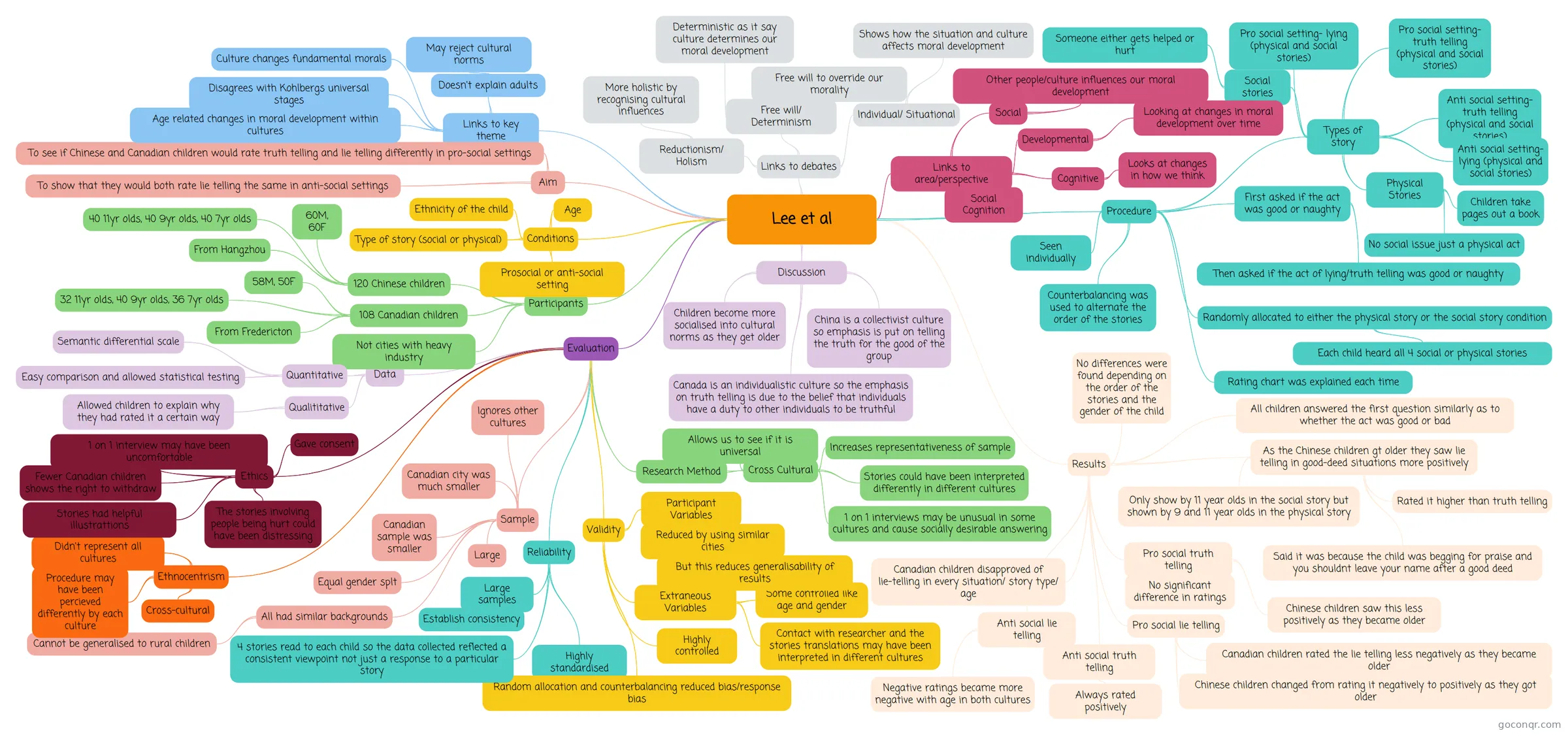
Mind map: Lee et al study
Map content
Lee et al
Conditions
- Ethnicity of the child
- Age
- Type of story (social or physical)
- Prosocial or anti-social setting
Aim
- To see if Chinese and Canadian children would rate truth telling and lie telling differently in pro-social settings
- To show that they would both rate lie telling the same in anti-social settings
Participants
- 120 Chinese children
- 60M, 60F
- 40 11yr olds, 40 9yr olds, 40 7yr olds
- From Hangzhou
- 108 Canadian children
- 58M, 50F
- 32 11yr olds, 40 9yr olds, 36 7yr olds
- From Fredericton
- Not cities with heavy industry
- 120 Chinese children
Procedure
- Types of story
- Pro social setting- lying (physical and social stories)
- Pro social setting- truth telling (physical and social stories)
- Anti social setting- truth telling (physical and social stories)
- Anti social setting- lying (physical and social stories)
- Physical Stories
- Children take pages out a book
- No social issue just a physical act
- Social stories
- Someone either gets helped or hurt
- First asked if the act was good or naughty
- Then asked if the act of lying/truth telling was good or naughty
- Randomly allocated to either the physical story or the social story condition
- Each child heard all 4 social or physical stories
- Seen individually
- Rating chart was explained each time
- Counterbalancing was used to alternate the order of the stories
- Types of story
Results
- No differences were found depending on the order of the stories and the gender of the child
- All children answered the first question similarly as to whether the act was good or bad
- As the Chinese children gt older they saw lie telling in good-deed situations more positively
- Rated it higher than truth telling
- Only show by 11 year olds in the social story but shown by 9 and 11 year olds in the physical story
- Said it was because the child was begging for praise and you shouldnt leave your name after a good deed
- Canadian children disapproved of lie-telling in every situation/ story type/ age
- Pro social truth telling
- No significant difference in ratings
- Chinese children saw this less positively as they became older
- Pro social lie telling
- Canadian children rated the lie telling less negatively as they became older
- Chinese children changed from rating it negatively to positively as they got older
- Anti social lie telling
- Negative ratings became more negative with age in both cultures
- Anti social truth telling
- Always rated positively
Discussion
- Children become more socialised into cultural norms as they get older
- China is a collectivist culture so emphasis is put on telling the truth for the good of the group
- Canada is an individualistic culture so the emphasis on truth telling is due to the belief that individuals have a duty to other individuals to be truthful
Evaluation
- Validity
- Extraneous Variables
- Some controlled like age and gender
- Contact with researcher and the stories translations may have been interpreted in different cultures
- Participant Variables
- Reduced by using similar cities
- But this reduces generalisability of results
- Reduced by using similar cities
- Highly controlled
- Random allocation and counterbalancing reduced bias/response bias
- Extraneous Variables
- Reliability
- Highly standardised
- Large samples
- Establish consistency
- 4 stories read to each child so the data collected reflected a consistent viewpoint not just a response to a particular story
- Ethics
- Gave consent
- Fewer Canadian children shows the right to withdraw
- Stories had helpful illustrattions
- The stories involving people being hurt could have been distressing
- 1 on 1 interview may have been uncomfortable
- Data
- Quantitative
- Semantic differential scale
- Easy comparison and allowed statistical testing
- Qualititative
- Allowed children to explain why they had rated it a certain way
- Quantitative
- Sample
- All had similar backgrounds
- Cannot be generalised to rural children
- Equal gender splt
- Large
- Canadian sample was smaller
- Canadian city was much smaller
- Ignores other cultures
- All had similar backgrounds
- Ethnocentrism
- Cross-cultural
- Procedure may have been percieved differently by each culture
- Didn't represent all cultures
- Research Method
- Cross Cultural
- Increases representativeness of sample
- Allows us to see if it is universal
- Stories could have been interpreted differently in different cultures
- 1 on 1 interviews may be unusual in some cultures and cause socially desirable answering
- Cross Cultural
- Validity
Links to area/perspective
- Developmental
- Looking at changes in moral development over time
- Cognitive
- Looks at changes in how we think
- Social
- Other people/culture influences our moral development
- Social Cognition
- Developmental
Links to key theme
- Age related changes in moral development within cultures
- Disagrees with Kohlbergs universal stages
- Culture changes fundamental morals
- Doesn't explain adults
- May reject cultural norms
Links to debates
- Individual/ Situational
- Shows how the situation and culture affects moral development
- Free will/ Determinism
- Deterministic as it say culture determines our moral development
- Free will to override our morality
- Reductionism/ Holism
- More holistic by recognising cultural influences
- Individual/ Situational
Information
- Description
- A-Level Psychology (The Developmental Area) Mind Map on Lee et al, created by Bethany Pass on 14/11/2016.
- Created by
- Bethany Pass
- Views
- 12
- History
-
- Created by Bethany Pass · Feb 2, 2016
- Copied by Bethany Pass · Feb 2, 2016
- Copied by Bethany Pass · Feb 2, 2016
- Copied by Bethany Pass · Sep 7, 2016
- Copied by Bethany Pass · Nov 2, 2016
- Copied by Bethany Pass · Nov 14, 2016
- Rating