
Mind map
ethnicity and crime
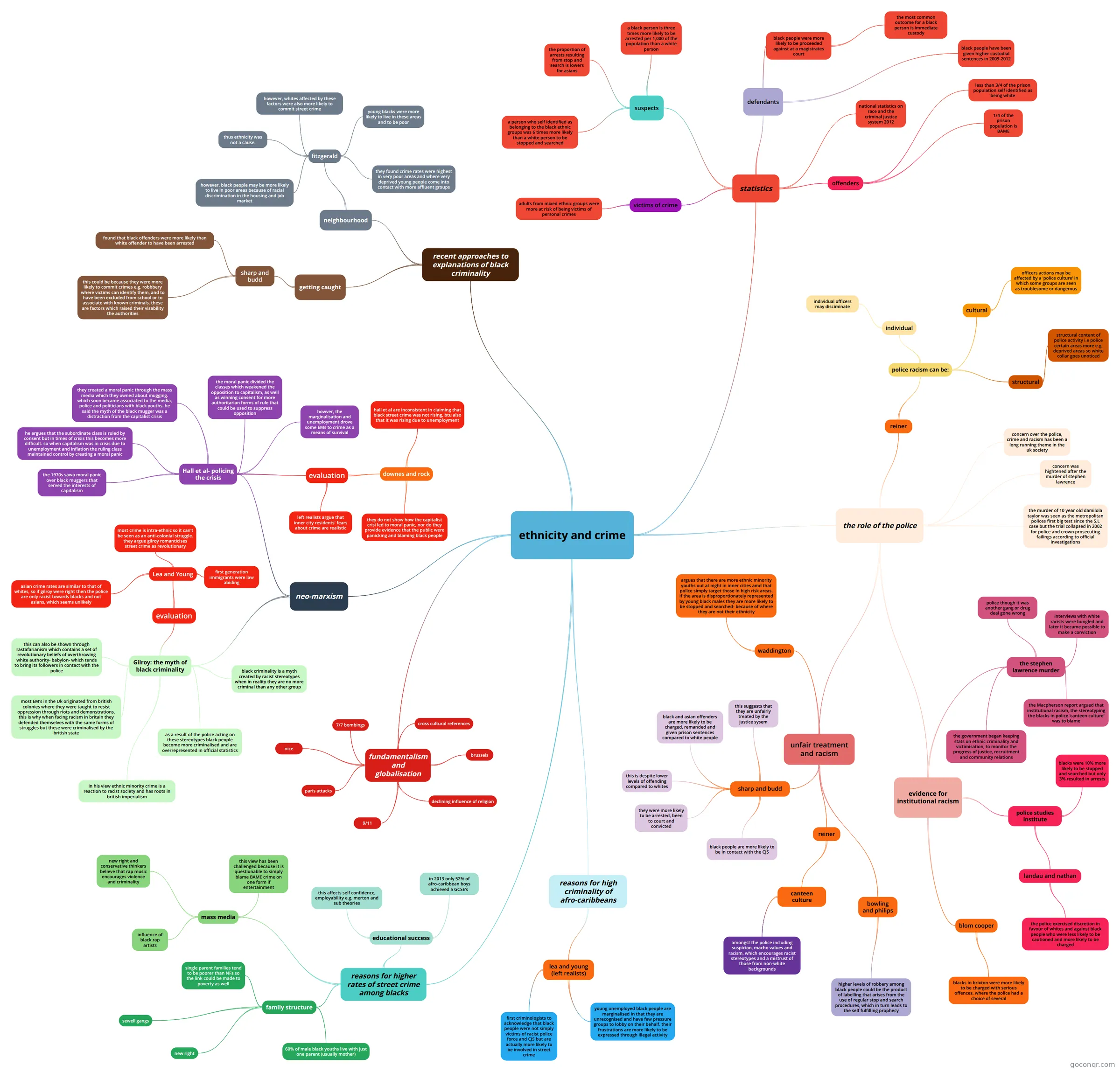
Mind map: ethnicity and crime
Map content
ethnicity and crime
statistics
- victims of crime
- adults from mixed ethnic groups were more at risk of being victims of personal crimes
- national statistics on race and the criminal justice system 2012
- suspects
- a person who self identified as belonging to the black ethnic groups was 6 times more likely than a white person to be stopped and searched
- the proportion of arrests resulting from stop and search is lowers for asians
- a black person is three times more likely to be arrested per 1,000 of the population than a white person
- defendants
- black people were more likely to be proceeded against at a magistrates court
- the most common outcome for a black person is immediate custody
- black people have been given higher custodial sentences in 2009-2012
- black people were more likely to be proceeded against at a magistrates court
- offenders
- less than 3/4 of the prison population self identified as being white
- 1/4 of the prison population is BAME
- victims of crime
the role of the police
- reiner
- police racism can be:
- individual
- individual officers may disciminate
- cultural
- officers actions may be affected by a 'police culture' in which some groups are seen as troublesome or dangerous
- structural
- structural content of police activity i.e police certain areas more e.g. deprived areas so white collar goes unoticed
- individual
- police racism can be:
- concern over the police, crime and racism has been a long running theme in the uk society
- concern was hightened after the murder of stephen lawrence
- the murder of 10 year old damilola taylor was seen as the metropolitan polices first big test since the S.L case but the trial collapsed in 2002 for police and crown prosecuting failings according to official investigations
- evidence for institutional racism
- the stephen lawrence murder
- police though it was another gang or drug deal gone wrong
- interviews with white racists were bungled and later it became possible to make a conviction
- the Macpherson report argued that institutional racism, the stereotyping the blacks in police 'canteen culture' was to blame
- the government began keeping stats on ethnic criminality and victimisation, to monitor the progress of justice, recruitment and community relations
- police studies institute
- blacks were 10% more likely to be stopped and searched but only 3% resulted in arrests
- landau and nathan
- the police exercised discretion in favour of whites and against black people who were less likely to be cautioned and more likely to be charged
- blom cooper
- blacks in brixton were more likely to be charged with serious offences, where the police had a choice of several
- the stephen lawrence murder
- unfair treatment and racism
- reiner
- canteen culture
- amongst the police including suspicion, macho values and racism, which encourages racist stereotypes and a mistrust of those from non-white backgrounds
- canteen culture
- bowling and philips
- higher levels of robbery among black people could be the product of labelling that arises from the use of regular stop and search procedures, which in turn leads to the self fulfilling prophecy
- sharp and budd
- black people are more likely to be in contact with the CJS
- they were more likely to be arrested, been to court and convicted
- this is despite lower levels of offending compared to whites
- black and asian offenders are more likely to be charged, remanded and given prison sentences compared to white people
- this suggests that they are unfairly treated by the justice sysem
- waddington
- argues that there are more ethnic minority youths out at night in inner cities amd that police simply target those in high risk areas. if the area is disproportionately represented by young black males they are more likely to be stopped and searched- because of where they are not their ethnicity
- reiner
- reiner
reasons for high criminality of afro-caribbeans
- lea and young (left realists)
- first criminologists to acknowledge that black people were not simply victims of racist police force and CJS but are actually more likely to be involved in street crime
- young unemployed black people are marginalised in that they are unrecognised and have few pressure groups to lobby on their behalf. their frustrations are more likely to be expressed through illegal activity
- lea and young (left realists)
reasons for higher rates of street crime among blacks
- educational success
- in 2013 only 52% of afro-caribbean boys achieved 5 GCSE's
- this affects self confidence, employability e.g. merton and sub theories
- family structure
- 60% of male black youths live with just one parent (usually mother)
- new right
- sewell gangs
- single parent families tend to be poorer than NFs so the link could be made to poverty as well
- mass media
- influence of black rap artists
- new right and conservative thinkers believe that rap music encourages violence and criminality
- this view has been challenged because it is questionable to simply blame BAME crime on one form if entertainment
- educational success
fundamentalism and globalisation
- cross cultural references
- declining influence of religion
- 9/11
- paris attacks
- nice
- 7/7 bombings
- brussels
neo-marxism
- Gilroy: the myth of black criminality
- black criminality is a myth created by racist stereotypes when in reality they are no more criminal than any other group
- as a result of the police acting on these stereotypes black people become more criminalised and are overrepresented in official statistics
- in his view ethnic minority crime is a reaction to racist society and has roots in british imperialism
- most EM's in the Uk originated from british colonies where they were taught to resist oppression through riots and demonstrations. this is why when facing racism in britain they defended themselves with the same forms of struggles but these were criminalised by the british state
- evaluation
- Lea and Young
- first generation immigrants were law abiding
- most crime is intra-ethnic so it can't be seen as an anti-colonial struggle. they argue gilroy romanticises street crime as revolutionary
- asian crime rates are similar to that of whites, so if gilroy were right then the police are only racist towards blacks and not asians, which seems unlikely
- Lea and Young
- this can also be shown through rastafarianism which contains a set of revolutionary beliefs of overthrowing white authority- babylon- which tends to bring its followers in contact with the police
- Hall et al- policing the crisis
- the 1970s sawa moral panic over black muggers that served the interests of capitalism
- he argues that the subordinate class is ruled by consent but in times of crisis this becomes more difficult. so when capitalism was in crisis due to unemployment and inflation the ruling class maintained control by creating a moral panic
- they created a moral panic through the mass media which they owned about mugging. which soon became associated to the media, police and politicians with black youths. he said the myth of the black mugger was a distraction from the capitalist crisis
- the moral panic divided the classes which weakened the opposition to capitalism, as well as winning consent for more authoritarian forms of rule that could be used to suppress opposition
- evaluation
- downes and rock
- hall et al are inconsistent in claiming that black street crime was not rising, btu also that it was rising due to unemployment
- they do not show how the capitalist crisi led to moral panic, nor do they provide evidence that the public were panicking and blaming black people
- left realists argue that inner city residents' fears about crime are realistic
- downes and rock
- howver, the marginalisation and unemployment drove some EMs to crime as a means of survival
- Gilroy: the myth of black criminality
recent approaches to explanations of black criminality
- neighbourhood
- fitzgerald
- they found crime rates were highest in very poor areas and where very deprived young people come into contact with more affluent groups
- young blacks were more likely to live in these areas and to be poor
- however, whites affected by these factors were also more likely to commit street crime
- thus ethnicity was not a cause.
- however, black people may be more likely to live in poor areas because of racial discrimination in the housing and job market
- fitzgerald
- getting caught
- sharp and budd
- found that black offenders were more likely than white offender to have been arrested
- this could be because they were more likely to commit crimes e.g. robbbery where victims can identify them, and to have been excluded from school or to associate with known criminals. these are factors which raised their visability the authorities
- sharp and budd
- neighbourhood
Information
- Description
- A2 Sociology A2 (crime and deviance) Mind Map on ethnicity and crime, created by Truely Costen on 08/03/2017.
- Created by
- Truely Costen
- Views
- 5
- Rating