
Mind map
Role of schemas
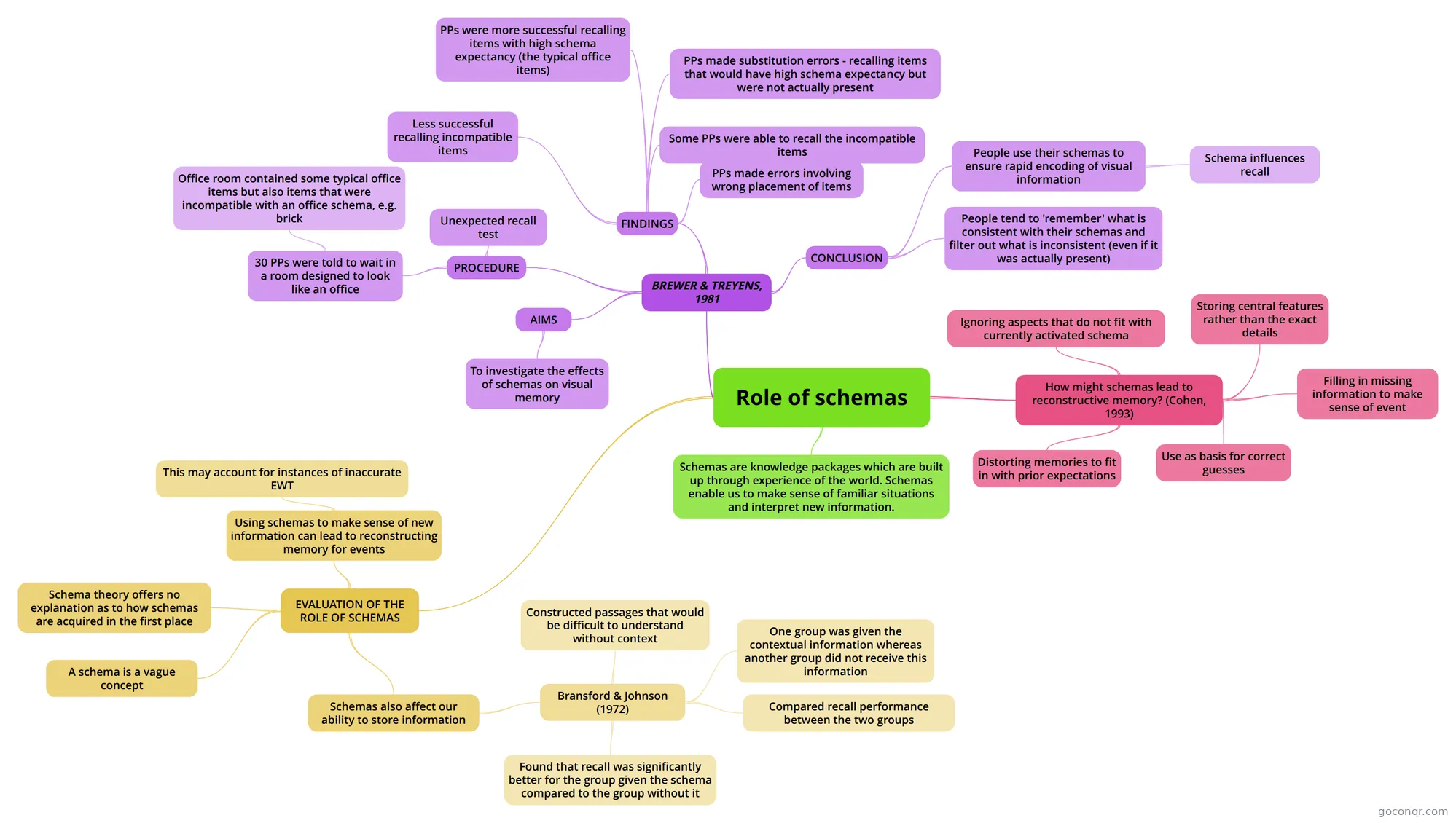
Mind map: Role of schemas
Map content
Role of schemas
Schemas are knowledge packages which are built up through experience of the world. Schemas enable us to make sense of familiar situations and interpret new information.
How might schemas lead to reconstructive memory? (Cohen, 1993)
- Ignoring aspects that do not fit with currently activated schema
- Storing central features rather than the exact details
- Filling in missing information to make sense of event
- Distorting memories to fit in with prior expectations
- Use as basis for correct guesses
BREWER & TREYENS, 1981
- AIMS
- To investigate the effects of schemas on visual memory
- PROCEDURE
- 30 PPs were told to wait in a room designed to look like an office
- Office room contained some typical office items but also items that were incompatible with an office schema, e.g. brick
- Unexpected recall test
- 30 PPs were told to wait in a room designed to look like an office
- FINDINGS
- PPs were more successful recalling items with high schema expectancy (the typical office items)
- Less successful recalling incompatible items
- Some PPs were able to recall the incompatible items
- PPs made substitution errors - recalling items that would have high schema expectancy but were not actually present
- PPs made errors involving wrong placement of items
- CONCLUSION
- People tend to 'remember' what is consistent with their schemas and filter out what is inconsistent (even if it was actually present)
- People use their schemas to ensure rapid encoding of visual information
- Schema influences recall
- AIMS
EVALUATION OF THE ROLE OF SCHEMAS
- Schemas also affect our ability to store information
- Bransford & Johnson (1972)
- Constructed passages that would be difficult to understand without context
- One group was given the contextual information whereas another group did not receive this information
- Compared recall performance between the two groups
- Found that recall was significantly better for the group given the schema compared to the group without it
- Bransford & Johnson (1972)
- A schema is a vague concept
- Schema theory offers no explanation as to how schemas are acquired in the first place
- Using schemas to make sense of new information can lead to reconstructing memory for events
- This may account for instances of inaccurate EWT
- Schemas also affect our ability to store information
Information
- Description
- A-Levels Psychology A-Level AQA A (Unit 1 Memory) Mind Map on Role of schemas, created by moeingthelawn on 06/05/2014.
- Created by
- moeingthelawn
- Views
- 176
- Tags
- Rating