
Mind map
Cultural Variations in Attachment
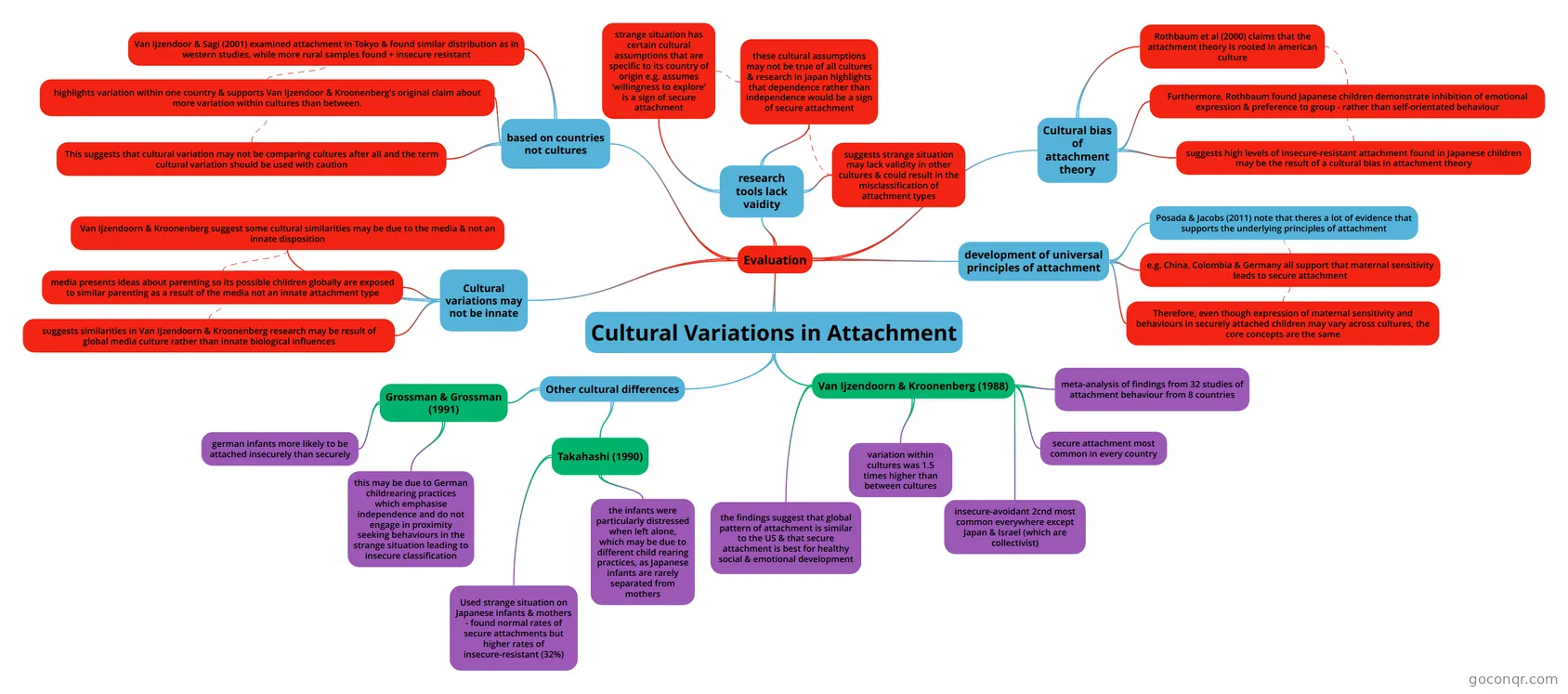
Mind map: Cultural variations in attachment
Map content
Cultural Variations in Attachment
Van Ijzendoorn & Kroonenberg (1988)
- meta-analysis of findings from 32 studies of attachment behaviour from 8 countries
- secure attachment most common in every country
- insecure-avoidant 2cnd most common everywhere except Japan & Israel (which are collectivist)
- variation within cultures was 1.5 times higher than between cultures
- the findings suggest that global pattern of attachment is similar to the US & that secure attachment is best for healthy social & emotional development
Other cultural differences
- Grossman & Grossman (1991)
- german infants more likely to be attached insecurely than securely
- this may be due to German childrearing practices which emphasise independence and do not engage in proximity seeking behaviours in the strange situation leading to insecure classification
- Takahashi (1990)
- Used strange situation on Japanese infants & mothers - found normal rates of secure attachments but higher rates of insecure-resistant (32%)
- the infants were particularly distressed when left alone, which may be due to different child rearing practices, as Japanese infants are rarely separated from mothers
- Grossman & Grossman (1991)
Evaluation
- Cultural variations may not be innate
- Van Ijzendoorn & Kroonenberg suggest some cultural similarities may be due to the media & not an innate disposition
- media presents ideas about parenting so its possible children globally are exposed to similar parenting as a result of the media not an innate attachment type
- suggests similarities in Van Ijzendoorn & Kroonenberg research may be result of global media culture rather than innate biological influences
- based on countries not cultures
- Van Ijzendoor & Sagi (2001) examined attachment in Tokyo & found similar distribution as in western studies, while more rural samples found + insecure resistant
- highlights variation within one country & supports Van Ijzendoor & Kroonenberg's original claim about more variation within cultures than between.
- This suggests that cultural variation may not be comparing cultures after all and the term cultural variation should be used with caution
- research tools lack vaidity
- strange situation has certain cultural assumptions that are specific to its country of origin e.g. assumes 'willingness to explore' is a sign of secure attachment
- these cultural assumptions may not be true of all cultures & research in Japan highlights that dependence rather than independence would be a sign of secure attachment
- suggests strange situation may lack validity in other cultures & could result in the misclassification of attachment types
- Cultural bias of attachment theory
- Rothbaum et al (2000) claims that the attachment theory is rooted in american culture
- Furthermore, Rothbaum found Japanese children demonstrate inhibition of emotional expression & preference to group - rather than self-orientated behaviour
- suggests high levels of insecure-resistant attachment found in Japanese children may be the result of a cultural bias in attachment theory
- development of universal principles of attachment
- Posada & Jacobs (2011) note that theres a lot of evidence that supports the underlying principles of attachment
- e.g. China, Colombia & Germany all support that maternal sensitivity leads to secure attachment
- Therefore, even though expression of maternal sensitivity and behaviours in securely attached children may vary across cultures, the core concepts are the same
- Cultural variations may not be innate
Information
- Description
- A level Psychology (Attachment) Mind Map on Cultural Variations in Attachment, created by Hannah Atkinson on 16/04/2017.
- Created by
- Hannah Atkinson
- Views
- 0
- Rating