
Mind map
Memory
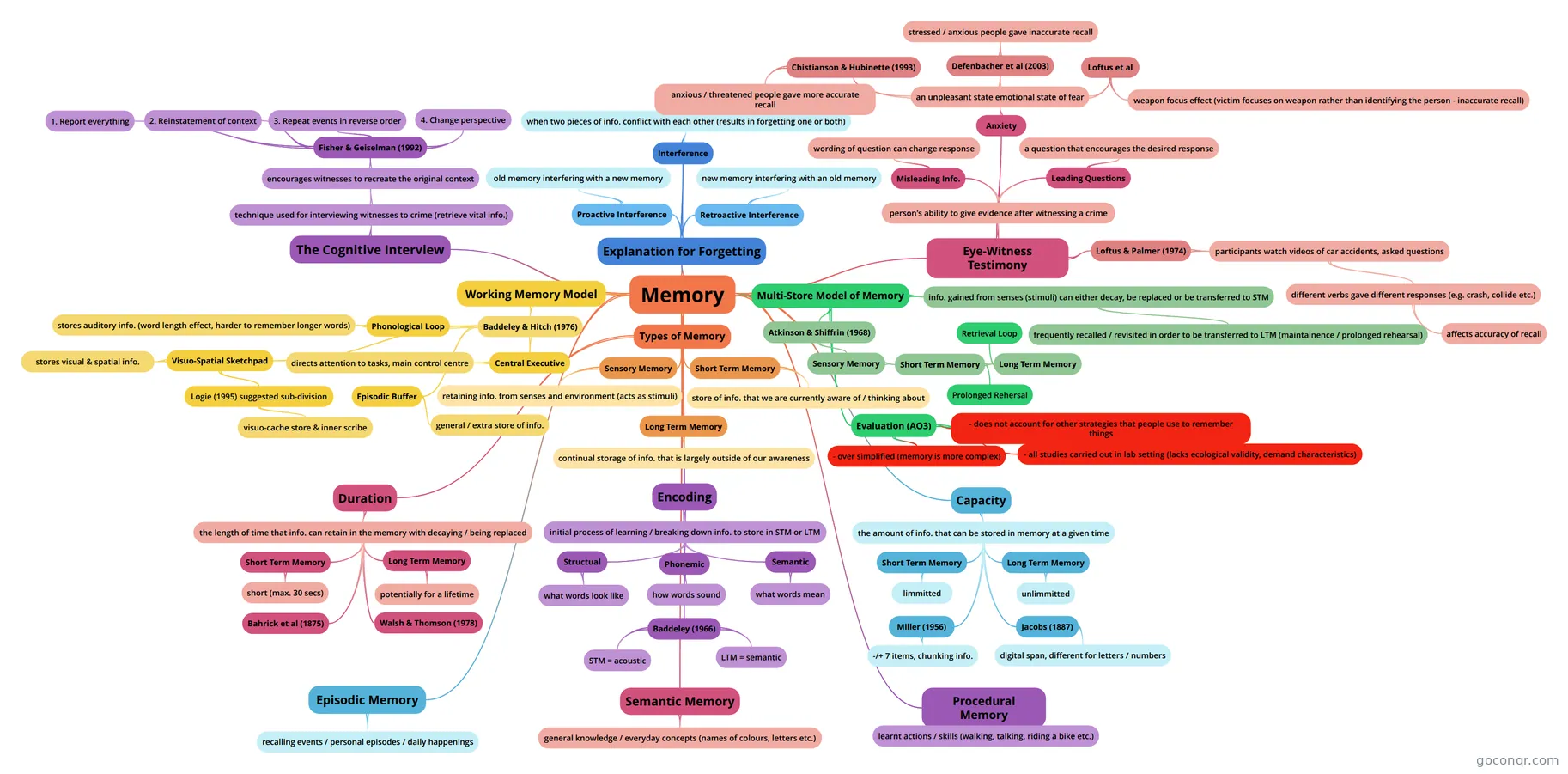
Mind map: Memory Types and Models
Map content
Memory
Types of Memory
- Sensory Memory
- retaining info. from senses and environment (acts as stimuli)
- Short Term Memory
- store of info. that we are currently aware of / thinking about
- Long Term Memory
- continual storage of info. that is largely outside of our awareness
- Duration
- the length of time that info. can retain in the memory with decaying / being replaced
- Short Term Memory
- short (max. 30 secs)
- Long Term Memory
- potentially for a lifetime
- Bahrick et al (1875)
- Walsh & Thomson (1978)
- Short Term Memory
- the length of time that info. can retain in the memory with decaying / being replaced
- Sensory Memory
Multi-Store Model of Memory
- Atkinson & Shiffrin (1968)
- Sensory Memory
- Short Term Memory
- Long Term Memory
- Retrieval Loop
- Prolonged Rehersal
- Long Term Memory
- Short Term Memory
- Sensory Memory
- info. gained from senses (stimuli) can either decay, be replaced or be transferred to STM
- frequently recalled / revisited in order to be transferred to LTM (maintainence / prolonged rehearsal)
- Evaluation (AO3)
- - over simplified (memory is more complex)
- - does not account for other strategies that people use to remember things
- - all studies carried out in lab setting (lacks ecological validity, demand characteristics)
- Atkinson & Shiffrin (1968)
Encoding
- initial process of learning / breaking down info. to store in STM or LTM
- Structual
- what words look like
- Phonemic
- how words sound
- Semantic
- what words mean
- Structual
- Baddeley (1966)
- STM = acoustic
- LTM = semantic
- initial process of learning / breaking down info. to store in STM or LTM
Capacity
- the amount of info. that can be stored in memory at a given time
- Short Term Memory
- limmitted
- Long Term Memory
- unlimmitted
- Miller (1956)
- -/+ 7 items, chunking info.
- Jacobs (1887)
- digital span, different for letters / numbers
- Short Term Memory
- the amount of info. that can be stored in memory at a given time
Working Memory Model
- Baddeley & Hitch (1976)
- Central Executive
- directs attention to tasks, main control centre
- Episodic Buffer
- general / extra store of info.
- Phonological Loop
- stores auditory info. (word length effect, harder to remember longer words)
- Visuo-Spatial Sketchpad
- stores visual & spatial info.
- Logie (1995) suggested sub-division
- visuo-cache store & inner scribe
- Central Executive
- Baddeley & Hitch (1976)
Episodic Memory
- recalling events / personal episodes / daily happenings
Semantic Memory
- general knowledge / everyday concepts (names of colours, letters etc.)
Procedural Memory
- learnt actions / skills (walking, talking, riding a bike etc.)
Explanation for Forgetting
- Proactive Interference
- old memory interfering with a new memory
- Retroactive Interference
- new memory interfering with an old memory
- Interference
- when two pieces of info. conflict with each other (results in forgetting one or both)
- Proactive Interference
Eye-Witness Testimony
- person's ability to give evidence after witnessing a crime
- Leading Questions
- a question that encourages the desired response
- Misleading Info.
- wording of question can change response
- Leading Questions
- Loftus & Palmer (1974)
- participants watch videos of car accidents, asked questions
- different verbs gave different responses (e.g. crash, collide etc.)
- affects accuracy of recall
- different verbs gave different responses (e.g. crash, collide etc.)
- participants watch videos of car accidents, asked questions
- Anxiety
- an unpleasant state emotional state of fear
- Chistianson & Hubinette (1993)
- anxious / threatened people gave more accurate recall
- Defenbacher et al (2003)
- stressed / anxious people gave inaccurate recall
- Loftus et al
- weapon focus effect (victim focuses on weapon rather than identifying the person - inaccurate recall)
- Chistianson & Hubinette (1993)
- an unpleasant state emotional state of fear
- person's ability to give evidence after witnessing a crime
The Cognitive Interview
- technique used for interviewing witnesses to crime (retrieve vital info.)
- encourages witnesses to recreate the original context
- Fisher & Geiselman (1992)
- 1. Report everything
- 2. Reinstatement of context
- 3. Repeat events in reverse order
- 4. Change perspective
- Fisher & Geiselman (1992)
- encourages witnesses to recreate the original context
- technique used for interviewing witnesses to crime (retrieve vital info.)
Information
- Description
- Mind Map on Memory, created by Lauren Soper on 09/05/2017.
- Created by
- Lauren Soper
- Views
- 0
- Rating