
Notes
Intro to bacteria
Content of the notes (1)
Page 1
Size
Prokaryote - most common escherichia coli 1.5um
Eukaryote- e.g. RBC 8 um
Microplasma - cell with no cell wall 0.4 um
The smaller the size
Large SA:V ratio
Nutrient transport faster
Higher growth rate . Allows the organism to evolve faster and so adapt to new environments
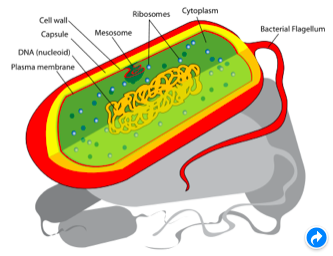
Prokaryote cell - See image
Cell wall
Cell membrane - selectively permeable , regulates passage of molecules in and out of bacteria
Nuclear region
Ribosomes made up of rRNA and protein
Capsules
Cytoplasm - containing enzymes, regulatory proteins and protein synthesis machinery
Protein functions in plasma membrane
Transport of nutrients
Energy generation
Secretion
Synthesis or peptidogylcan
Regulatory proteins
Cell wall
Provides shape and rigidity
Gram staining - divides bacteria into two groups
gram positive - peptidoglycan layer retains crystal violet-iodine complex
gram negative - liposaccharide layer washes away upon alcohol removing crystal violet-iodine complex
lipopolysaccharide membrane has a section which acts as a pyrogenic endotoxin
Peptidoglycan backbone is a polymer of two sugar derivatives each backbone linked by peptide bridge
Enzymes involved in forming peptidoglycan cross links are targets of antibiotics such as penicillin
Acid fast organisms
Peptidoglycan and lipids in the cell wall
Don't stain well with gram stain
Slow growing
Mycolic acids in cell wall.
Impedes entry of molecules
Protects from acids, alkalis and digestion in phagocytes
Responsible for inflammatory response in lungs
Mycoplasmas
Pleomorphic o cell wall
Smallest replicating organisms
No cell wall
Penicillin has no effect
Parasitic or saprophytic
Require external supply of cholesterol, amino acids and fatty acids
Cell surface structures
Flagella
-Function is motility
-Rigid structures
-Composed of flagellin (protein subunits)
-Chemotaxis (movement of bacteria towards nutrients)
-Stereotyping
-Molecular typing
Fimbriae and pili
-Hairlike structures of bacterial cells
-Attachment to surfaces-- environmental, virulence
-Sexual reproduction-- allow transfer of plasmids and so antibiotic resistance
Outer membrane proteins
Porin proteins form pores on bacterial cell surface allowing nutrients from outside into periplasmic space
Proteins that -specifically bind
-scavenge for nutrients
-enhance adhesion to/ interaction with target cells and surfaces
Capsules and slime layers
True capsule is a discrete detectable layer of polysaccharide outside cell wall
A slime layer is a less discrete structure or matrix which embeds cells
Give adherence of bacteria to particular surfaces - may be specific or non specific
Taxonomy
Two names, genus and species
Classification
Phenotype
-Shape
---coccus
---spirillum
---bacillus
-Stain
---Gram positive
---Gram negative
---Acid-Fast
-Oxygen requirements
---Aerobic 20% o2
---microaerophillic-- 4/5% o2
---anaerobic 0%
-Culture properties
-Colonial morphology
-Biochemistry reactions
genotype
-DNA based
---GC content
---Genome hybridisation i.e. %hybridised
-Phylogenetic analyses
-MLST
-Whole genome
-rRNA sequences
Information
- Description
- Vet Med 1 (ID) Note on Intro to bacteria, created by Alice Butterworth on 10/11/2017.
- Created by
- Alice Butterworth
- Views
- 0
- Rating