
Notes
Clostridia + Staphylococci
Content of the notes (2)
Page 1
Clostridia
Anaerobic
Varying
Gram negative
Produce spores
Under anaerobic conditions?Hetero genus
Most species have large battery of virulence factors
Largely saprophytic
Enzymes developed to break down
Disease
Neurotrophic
Enterotoxaemia's
Gas gangrene
Clostridium perfringens
Gas gangrene care
Virulence determinants
Major
Alpha
Beta
Epsilon
Iota
Enterotoxin (CPE)
Beta-2
NetB
Minor
Theta
Delta
Gamma
Kappa
Lambda
Mu
Nu
Sialidase
Double zone
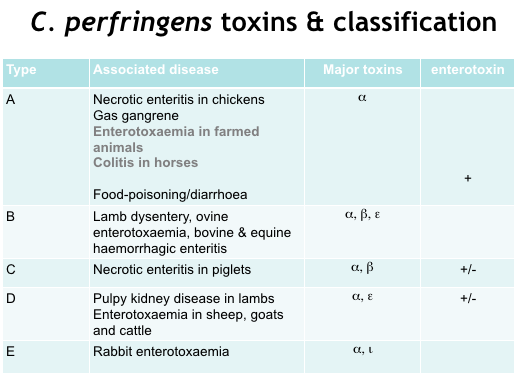
Toxins and classifications
Epsilon toxin
Activated by trypsin
Plasmid encoded
Pore forming toxin
Increases vascular permeability in the intestines kidneys ...
Type D
Associated with pulpy kidney disease
Beta toxins
Heat labile pore forming toxin
Increase capillary permeability
???
Alpha toxins
Membrane damaging toxin
Haemolytic
Cytolytic
Necrotic
Essential with theta toxin for gas gangrene
Associated with necrotic enteritis in chickens
2-5 Weeks of age
extensive production losses world Wide
poor feed conversion rates
weight loss
Mortality 5 - 50%
Net B
Cytotoxic to a chicken LMH cells
Pore-forming toxin
netB mutant unable to cause NE
Outbreak strains carry netB
Necrotic enteritis in chickens
Treatment involves antimicrobials
NE often associated in co infection
Most models require confection with eimeria
Reduction in butyrate -producing strains
Diet
High protein
High viscosity diets
Non-digestible polysaccharides
Pulpy kidney disease
Typically cause by type D
Sudden death
Predisposing factors
Changes in diet
increase in food intake
Control and prevention
Vaccination
Neutrotoxins
???
Tetanus
slide 17??
cause?
Treatment
Antitoxin
Sedation
Antibiotics
Death -resp distress
Prevention
Vaccination
Botulism
7 toxinogenic types
Cause
Intoxication - ingestion of toxin
Often outbreak
Contamination of feed
Chicken litter
Illegal to be brought on to farms or fields
Effects
Sheep
Horses
Cows
Dogs
Rarely fatal for cats
Shaker foal syndrome
Infection in gut due to lack of competitive flora
??
Toxins
Similar to teNT but diff target cells
PNS
Stimulatory motor neurons
Weakness of flaccid paralysis
Symptoms similar to colic
Diff
Bot more comfy standing , Colic more comfy lying
No tongue reflex in Bot
Usually euthanised
Grass sickness
EQS fatal neurogenerative disease
More frequent occurring in UK
Acute EGS
Fatal/ requires euthanasia
Chronic
Weightloss or dysphagia
Intensive care
Encouragement of horse to eat
Poor prognosis
Risk factors
Ingestion of agent and prod of neurotoxins
Bot C main suspect
See slide 26
Other disease
Blackleg
Braxy
Malignant oedema
Vaccination
Summary?
Page 2
Staphylococci
Aerobic
Catalase postitive
Oxidase negative
Grow in NaCL concentrations
Coagulase +ve
More pathogenic
More virulent
S. aureus
S. pseudintermedius
?
Coagulase -ve
More antibiotic resistant
?
Often -ve and +ve occupy same niche
Nomads
???
Many found in diff animals
Preffered host species
Co-evolution
Will cross species barrier
Colonisation
Carriage
Infection
S. pseudintermedius
???
Pyoderma
Alterations of skin surface micro environment
Trauma
allergic skin disease or underlying skin disease
Breed associations
Skin folds
Largely superficial
Often treatment involves use of antimicrobial
Recurring
Treat underlying disease
Treatment ofre infections if underlying disease not treated
Medicated shampoos
Other diseases
Greasy pig disease
S.hyicus
Bumblefoot
Turkeys and chickens
S. gallinarum / S.aureus oother staph spp
S. aureus disease
Skin + soft tissue infection
???
Inasive infections
>???
Toxinoses
Due to production of toxins
Food poisoning
Scaled ski syndrome
Toxic shock syndrome
Virulence determinants
????
Stick - Adhesions
Surface proteins allow attatchment
fnbA fnbB
Promot adhesion to collagen
Clumping factor - Stick and stealth
Fibrin/Fibrinogen binding ???
Protein A - stealth
Surface associate protein
used for molecular typing
Capsuar polysaccharides
Potent access potentiators
Prevents phagocytosis
Important in mastitis
???
Immune evasion
Chemotaxix inhib protein
???
Other toxins
????
MRSA
Resistance conferred by mega gene
Alt penicillin binding protein
Encoded on a mobile gene cassette
Typing of isolates
???
Epidemiology in humans
nosocomial infections
two predominant strains
Community associated MRSA
In animals
Dogs ?
Horses ?
Livestock?
Resistant to ?
All B - lactam antimicrobials
Fluoroquinolons
MRSP
More multi drug resistance
Hospital acquired
Can be carried on mucosal surfaces for up to 11 months within hospitals
??
Resistant to?
see slide 56
What should we screen for MRSA/MRSP?
?
At risk patients
Dogs and cats
???
Horses
??
summary?
Information
- Description
- Vet Med 1 (ID) Note on Clostridia + Staphylococci, created by Alice Butterworth on 29/01/2018.
- Created by
- Alice Butterworth
- Views
- 2
- Rating