
Quiz
Mechanisms of Cell injury
Este quiz tem tipos de pergunta que abrem no player de sempre.
Perguntas do quiz (12)
1Terminology:
1. [blank_start]aetiology[blank_end]: cause of disease
2. [blank_start]pathogenesis[blank_end]: the mechanism of how disease develops
3. [blank_start]morphological changes[blank_end]: structural changes in tissues and organs
4. [blank_start]clinical significance[blank_end]: functional consequences
5. [blank_start]antemortem[blank_end]: before death
6. [blank_start]postmortem[blank_end]: after death
7. [blank_start]anatomical pathology[blank_end]: postmortem and tissue biopsy
8. [blank_start]gross pathology[blank_end]: postmortem with naked eye
9. [blank_start]histopathology[blank_end]: postmortem with microscope
10. [blank_start]clinical pathology[blank_end]: analysis of body fluids and cells- Aaetiology
- Bpathogenesis
- Cmorphological changes
- Dclinical significance
- Eantemortem
- Fpostmortem
- Ganatomical pathology
- Hgross pathology
- Ihistopathology
- Jclinical pathology
2ATP depletion is caused by [blank_start]hypoxia[blank_end] resulting in [blank_start]decreased[blank_end] oxidative posphorylation, [blank_start]decreased[blank_end] ATP, [blank_start]increased[blank_end] anaerobic glycolysis, [blank_start]decreased[blank_end] glycogen and decreased pH. the sodium potassium pump fails and ribosomes [blank_start]detach from[blank_end] the RER.
- Ahypoxia
- Bfree radicals
- Cdecreased
- Dincreased
- Edecreased
- Fincreased
- Gincreased
- Hdecreased
- Idecreased
- Jincreased
- Kdetach from
- Lattach to
3the three main causes of membrane damage are:
1. [blank_start]free radicals[blank_end] that cause lipid peroxidation
2. [blank_start]direct damage[blank_end] from chemicals, viruses etc.
3. [blank_start]Hypoxia[blank_end] resulting in ATP depletion.- Afree radicals
- Bdirect damage
- CHypoxia
4the most reactive oxygen species are [blank_start]superoxide[blank_end], [blank_start]hydrogen peroxide[blank_end] and [blank_start]hydroxyl radical[blank_end].
- Asuperoxide
- Bhydrogen peroxide
- Chydroxyl radical
5which of the following are sources of free radicals?
- Aby-products of oxidative metabolism
- Bphagocytic cells
- Cmetals
- Dorganophosphates
- Ereperfusion following necrosis
- Freperfusion following ischaemia
- Gradiation and UV light
- Hdrug and chemical exposure
- Initric oxide.
6free radicals injure cells via:
1. [blank_start]lipid peroxidation[blank_end] leading to extensive membrane damage
2. [blank_start]DNA damage[blank_end] which causes sing strand breaks
3. [blank_start]protein damage[blank_end] which causes the oxidation of amino acids- Alipid peroxidation
- BDNA damage
- Cprotein damage
7two patterns of reversible cell injury include:
1. [blank_start]hydropic degeneration[blank_end]: acute cell swelling due to fluid influx
2. [blank_start]fatty change[blank_end]: cell swelling due to lipid accumulation- Ahydropic degeneration
- Bfatty change
8increased cytosolic calcium is associated with reversible cell injury.
- AVerdadeiro
- BFalso
9what type of cell injury is seen here microscopically? is it reversible?
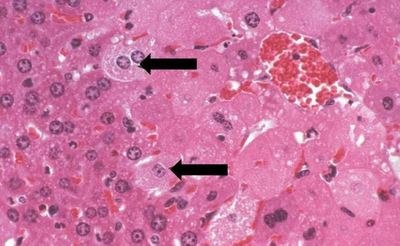
- Afatty change
- Bhydropic degeneration
- Cno it is not reversible
- Dyes it is reversible
10what type of cell injury is seen here grossly? is it reversible?
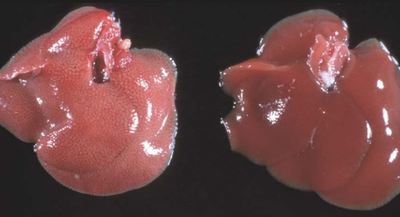
- Afatty change
- Bhydropic degeneration
- Cno it is not reversible
- Dyes it is reversible
11what type of cell injury is seen here microscopically? is it reversible?
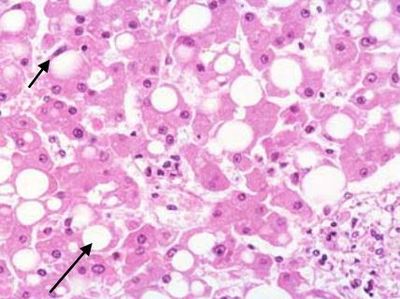
- Afatty change
- Bhydropic degeneration
- Cno it is no reversible
- Dyes it is reversible
12what type of cell injury is seen here grossly? is it reversible?
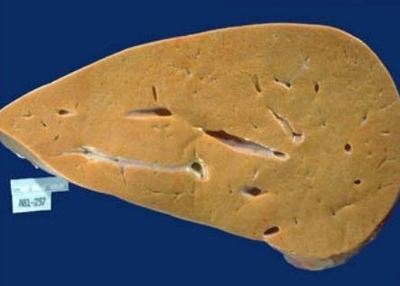
- Afatty change
- Bhydropic degeneration
- Cyes it is reversible
- Dno it is not reversible.
Informações
- Descrição
- Pathology (Introductory principles) Quiz sobre Mechanisms of Cell injury, criado por Kayleigh Van em 19-10-2016.
- Autor
- Kayleigh Van
- Idioma
- English
- Visualizações
- 265
- Etiquetas
- Avaliação
- Ainda sem avaliações Avalie este quiz