
Flashcards
Biomolecules
Flashcards do conjunto (86)
- 1What is a sugar?A carbonyl group (CHO)
Multiple OH groups - 2Sugars can beTrioses (3 carbon sugars)
Pentose (5 carbon sugars e.g. ribose)
Hexose (6 carbon sugars e.g. fructose and glucose) - 3What sugars form ring structures and release water?Pentose and hexose
- 4What is a Carbohydrate?Carbohydrates include sugars and sugar polymers
polymers of glucose joined together in the ß 1-4 linkage confirmation - 5how does maltose formWhen glucose is joined to glucose, it forms a glycosidic linkage
- 6How is sucrose formedWhen fructose is joined to glucose it again forms a glycosidic linkage
- 7What is starcha storage unit for glucose
- 8What do chloroplasts makesugar
- 9What do monomers makeprotein
- 10Where can triglycerides be foundin droplets in fatty tissue that is a long carbon chain joined by using a glycerol molecule
- 11What is a fat?Triglycerides
Sterols
Phospholipids (also glycolipids) - 12What are phospholipidsHave a long fatty chain like triglycerides
They have a hydrophilic group attached to the glycerol molecule - 13What is hydrophilliclikes water
have electrically charged side chains - 14What is hydrophobichates water
- 15What happens in the lipid bilayerhydrophilic heads are closer to the water whereas the hydrophobic tails are further away from water
- 16What is cholesterol needed forStabilise our membranes
- 17What is a protein?Proteins are made of amino acids
- 18What do amino acids containAn amino acid group (NH2)
An acid group (carboxyllic acid)
Other structures involving carbon, sulphur etc. - 19What is hydrophobicity determined bynon-polar side groups
- 20How are polar side chains formedformed by hydroxyl groups or they will contain other amino groups
When protonated, considered basic - 21What is a polypeptide1. sequence of amino acids, proteins are joined by peptide bonds
Secondary structure: internal bonding within polypeptide molecules
Tertiary structure: pattern of folding conferred by hydrophilic and hydrophobic interactions within the molecular structures
Quaternary structure: assembly of more than one polypeptide into a complex protein - 22what is every fourth amino acid bonded by in the double helox of the alpha helixhydrogen
- 23what is the sructure of the beta pleated sheeteach sheet is parallel to another and joined by a hydrogen bond
These two structures combined form a tertiary structure - 24what forms the quartenary structureTwo large polypeptide bonds form one large protein
- 25What is a nucleic acid?Ribonucleic acid (RNA) - transmits instructions from DNA
Deoxyribonucleic acid (DNA) - stores information
Nucleic acids are polymers of Nucleotides - 26What is a nucleotide1. Ring structures
2. A 5-carbon sugar (Pentose)
3. Phosphate (one or more) - 27What forms nucleic acidsNucleotides are joined together to form polynucleotides
- 28What is found in RNAUracil
- 29What is found in DNAThymine
- 30Where does DNA occurNucleus
transcribed to synthesise protein, transcribed to RNA, RNA leaves nucleus and through ribosome it is the code contained in nucleotide sequence on the mRNA. used to synthesise protein using amino acids (occurs in cytoplasm) - 31What is ATPThe cells energy shuttle
Provides energy for cellular functions - 32How is energy released from ATPwhen the terminal phosphate group is hydrolysed
ATP + H2O -> ADP + ∆G = 30.5 kJ/Mol - 33What are prokaryotesBacteria, Archaea
- 34What are eukaryotesprotists, plants, animals and fungi
cells are smaller and similar to prokaryotic cells - 35What does a prokaryotic cell containDNA is contained in nucleoid region
Ribosomes
Plasma membrane
Cell wall - 36What happens in the nucleolusRibosomes are synthesised
DNA is contained in chromatin
(wrapped around proteins) - 37What does the nuclear envelope containStructure of membrane
Nucleus surrounded by two membranes
Not sealed off cytoplasm
Has pores - 38What are ribosomesMade up of protein and RNA
Large subunit and small subunit
Synthesises protein
Attached to the endoplasmic reticulum - 39What is GolgiStacks of flattened membranous sacs; has polarity (cis and trans faces)
Function: modifies proteins, carbohydrates on proteins, and phospholipids
synthesis of many polysaccharides and sorting of Golgi products - 40What is the function of a lysosomebreakdown of ingested substances
Membranous sac of hydrolytic enzymes (in animal cells) - 41What does the mitochondiron consist ofOuter membrane
DNA
Inner membrane
Cristae
Matrix
Intermembrane space (essential for the transfer of energy)
Ribosomes - 42What does a plant cell containLarge central vacuole
Large membrane-bounded vesicle
Cell wall
Chloroplast
digestion, storage, water balance, cell growth and protection - 43What is a chloroplastTwo membranes around a fluid stroma, contains thylakoids stacked into grana
Function: photosynthesis - 44What is an enzymeA chemial agent that speeds up a reaction without being consumed by the reaction
An Enzyme is a catalytic protein - 45What are the main functions of enzymesAccelerate reactions
Are specific for substrates
Are not produced or consumed in reactions
Are proteins - 46What are the functions of enzymes as catalystsThe active site can lower an EA barrier by
Orienting substrates correctly
Straining substrate bonds
Providing microenvironment
Too much hear can destroy enzyme structure - 47What are cofactorsAre non-protein enzyme helpers
Zinc - 48What are co-enzymesAre organic cofactors
Vitamins, Acetyl CoA - 49What are the Inhibitors of Enzyme activityDecrease enzyme activity.
Competitive - complete with substrate from the same binding site
Non-competitive - bind enzyme in other location (allosteric site), altering shape - 50What are the activators of enzyme activityincrease enzyme activity
Bind to allosteric sites and keep enzymes in active configurations - 51What are the competitive inhibitors of enzymesBind to active site of enzyme
Compete with substrate
Inhibitor binds to active site and prevents substrate binding - 52What are the non-competitive inhibitors of enzymesBind to another part of the enzyme (not active site) changing the function
Binds to enzyme at non-active site, altering conformation of enzyme to ensure active site no longer functions - 53What is allosteric regulationa proteins fuction at one site is affected by the binding of a regulatory molecule at another site
Many enzymes are allosterically regulated
Used to control enzyme sequences - 54What do obligate aerobes haveoxygen
- 55What do facultative anaerobes havePrefer oxygen
- 56What causes obligate anaerobes to dieKilled by oxygen
- 57where can anaerobic organisms be foundOcean sediments
Human lower intestine and appendix
Stomachs of ruminant animals
Infected wounds
Between teeth/tongue pits - 58What does fermentation involveProduces ATP via substrate-level phosphorylisation
Uses organic substance as final electron acceptor
(e.g. pyruviate, acetaldehyde)
Used by most organisms when o2 is limited - 59What does anaerobic respiration involveelectron transport chain
Produces ATP via oxidative and substrate-level phosphorylisation
Uses inorganic substance as final electron acceptor (e.g. nitrate, sulphate)
Uses mainly by bacteria in anaerobic environments - 60What does aerobic respiration involveUses an electron transport chain
Produces ATP via oxidative and substrate level phosphorylisation
oxygen as final electron acceptor
Used by plants, animals and prokaryotes - 61What do membranes allowSeparation of cellular activities
Gatekeeper of what enters and exits cells - 62What are membranesphospholipids, proteins, sterols and carbohydrates
Polar = like water
Hydrophobic + hydrophilic = amphipathic
Membranes are formed from phospholipids arranged into bilayers - 63What are integral proteinspenetrate the hydrophobic core of lipid bilayer
transmembrane proteins spanning the membrane
Higher number of hydrophilic amino acids
Higher number of hydrophobic amino acids - 64How do you demonstrate the fluidity of membranesCells fused
Proteins quickly mix
Saturation of fatty acids in phospholipids of the bilayer: high saturation = decreases fluidity - 65What is the role of sterolsStabilise membranes Cholesterol - reduces fluidity at moderate temperatures
Keeps membranes fluid at low temperatures
Increases strength
plants use sterols to control fluidity over different temperature ranges - 66Where do membrane carbohydrates formOn the surface of membrane
Carbohydrate attached to protein = glycoprotein
Carbohydrate attached to lipid = glycolipid - 67What is the role of membrane carbohydrates in cell-cell recognitionCells bind to surface molecules on the extracellular surface the plasma membrane.
Carbohydrates on the external side of plasma membrane vary among species, individuals and even cell types in an individual - 68What are the peripheral membrane proteinsHydrophillic
Easily washed off - 69What are integral membrane proteinsAmphiphatic
Difficult to dissolve - 70What is the role of membrane carbohydratesGlycolipids, glycoproteins cell recognition
Self' recognition
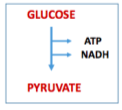
A,B,O blood group - 71What is the glycolysis cycle
- 72What is the cellular respiration formula

- 73What are the steps in the citric acid cycle

- 74What is the photosynthesis/respiration cycle
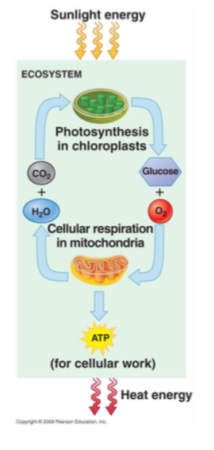
- 75How is hydrogen extracted from bonds by Dehydrogenases
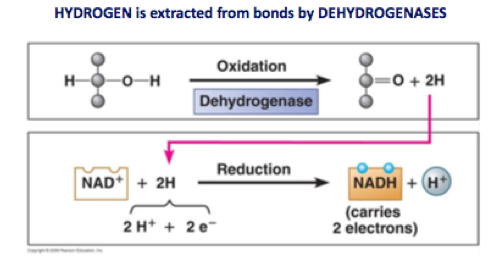
- 76What is the electron flow cycle in respiration
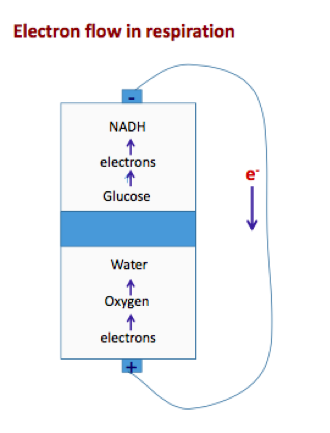
- 77Where does photosynthesis occurPlants, prokaryotes, algae and certain protists
- 78What is the difference between the action spectrum and the absorption spectrumAn action spectrum describes the wavelength of light that are the most effective at driving photosynthesis
An absorption spectrum describes the wavelengths of light that are absorbed by pigments - 79What are the two possible routes for electron flow during the light reactions of photosynthesisNon-cyclic electron flow
Cyclic electron flow - 80What is cyclic electron flowUses only Ps I
Only generates ATP
Active in far-red light
Does not release O2 - 81What is non-cyclic electron flowUses both PS I & PS II
Generates ATP and NADPH
Releases O2 - 82What is the most abundant protein on earth?Rubisco
- 83What reaction does Rubisco catalyse

- 84What is the product of carbon fixation?3-phosphoglycerate (3 carbons) = C3 photosynthesis
- 85What are the three stages of the calvin cycleCarbon fixation
Reduction
Regeneration - 86What are the inputs to the Calvin cycleMore ATP is needed than NADPH
ATP and NADPH are produced by non-cyclic electron flow
Extra ATP can be produced by cyclic electron flow
Informações
- Descrição
- Tertiary Concepts in Biology FlashCards sobre Biomolecules, criado por Olivia Gniadek em 07-05-2018.
- Criado por
- Olivia Gniadek
- Visualizações
- 10
- Tags
- Avaliação