
Flashcards
Proteins
Flashcards do conjunto (59)
- 1What is the structure of proteins vital to?Their function
- 2Describe the general structure of proteins?Conserved across proteins i.e. recognisable elements/part but with modification of 3D structure to achieve specific function
- 3What else determines the function of a protein - what in turn determines those?1) Chemistry and shape
2) Amino acid composition (different amino acids have different chemical and structural properties) - 4What are the levels of structure?1) Primary
2) Secondary - 2D fold, hydrogen bonds
3) Tertiary
4) Quaternary - interaction of subunits - 5How is a protein always read?From the N terminus (amine group) to the C terminus (carboxyl group)
- 6Describe the structure of an amino acid. What determines the identity of an amino acid?Amino group (NH2) attached to a central carbon and then a carboxyl group. The R group attached to the central carbon determines the identity of the amino acid.
- 7Give some examples of the different ways in which amino acids are classified.Size, charge, pH, etc.
- 8Which are the non-polar aliphatic side groups amino acids? (6)1) Glycine, G
2) Alanine, A
3) Valine, V
4) Leucine, L
5) Methionine, M
6) Isoleucine, I - 9Which are the amino acids which are polar, with uncharged side groups?1) Serine
2) Threonine
3) Cysteine
4) Proline
5) Asparagine
6) Glutamine - 10Which amino acids have aromatic side groups?1) Phenylalanine, F
2) Tyrosine, Y
3) Tryptophan, W - 11Which are the amino acids which have positively charged side groups?1) Lysine, K
2) Histidine, H
3) Arginine, R - 12Which are the amino acids which have negatively charged side groups?1) Glutamate, E
2) Aspartate, D - 13How are amino acids held together in a protein?Peptide bond between the carboxyl and amine group - formed during translation via peptidyl transferase activity of the large ribosomal subunit, leads to production of water.
- 14Describe the characteristics of the peptide bond between two amino acids.In 3D the bond is planar (i.e can't twist around it). The peptide bond can undergo hydrogen bonding which is important for holding proteins together.
- 15When is a peptide chain classified as a protein?When there are more than 50 amino acids.
- 16How many amino acids are in a protein? What is there huge potential for?1) 50-2500 amino acids but there can be as many as 5,000
2) Huge variation - although not all combinations exist as not all of them are useful - 17What determines secondary structure?The interaction between the peptide bonds via hydrogen bonding
- 18What are the two main types of secondary structure?a-helix and B-sheet
- 19Describe the orientation of amino acids in an alpha helix.The N terminus is at the top of the structure. R groups point outwards (exposed to, and able to react with, anything in the environment). The hydrogen bonds run vertically between H and O of distinct peptide bonds.
- 20Which amino acid is the exception to the description in the previous card?Proline - its R group forms a loop structure. This prevents it from forming part of a helical structure as it is unable to twist. As such proline is usually found at the end of a helix - or within but this breaks the helix.
- 21Describe the structure of a B sheet.A flat sheet, peptide chains run along one plane while hydrogen bonds run along another - form between amide links. The strands can be parallel or antiparallel. Chains are linked by other molecules at the ends - antiparallel configuration requires small loops while a parallel configuration requires large loops.
- 22What is the function of hydrogen bonds?Stabilise the structure.
- 23How can beta sheets form a 3D structure?By stacking one on top of the other.
- 24What does 'disorder' refer to in protein structure? What is this useful to? What are these residue usually?While technically not a secondary structure, regions of protein can be wholly disordered. There are regions of protein which are not formed in an orderly manner. Regions of disorder interact with solvent inside out cells (water). As such these residues are usually hydrophilic (often rich in polar residues). The interaction of disordered regions are important in forming larger structures - can become ordered as they interact (key forming in a lock)
- 25How do tertiary structures usually form? What are they usually composed of? Give examples (3).1) Can involve interaction with peptide bonds if they're not being used up for hydrogen bonds for the secondary structure.
2) Can be made of B sheets only - such as beta bowel, found in bacteria; alpha only; alpha & beta. - 26What do tertiary structures exist as?Single units
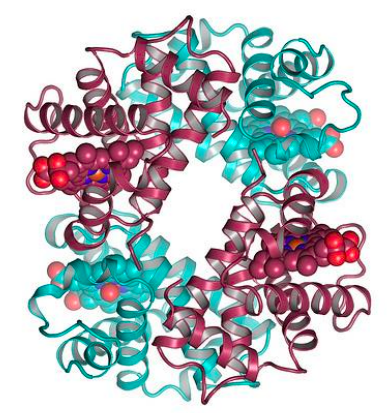
- 27What is this? What is the blue component?1) Haemoglobin (4 subunits)
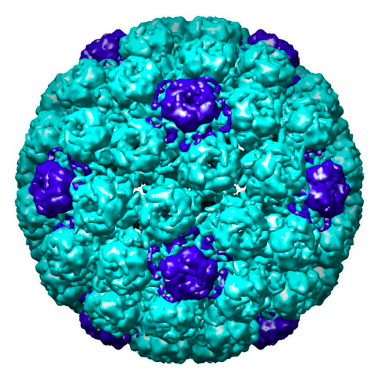
2) Myoglobin - important for carrying oxygen - 28What is a quaternary structure?Multiple tertiary subunits come together, can be homo or hetero.
- 29What is this?SV40, a viral capsid which is made of a quaternary protein complex to coat viral RNA.
- 30Describe the structure of collagen. Consider: 1) Primary and tertiary structure 2) How tensile strength is achieved1) The primary structure of collagen contains many repeating motifs (Pro-Pro-Gly) which consequently means that it cannot form a helix (because of proline). However the primary collagen can interact with each other via glycine to form a triple helix.
2) Tight packing of the chains results in strong hydrogen bonding & cross-linking (i.e. through covalent disulphide bonds which occur due posttranslational modification) between side groups of amino acids. - 31Through which side groups is bonding particularly prevalent within the triple helix?Cysteines and lysines.
- 32What can cause collagen to become weak?Even small changes in amino acids (such as point mutations) can have a large effect on the bonding of collagen within the triple helix and make it considerably weaker.
- 33How are proteins generally named? (Give two examples within one category)Based on 3D structure i.e. fibrous and globular
- 34Describe the globular proteins - how common are they?1) Overall globular shape, with a mix of secondary structures
2) Majority of proteins are globular - 35Describe the structure of fibrous proteins. What are they often dominated by? What do they tend to be?1) Extensive packing of secondary structure
2) Often dominated by one type of secondary structure
3) Can form structural proteins (e.g. collagen or keratin) - 36What are the differences in protein structure depending on the amount of intramolecular contacts and intermolecular contacts?More intramolecular contacts results in the protein being folded correctly - lots of intermolecular contacts can lead to amorphous aggregates, oligomers and amyloid fibrils.
- 37What is the folding problem? How does folding occur?1) For a given polypeptide chain there are a huge number of possibilities in terms of folding.
2) Folding occurs spontaneously through the hydrophobic effect and hydrogen/polar bonding. - 38What is folding driven by and how does it end up in its native state?Driven by reducing energy - native protein conformation is the lowest energy state and most stable.
- 39What is the hydrophobic effect? How does this help drive protein folding? What is the exception?1) An entropic effect, it is energyetcially beneficial for hydrophobic substances to attempt to refuce their surface area (when in water) in order to reduce interaction with water.
2) There are a class of amino acids which are hydrophobic (such as glycine and alanine). This helps to drive protein folding by driving hydrophobic amino acids to the centre of the structure.
3) The exception are proteins located in the say the cell membrane, where lipids are the main substance, this results in the reverse of the effect in water. - 40What can happen to proteins which don't fold spontaneously?These can end up forming larger non-useful structures which are then usually unfolded by protein chaperones.
- 41List three factors which can unfold proteins.1) Heat
2) pH
3) Detergent - 42What are chaperones/heat shock proteins? When do their levels increase?1) Help fold many proteins
2) increase when the cell is subjected to stress e.g. heat shock - 43How do molecular chaperones/heat shock proteins work? (2) Give examples for each.1) Some bind to hydrophobic residues and prevent hydrophobic effect driven folding (e.g. HSP70)
2) Some act to protect the folding protein from the cytoplasm i.e. a unique environment e.g. GroEL - separates protein from the surrounding environment, provide energy to prevent incorrect folding. - 44What do chaperones often do?Use ATP to provide energy to the folding process.
- 45How does the GroEL/ES system work?Unfolded substrate proteins bind to a hydrophobic binding patch on the inside of the interior rim of the open cavity of GroEL. Then with the additional binding of ATP, this induces a conformational change that allows association of the binary complex with a separate structure GroES. This causes the subunits of the chaperon to rotate such that the hydrophobic substrate is binding site is removed from the the interior of the cavity, causing the substrate protein to be ejected from the now largely hydrophilic chamber. The hydrophilic environment now favours the burying of the hydrophobic residues of the substrate, inducing substrate folding. Hydrolysis of ATP and binding of a new substrate protein to the opposite cavity sends an allosteric signal causing the GroES and the encapsulated protein to be released into the cytosol. A given protein will undergo rounds of multiple folding, returning each time to its native unfolded state, until native conformation is reached.
- 46What are the causes of misfolding proteins? (2)1) Inherited mutations
2) Environmental stress - 47What are the different mechanisms by which misfolding can cause disease? (3)1) Loss of function
2) Toxic gain of function
3) Dominant negative - 48Give examples of neurodegenerative diseases which occur due to misfolding proteins?1) Alzheimer's
2) Parkinson's - 49Give an example of a metabolic disorder which arises due to misfolded proteins?1) Monogenic obesity
- 50Which protein can misfold to cause cancer?p53
- 51What are the different types of post translational modification? (4)1) Addition of other functional groups (Acetate, phosphate and lipids)
2) Addition of other protein/peptides (Ubiquitination, sumoylation, neddylation)
3) Changing the chemical nature of amino acids (deamination, elimination)
4) Structural changes (disulphide, cleavage) - 52How is a protein phosphorylated? What is phosphorylation important for?1) Phosphate added to an R group - kinases phosphorylate, phosphatases dephosphorylate
2) Very important in cell signalling and enzyme activity - provides an 'On/Off' switch, which needs to be rapid (would be too slow if arose from genome translation) - 53What are disulphide bridges? Why are disulphide bridges important? What does the formation of a disulphide bridge require?1) Covalent links between cysteine residues.
2) Stabilises 3D structures and important for structural changes
3) Requires a specific environment to form - often found extracellularly. - 54What is cleavage important for? Give an example,Can be used to change protein structure after translation i.e. in the digestive system. Useful for insulin which is initially produced as one long chain (preproinsulin). Part of the chain is then removed to form proinsulin and then insulin (which consist of two chains following the removal of chain C)
- 55What are membrane anchors important for? How are they made?1) Anchor a protein to one side or the other of a membrane
2) Can either be linked by a) a fatty acid or by b) a prenyl group c) a myristyl anchor d) farnesyl anchor e) glycosylphosphatidylinositol (GPI) anchor - 56What is ubiquitination?Ubiquitin marks proteins for degradation (if multi ubiquinated) As the protein gets multi ubiquitinated it gets taken up by a proteasome (i.e. 26S) for degradation. A single ubiquitin marker can just be involved in regulation of processes (mono ubiquitination)
- 57What are the different enzymes etc. which can be associated with ubiquitin?1) Ubiquitin-activating enzyme
2) Ubiquitin-conjugating enzyme
3) Ubiquitin ligase - 58What is deamination?An unavoidable chemical reaction physiological reaction whereby an NH3 group is lost and 2 H20 is added. This results in structural changes and therefore protein damage.
- 59How can this process be reversed? What is the limit?1) The process can be reversed/reduced by removing reactive species from the cytosol
2) The process cannot be completely stopped - hence all proteins have a limited life span and therefore ubiquitination is required.
Informações
- Descrição
- Dr M Roberts 10/10/17
- Criado por
- Anna Hogarth · out 2017
- Atualizado
- 3 fev 2018
- Visualizações
- 1
- Avaliação