
Flashcards
Attachment
Flashcards do conjunto (34)
- 1AttachmentAn emotional bond between two individuals.
- 2Caregiver-infant interactions: ReciprocityHow two people interact.
Mother-infant interaction is reciprocal as mother and infant respond to each other's signals and each elicit a response from one another. - 3Caregiver-infant interactions: Interactional SynchronyMother and infant reflect both the actions and emotions of the other and do this in a coordinated and synchronised way.
- 4Evaluation of care-giver interactionsStrength:
Controlled lab experiments.
This is because mother-infant interactions are well-controlled procedures, with both mother and infant being filmed.
This means that very fine details are recorded and analysed. The participants also do not know they are being observed so their behaviour will not change.
Therefore, the research has good validity.
Weakness:
Hard to know what is happening when observing infants.
This is because mother and infant interactions show the same patterns and are merely only hand movements and expressions.
This means that it is very difficult to determine what is taking place from the infant's perspective.
Therefore, the research is unreliable. - 5Attachment figures: Parent-infant attachmentSchaffer and Emerson(1964) found that the majority of babies form primary attachments to their mothers around 7 months.
Within a few weeks secondary attachments are formed with other family members including fathers. At 18 months 75% of the babies had formed an attachment to their father. - 6Attachment figures: The role of the fatherGrossman(2002) carried out a longitudinal study into how parents behaviour effects the quality of an attachment.
He found that many children form a close nurturing bond with mothers and a playful and creative bond with fathers.
This shows that fathers have a different role in attachment- One that is to do this with play, stimulation and problem solving.
Mothers attachment is to do with nurturing. - 7Attachment figures: Fathers as primary carersTiffany Field(1978) filmed 4-month old babies in face-to-face interactions with primary caregiver mothers, fathers and secondary caregiver fathers.
She found that primary caregiver fathers adapt the role of a mother and spend more time smiling and imitating with the infant than the secondary caregiver.
This behaviour seems to be important when developing an attachment, so the key to attachment is the level of responsiveness not the gender. - 8Evaluation of Attachment figuresWeakness:
Children without fathers do not develop differently.
McCallum and Golombok(2004) found that children growing up in single/same sex families do not develop any differently from those in heterosexual families.
This means that the fathers role as the secondary attachment figure is not important in the infants development.
Therefore, the research is unreliable.
Weakness:
Inconsistent findings
This is because psychologists have been interested in different research questions. Some have looked at the role fathers have in secondary attachments and others have looked at their role in primary attachments.
This is problematic as psychologists cannot determine what the role of the father actually is.
Therefore, the reseach lacks validity. - 9Schaffer and Emerson(1964)Aim-Investigate the formation of early attachments.
Method-60 babies and their mothers were visited at home every month for the first year and again at 18 months. The researchers tested separation and stranger anxiety.
Findings-Between 25-32 weeks of age 50% of the babies showed separation anxiety towards a particular adult(Specific attachment). By the age of 40 weeks, 80% of the babies had a specific attachment and 30% had formed multiple attachments. - 10Evaluation of Schaffer and Emerson's studyStrength:
Good external validity
This is because most of the observation was actually done by the parents themselves.
This means that the behaviour of the babies was natural and not affected by the presence of observers.
Therefore, the study has good external validity.
Strength:
Longitudinal design
This is because the study was carried out longitudinally.
This means that the same children were followed-up and observed regularly.
Therefore, the study has high internal validity with confounding variables being controlled.
Weakness:
Limited sample characteristsics
This is because the data gathered on the 60 babies and their carers was taken from the same district and social class within the same city.
This means that their child-rearing practices would of been very similar and very different to other cultures and generations.
Therefore, the reuslts cannot be generalised to the latter of the population. - 11Schaffer's stages of attachmentStage 1-Asocial
The baby is recognising and forming bonds with its carer. The baby's behaviour towards human objects and humans is similar.
Stage 2-Indiscriminate
From 2-7 months baby's show a preference for humans rather than objects. They also prefer familiar adults. They do not show separation or stranger anxiety.
Stage 3-Specific attachments
Around 7 months baby's start to show stranger anxiety and separation anxiety. The baby forms a specific attachment to a primary attachment figure.
Stage 4-Multiple attachments
Soon after, baby's start to show multiple attachments to other adults with whom the regularly spend time with. These relationships are called secondary attachments. - 12Evaluation of the stages of attachmentWeakness:
Problem studying the asocial stage
This is because within this stage babies have poor coordination and are generally immobile.
This means that it is therefore very difficult to make any judgments about their behaviour based on the observations.
Therefore, the evidence is unreliable.
Weakness:
Measuring multiple attachments
This is because there may be a problem with how it's assessed. Just because a baby gets distressed when an individual leaves the room does not mean they have an attachment to that person.
Bowlby pointed out that children also get distressed when a playmate leaves the room but that does not signify an attachment.
This is a problem for Schaffer and Emmerson's stages because their observation does not leave us a way to distinguish between behaviour shown towards a primary or secondary attachment figure. - 13Animal studies of attachment Lorenz's researchAim-To investigate imprinting.
Procedure-Divided a clutch of goose eggs. Half the eggs hatched in their natural environment with their mother an the other half hatched in an incubator with Lorenz.
Findings- Once hatched, the incubator group followed Lorenz and the the control group followed their mother. When the 2 groups where mixed they continued to follow the first moving object they had seen.
Conclusion- Imprinting generally happens to the first moving object seen and has to take place within a critical period.
Imprinting also has an impact on mate preferences known as sexual selection. - 14Evaluation of Lorenz's studyWeakness:
Problem Generalising to humans
This is because Lorenz's study used birds which makes it difficult to generalise to humans as mammalian attachment is very different.
This means that it is not appropriate to generalise any of Lorenz's ideas to humans.
Therefore, the study is unreliable.
Weakness:
Questionable observations
This is because Guiton et al(1966) found that chickens imprinted on yellow washing up gloves. As they grew older they tried to mate with them. However, with experience they learned to prefer mating with real chickens.
This means that the impact of imprinting is not as permanent as Lorenz believed.
Therefore, his research is unreliable. - 15Animal studies of attachment Harlow's researchAim-To investigate the importance of contact comfort.
Procedure-Harlow reared 16 baby rhesus monkey's with two wire model 'mothers'. In one condition milk was dispensed by a plain wire and in the second condition the milk was dispensed by the cloth-covered mother.
Findings-The baby monkeys cuddled the soft object in preference to the wire one. They also sought comfort from the soft object when frightened regardless of which dispensed milk. - 16Evaluation of Harlow's studyStrength:
Theoretical and Practical Value
This is because Harlow's findings have showed that attachment does not develop as the result of being fed by a mother but as a result of contact comfort. Harlow's research has also had important applications in a range of practical contexts i.e Helped social workers understand the risks of child neglect and abuse so they can intervene.
Weakness:
Ethical issues
This is because the monkeys suffered greatly as a result of Harlow's procedures. As the monkeys are similar to humans the results were able to be generalised. However, this also means that their suffering was human-like.
Therefore, the research unethical. - 17Explanations for attachment: Learning TheoryA set of theories from the behaviourist approach in psychology, that emphasises the role of learning in the acquisition of behaviour.
Classical conditioning:
Learning to associate 2 stimuli together. This is so each stimuli elicits the same response.
Conditioning of attachment:
Unconditioned stimulus(Food)-Unconditioned response(Pleasure)
Neutral stimulus(Mother)-No response
Unconditioned+Neutral stimulus(Food+Mother)-Unconditioned response(Pleasure)
Conditioned stimulus(Mother)-Conditioned response(Pleasure)
Operant conditioning:
Learning is an active process whereby you learn to repeat or not to repeat certain behaviour based on their consequences. Positive reinforcement occurs when behaviour is rewarded. Negative reinforcement occurs when unwanted feelings or discomfort is removed.
The interplay of mutual reinforcement strengthens an attachment.
Drive reduction
Hunger can be thought as the primary drive. Attachment is the secondary drive learned by association between the caregiver and the satisfaction of the primary drive. - 18Evaluation of Learning TheoryWeakness:
Counter-evidence
This is because animal studies have shown that young animals do not necessarily attach to/imprint on those who feed them.
This means that attachment does not develop as a result of feeding so the same must be true for humans.
Therefore, the learning theory for attachment must be unreliable.
Weakness:
Counter-evidence
This is because research with human infants also shows that feeding does not appear to be an important factor in humans. In Schaffer and Emerson's study, many of the babies formed an attachment with those who spent the most time with them rather than who fed them.
This means that feeding is not the key element to attachment and so there is no unconditioned stimulus or primary drive involved.
Weakness:
Other factors
This is because the research ignores the quality of attachment and the idea of reciprocity and interactional synchrony.
This means that the idea of cupboard love is hard believe as we would expect to find these complex interactions to build an attachment.
Therefore, the research is unreliable. - 19Explanations for attachment: Bowlby's Monotrophic TheoryMonotropy:
Bowlby's theory is described as monotropic because he placed great emphasis on a child's attachment to one particular caregiver (Primary attachment figure) which is different and more important than any other attachment.
The more time spent with this individual the better:
-The law of continuity
-The law of accumulated separation
Social Releasers and Critical Period:
Social releasers are a set of innate behaviours that encourage attention from adults to activate the adult attachment. The critical period refers to the time within which the attachment must form. For humans its about 2 years.
Internal working model:
Bowlby proposed that a child forms a mental representation of their relationship with their primary caregiver. They are important in affecting our future relationships because they carry our perception of what relationships are. - 20Evaluation of Bowlby's TheoryStrength:
Support for social releasers
This is because there is clear evidence to show that cute infant behaviours are intended to initiate social interactions. Brazelton et al(1975) observed mothers and babies during their interactions. He then experimented and told primary caregivers to ignore their babies signals. The babies showed distress and lied motionless. This means that interaction is very important to both the infant and caregiver.
Therefore, the theory has good supporting evidence.
Strength:
Support for the internal working model
This is because Bailey et al(2007) assessed the quality of attachments. The researchers found that mothers who reported poor attachments to their own parents were much more likely to have a poor attachment to their own child.
This means that the internal working model of attachment was being passed through the families.
Therefore, the theory has good supporting evidence.
Weakness:
Mixed evidence for monotropy
This is because in Schaffer and Emerson's study, most babies formed multiple attachment as well as forming a primary attachment. - 21Ainsworth's Strange SituationAim-A controlled observation designed to measure the security of attachment a child displays towards a caregiver.
The child is placed in a mildly stressful situation in order to observe separation anxiety, stranger anxiety, willingness to explore and reunion behaviour.
Procedure-
1.Child and caregiver enter an unfamiliar playroom. The child is encouraged to explore.
2.A stranger comes in and tries to interact with the child.
3.The caregiver leaves the child and stranger together.
4.The caregiver returns and the stranger leaves.
5.The caregiver leaves the child alone.
6.The stranger returns.
7.The caregiver returns and is reunited with the child.
Findings-3 main types of attachment - 22Types of attachmentSecure attachment(Type B)-Proximity seeking and secure base behaviour. Moderate separation and stranger anxiety. Require and accept comfort from the caregiver.
Insecure-avoidant attachment(Type A)-Do not seek proximity or show secure base behaviour. Show little or no stranger or separation anxiety. Do not require comfort from the caregiver.
Insecure-resistant attachment(Type C)-Seek greater proximity and explore less. Show huge stranger and separation anxiety. Resist comfort when reunited with their caregiver. - 23Evaluation of the strange situationStrength:
Good reliability
This is because the strange situation takes place under controlled conditions and is easy to observe.
This means we can be confident that the attachment type of an infant identified in the strange situation does not depend on who is observing them.
Therefore, the strange situation has good reliability.
Weakness:
Culture-bound
This is because cultural differences in childhood experiences are likely to mean that children respond differently to the strange situation.
This means that the strange situation cannot be applied to all infants as their responses differ.
Therefore, the results cannot be generalised.
Strength:
Support for validity
This is because the attachment types identified by the strange situation are strongly predictive of later development. Babies who were securely attached were able to form romantic relationships and friendships in adulthood. Insecure-resistant babies had difficulties forming friendships and were often bullied.
This improves the validity of the theory as it can explain subsequent outcomes. - 24Cultural VariationsCulture-The norms and values that exist within a group of people.
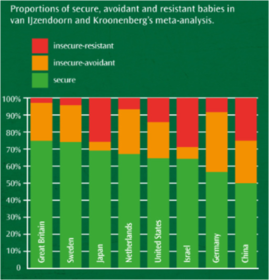
Culture Variations- The differences in the norms and values that exist between people in different groups. - 25Studies of Cultural variations: -Ijzendoorn and Kroonenberg (Aim and Procedure)Ijzendoorn and Kroonenboorg(1988)
Aim-Conducted a study into the proportions of secure, insecure-avoidant and insecure-resistant attachments across a range of countries.
Procedure-They located 32 studies of attachment where the Strange Situation had been used to investigate attachment types. The 32 studies were conducted in 8 countries to 1,990 children. The results were meta-analysed. - 26Studies of Cultural variations: -Ijzendoorn and Kroonenberg (Findings)
- 27Evaluation of cultural variations in attachmentStrength:
Large samples
This is because in van Ijzendoorn's meta-analysis 2000 babies and their attachment figures were assessed. This collection of data increases the internal validity of the study and reduces the impact of anomalies on the results. Therefore, making the research more reliable and results more generalisable to the population.
Weakness:
Samples were unrepresentative of the culture
This is because the meta-analysis by Ijzendoorn and Kroonenberg claimed to study cultural variation when in fact the comparisons were between countries not cultures. Within any country there are many different cultures, each with their own very different child-rearing style.
This means that comparisons between cultures may have little meaning. The particular cultural characteristics of the sample need to be specified.
Weakness:
Biased sample
This is because over half of the 32 studies were carried out in the USA. This dominance of American research makes the sample biased. It is too dominated by individualistic and westernised cultures so results cannot be generalised to the world. - 28Bowlby's Theory of Maternal DeprivationThe emotional and intellectual consequences of separation between a child and a mother/mother substitute.
Separation vs deprivation:
-Separation is when the child is not in the presence of the primary attachment figure.
-Only becomes an issue if the child is deprived.
-Brief separations=Not significant
-Extended separations=Harm
The critical period:
-First 30 months of life.
-If an attachment is not formed within this period then psychological damage is inevitable.
Intellectual development:
-Children will suffer mental retardation if they are deprived of maternal care for too long.
-Characterised by low IQ.
Emotional development:
-Affectionless psychopathy is the inability to experience guilt or strong emotion for others.
-Prevents the person developing normal relationships.
-Psychopaths lack remorse. - 29Bowlby's 44 thieves studyAim-To examine the link between affectionless psychopathy and maternal deprivation.
Procedure-44 criminal teens accused of stealing. They were interviewed for signs of affectionless psychopathy(Lack of affection, guilt and empathy)Their families were also interviewed and a control group was set up.
Findings-14/44 were described as affectionless psychopaths. Of this 12 had experienced prolonged separation from their mothers.
Conclusion-Prolonged early separation caused affectionless psychopathy. - 30Evaluation of Bowlby's Theory of Maternal DeprivationWeakness:
The evidence may be poor
This is because Bowlby used evidence from studies conducted in the second world war. These are flawed as evidence as war-orphans were traumatised and often had poor after-care, therefore these factors might have been the causes of later developmental difficulties rather than separation.
Weakness:
Counter evidence
This is because Lewis(1954) partially replicated the 44 thieves study on a larger scale, looking at 500 young people. She discovered that that a history of prolonged separation from the mother did not predict criminality in adulthood. This is a problem for the theory as it suggests that other factors may affect the outcome of early maternal deprivation.
Weakness:
Sensitive period
This is because Bowlby believed that an attachment must form within a critical period else long-term damage would be caused. However, later research has shown that damage is not inevitable. Some cases of very severe deprivation have had good outcomes provided the child has some form of social interaction and good after care. - 31InstitutionalisationThe effects of living in an institutional setting. i.e. A hospital or orphanage-Little or no emotional care provided.
- 32Effects of institutionalisation Romanian Orphan StudiesRutter's ERA study(2011)
Followed a group of Romanian orphans adopted in Britain to test to what extent good care could make up for bad childhood experiences.
At first the children showed signs of mental retardation . However at age 11 the children showed differential rates.
They concluded that there was a difference in outcome related to whether adoption took place before 6 months or after.
Those who were adopted after 6 months showed signs of disinhibited attachment(i.e. Attention seeking and clinginess) - 33Evaluation of the effects of institutionalisationStrength:
Real-life application
This is because Rutter's ERA study enhanced our understanding of the effects of institutionalisation which have led to improvements in the way children are cared for.
This means that research has been immensely valuable in practical terms .
Therefore, the study has real-life application.
Weakness:
Romanian Orphans were not typical.
This is because the conditions were so bad that the results collected cannot be applied to understanding the impact of better quality institutional care.
This means that the study lacks generalisability because the environment had situational variables.
Weakness-Ethical issues - 34Attachment and later relationshipsInternal working model.
Relationships in later childhood.
Relationships in adulthood with romantic partners.
Relationships in adulthood as a parent.
Informações
- Descrição
- AS - Level Psychology (AS) FlashCards sobre Attachment , criado por Ellie Shuter em 29-03-2016.
- Criado por
- Ellie Shuter
- Visualizações
- 1
- Avaliação