
763212
Descrição

FlashCards por Chloe Zaydner, atualizado more than 1 year ago

|
Criado por Chloe Zaydner
mais de 12 anos atrás
|
|
| Questão | Responda |
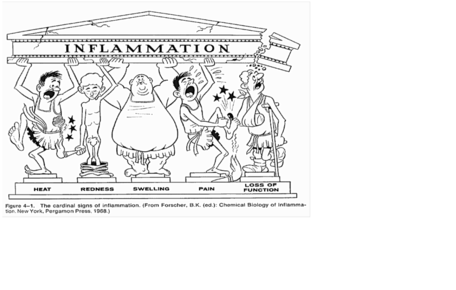
| What are the 5 cardinal signs of Acute Inflammation |
Image:
Picture1 (image/png)
|
| What are the 6 stages of emigration of neutrophils? | Rolling (selectins), Firm adhesion (integrin to ICAM1), Diapedesis (CD31 cell-to-cell adhesion molecule), Chemotaxis (C5a and LTB4), Phagocytosis (C3b and Ig) and finally Killing of bacteria (using superoxides and lysozyme |
| What stimulates release of acute phase proteins? | TNF-a, IL-6 and IL-1 |
| What are the acute phase proteins which AREN'T present in normal situations? | CRP and serum amyloid A |
| Why do blood levels of acute phase proteins rise during inflammation? | release of cytokines (IL-1, 6 & TNF-a) causes liver to synthesise more acute phase proteins. |
| What effect do prostaglandins have on endogenous pyrogen production? | Prostaglandins feed back on endogenous pyrogens and have a negative feedback mechanism. |
| How does a transudate and an exudate differ? | Transudates are ultrafiltrates of the blood with little protein and few cells so appear grossly clear. Exudates appear grossly cloudy due to high amounts of protein and cells. |
| What type of cell is frequently seen in purulent discharge? | Neutrophils |
| What occurs during the inflammatory phase of wound healing? | Haemostasis and acute inflammation |
| What 3 things occur during the proliferation phase of wound healing? | Fibrosis, angiogenesis and epithelisation (granulation tissue is formed!) |
| What happens in the maturation phase? | Collagen type III is remodelled to collagen type I |
| What are the signs of healthy granulation tissue? | Pinky-red; does not bleed easily; granular and uneven. |
| Describe the key points of bone remodelling? | Fracture causes rip in periosteum and fragments. Fragments necrose and a haematoma forms at fracture site (primary callus). The primary callus undergoes osteoclastic bone removal and structured lammelar bone replaces woven bone (secondary callus). Remodelling has finished. |
| How does gut repair? | Instead of forming granulation tissue from the margins, the serosal surface forms capillary buds - islands of granulation tissue that form fibrous adhesions between loops of gut (can lead to obstruction!) |
| What is fibrinous inflammation and how does it differ from fibrosis? | Fibrinous inflammation is an acute response leading to increased vascular permeability. There is emigration of neutrophils and fibrinogen is polymerised into strands by plasmin but is disorganised; a scaffold for subsequent fibrosis. |
| What is 'fibrosis'? | a sequel to chronic inflammation. Infiltration with mononucleur cells (macrophages, lymphocytes, plasma cells) tissue destruction and repair. |
| What are two cell types that can form from a macrophage involved in granulomatous inflammation? | Epitheliod macrophage and giant cells |
Quer criar seus próprios Flashcards gratuitos com GoConqr? Saiba mais.