
Mapa mental
ATTACHMENT
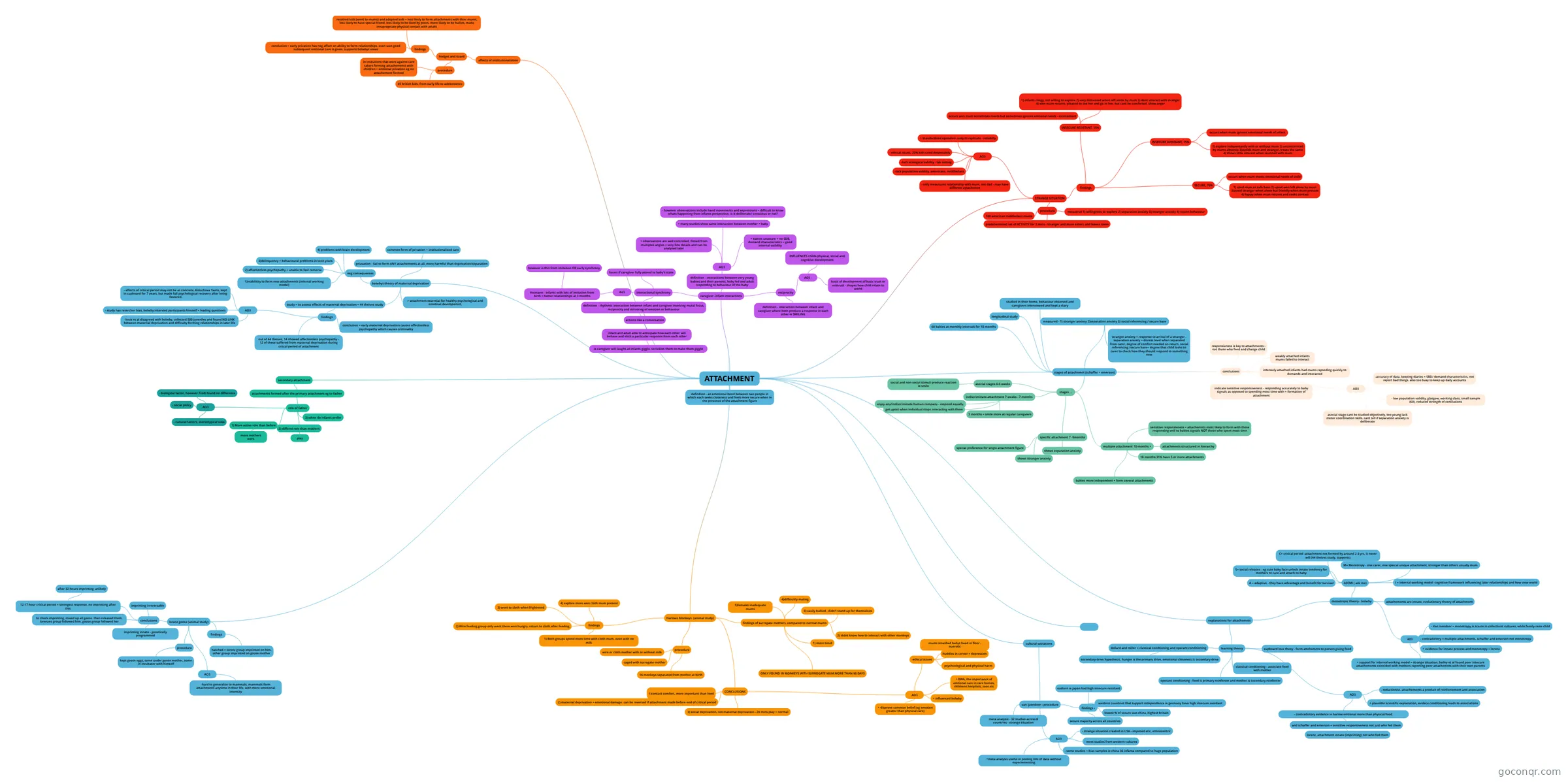
Mind map: Attachment theory and studies
Conteúdo do mapa
ATTACHMENT
definition - an emotional bond between two people in which each seeks closeness and feels more secure when in the presence of the attachment figure
caregiver -infant interactions
- definition - interactions between very young babies and their parents, baby led and adult responding to behaviour of the baby
- AO3
- + many studies show same interaction between mother + baby
- - however observations include hand movements and expressions = difficult to know whats happening from infants perspective. is it deliberate/ conscious or not?
- + observations are well controlled, filmed from multiples angles = very fine details and can be analysed later
- + babies unaware = no SDB, demand characteristics = good internal vailidity
- + many studies show same interaction between mother + baby
- AO3
- reciprocity
- definition - interaction between infant and caregiver where both produce a response in each other ie SMILING
- AO3 -
- INFLUENCES childs physical, social and cognitive development
- basis of development of basic trust or mistrust - shapes how child relate to world
- interactional synchrony
- definition - rhythmic interaction between infant and caregiver involving mutal focus, reciprocity and mirroring of emotion or behaviour
- actions like a conversation
- infant and adult able to anticipate how each other will behave and elicit a particular response from each other
- ie caregiver will laughs at infants giggle, so tickles them to make them giggle
- infant and adult able to anticipate how each other will behave and elicit a particular response from each other
- actions like a conversation
- forms if caregiver fully attend to baby's state
- Ao3
- Heimann - infants with lots of imitation from birth = better relationships at 3 months
- however is this from imitation OR early synchrony
- Heimann - infants with lots of imitation from birth = better relationships at 3 months
- definition - rhythmic interaction between infant and caregiver involving mutal focus, reciprocity and mirroring of emotion or behaviour
- definition - interactions between very young babies and their parents, baby led and adult responding to behaviour of the baby
stages of attachment (schaffer + emerson)
- 60 babies at monthly intervals for 18 months
- longitudinal study
- studied in their home, behaviour observed and caregivers interviewed and kept a diary
- measured - 1) stranger anxiety 2)separation anxiety 3) social referencing / secure base
- stranger anxiety = response to arrival of a stranger . separation anxiety = disress level when separated from carer, degree of comfort needed on return. social referencing /secure base= degree that child looks to carer to check how they should respond to something new
- stages ...
- asocial stages 0-6 weeks
- social and non-social stimuli produce reaction ie smile
- indiscriminate attachment 7 weeks - 7 months
- enjoy any/indiscriminate human company - respond equally.
- get upset when individual stops interacting with them
- 3 months = smile more at regular caregviers
- specific attachment 7 -9months
- special preference for single attachment figure
- shows stranger anxiety
- shows separation anxiety
- multiple attachment 10 months +
- babies more independent + form several attachments
- 18 months 31% have 5 or more attachments
- attachments structured in hierarchy
- sensitive responsivness = attachemnts most likely to form with those responding well to babies signals NOT those who spent most time
- asocial stages 0-6 weeks
- conclusions
- indicate sensitive responsiveness - responding accurately to baby signals as opposed to spending most time with = formation of attachment
- intensely attached infants had mums repsoding quickly to demands and interacted
- weakly attached infants mums failed to interact
- responsivness is key to attachments - not those who feed and change child
- AO3
- - low population validity. glasgow, working class, small sample (60). reduced strength of conclusions
- -accuracy of data. keeping diaries = SBD/ demand characteristics, not report bad things. also too busy to keep up daily accounts
- asocial stage cant be studied objectively, too young lack motor coordination skills. cant tell if separation anxiety is deliberate
secondary attachment
- attachments formed after the primary attachment eg to father
- role of father
- 1) More active role than before
- more mothers work
- 2) differnt role than mothers
- play
- 3) when do infants prefer
- AO3
- - cultural factors, stereotypical view
- - social policy
- - biological factor, however Frodi found no difference
- 1) More active role than before
- role of father
- attachments formed after the primary attachment eg to father
Harlows Monkeys. (animal study)
- procedure
- 16 monkeys separated from mother at birth
- caged with surrogate mother
- wire or cloth mother with or without milk
- findings
- 1) Both groups spend more time with cloth mum. even with no milk
- 2) Wire feeding group only went there wen hungry. return to cloth after feeding
- 3) went to cloth when frightened
- 4) explore more wen cloth mum present
- findings of surrogate mothers, compared to normal mums
- 1) more timid
- 2) didnt know how to interact with other monkeys
- 3) easily bullied . didn't stand up for themselves
- 4)difficultly mating
- 5)females inadequate mums
- ONLY FOUND IN MONKEYS WITH SURROGATE MUM MORE THAN 90 DAYS
- CONCLUSIONS
- 1)contact comfort, more important than food
- 2) maternal deprivation = emotional damage. can be reversed if attachment made before end of critical period
- 3) social deprivation, not maternal deprivation - 20 mins play = normal
- AO3
- + disprove common belief (eg emotion greater than physical care)
- + influenced bolwby
- + RWA, the importance of emtional care in care homes, childrens hospitals, zoos etc
- -ethical issues
- psychcological and physical harm
- huddles in corner = depression
- mums smashed babys head in floor - nuerotic
- procedure
lorenz goose (animal study)
- procedure
- kept goose eggs, some under goose mother, some in incubator with himself
- findings
- hatched = lorenz group imprinted on him. other group imprinted on goose mother
- conclusions
- imprinting innate - genetically programmed
- to check imprinting, mixed up all geese. then released them. lorenzes group followed him. goose group followed her
- 12-17 hour critical period = strongest response. no imprinting after this
- after 32 hours imprinting unlikely
- imprinting irreversable
- AO3
- -hard to generalise to mammals, mammals form attachments anytime in their life, with more emotional intensity
- procedure
explanations for attachemnts
- learning theory
- dollard and miller = classical condtioning and operant conditioning
- secondary drive hypothesis. hunger is the primary drive, emotional closeness is secondary drive
- classical condtioning - associate food with mother
- operant condtioning - food is primary reinforcer and mother is secondary reinforcer
- cupboard love theoy - form attchemnts to person giving food
- AO3
- - contradictory evidence ie harlow emtional more than physical/food.
- and schaffer and emerson = sensitive responsiveness not just who fed them
- lorenz, attachment innate (imprinting) not who fed them
- and schaffer and emerson = sensitive responsiveness not just who fed them
- + plausible scientific explanation, evidece conditioning leads to associations
- - reductionist. attachements a product of reinforcement and association
- - contradictory evidence ie harlow emtional more than physical/food.
- dollard and miller = classical condtioning and operant conditioning
- monotropic theory - bolwby
- attachements are innate, evolutionary theory of attachment
- ASCMI ( ask me)
- A = adaptive - they have advantage and benefit for survival
- S= social releases - eg cute baby face unlock innate tendency for mothers to care and attach to baby
- C= critical period -attachment not formed by around 2-3 yrs, it never will (44 theives study, supports)
- M= Monotropy - one carer, one speical unique attachment, stronger than others usually mum
- I = internal working model -cognitive framework influencing later relationships and how view world
- A03
- + support for internal working model = strange situation, bailey et al found poor insecure attachements coincided with mothers reporting poor attachemnts with their own parents
- + evidence for innate process and monotropy = lorenz
- - contradictory = multiple attachments, schaffer and emerson not monotropy
- - Van isendoor = monotropy is scarce in collectivist cultures, while family raise child
- learning theory
STRANGE SITUATION
- procedure
- 100 american middleclass mums
- predetermined set of ACTIVITY for 2 mins - stranger and mum enters and leaves room
- meausred 1) willingness to explore 2) separation anxiety 3) stranger anxiety 4) reuion behaviour
- findings
- SECURE, 70%
- 1) used mum as safe base 2) upset wen left alone by mum 3)avoid stranger when alone but friendly when mum present 4) happy when mum returns and seeks contact
- occurs when mum meets emotional needs of child
- INSECURE AVOIDANT, 15%
- 1) explore indepentantly with or without mum 2) unconcernced by mums absence 3)avoids mum and stranger, treats the same 4) shows little interest when reunited with mum
- occurs when mum ignores emotional needs of infant
- INSECURE RESISTANT, 15%
- 1) infants clingy, not willing to explore 2) very distressed when left alone by mum 3) dont interact with stranger 4) wen mum returns, pleased to see her and go to her, but cant be comforted, show anger
- occurs wen mum sometimes meets but sometimes ignores emtional needs - inconsistent
- SECURE, 70%
- AO3
- -lack population validity, americans, middleclass
- -lack ecological validity - lab setting
- - ethical issues, 20% kids cried desperately
- - only meausures relationship with mum, not dad - may have different aytachemnt
- + standardised episodes= easy to replicate - reliabilty
- procedure
cultural vaviations
- van ijzendoor - procedure
- meta analysis - 32 studies across 8 countries - strange situation
- findings -
- secure majority across all countries
- lowest % of secure was china, highest britain
- western countries that support independence ie germany have high insecure avoidant
- eastern ie japan had high insecure resistant
- AO3
- +meta analysis useful in pooling lots of data without experiementing
- - some studies = bias samples ie china 36 infanta compared to huge population
- - most studies from western cultures
- - strange situation created in USA - imposed etic, ethnocentric
- van ijzendoor - procedure
bolwbys theory of maternal deprivation
- = attachment essential for healthy psychological and emotinal developemnt,
- neg consequences
- 1)inabilitity to form new attachments (internal working model)
- 2) affectionless psychopathy = unable to feel remorse
- 3)delinquency = behavioural problems in teen years
- 4) problems with brain development
- priavation - fail to form ANY attachements at all, more harmful than deprivation/separation
- common form of privation = institutionalised care
- study = to assess effects of maternal deprivation = 44 theives study
- findings
- out of 44 theives, 14 showed affectionless psychopathy - 12 of these suffered from maternal deprivation during critcal period of attachment
- conclusion = early maternal deprivation causes affectionless psychopathy which causes criminality
- AO3
- -louis et al disagreed with bolwby, collected 500 juveniles and found NO LINK between maternal deprivation and difficulty forming relationships in later life
- - study has resercher bias, bolwby intervied participants himself = leading questions
- - effects of critical period may not be as concrete, Koluchova Twins, kept in cupboard for 7 years, but made full psychological recovery after being fostered
- findings
affects of institutionalistion
- hodges and tizard
- procedure
- 65 british kids, from early life to adolensence
- in insitutions that were against care takers forming attachements with children = emtional privation eg no attachement formed
- findings
- resotred kids (went to mums) and adopted kids = less likely to form attachments with thier mums, less likely to have special friend, less likely to be liked by peers, more likely to be bullies, made innapropriate physical contact with adults
- conclusion = early privation has neg affect on ability to form relationships. even wen good subsequent emtional care is given. supports bolwbys views
- procedure
- hodges and tizard
Informações
- Descrição
- Mapa Mental sobre ATTACHMENT, criado por Sonia Djan em 05-04-2018.
- Criado por
- Sonia Djan
- Visualizações
- 2
- Avaliação