
Mapa mental
attachment
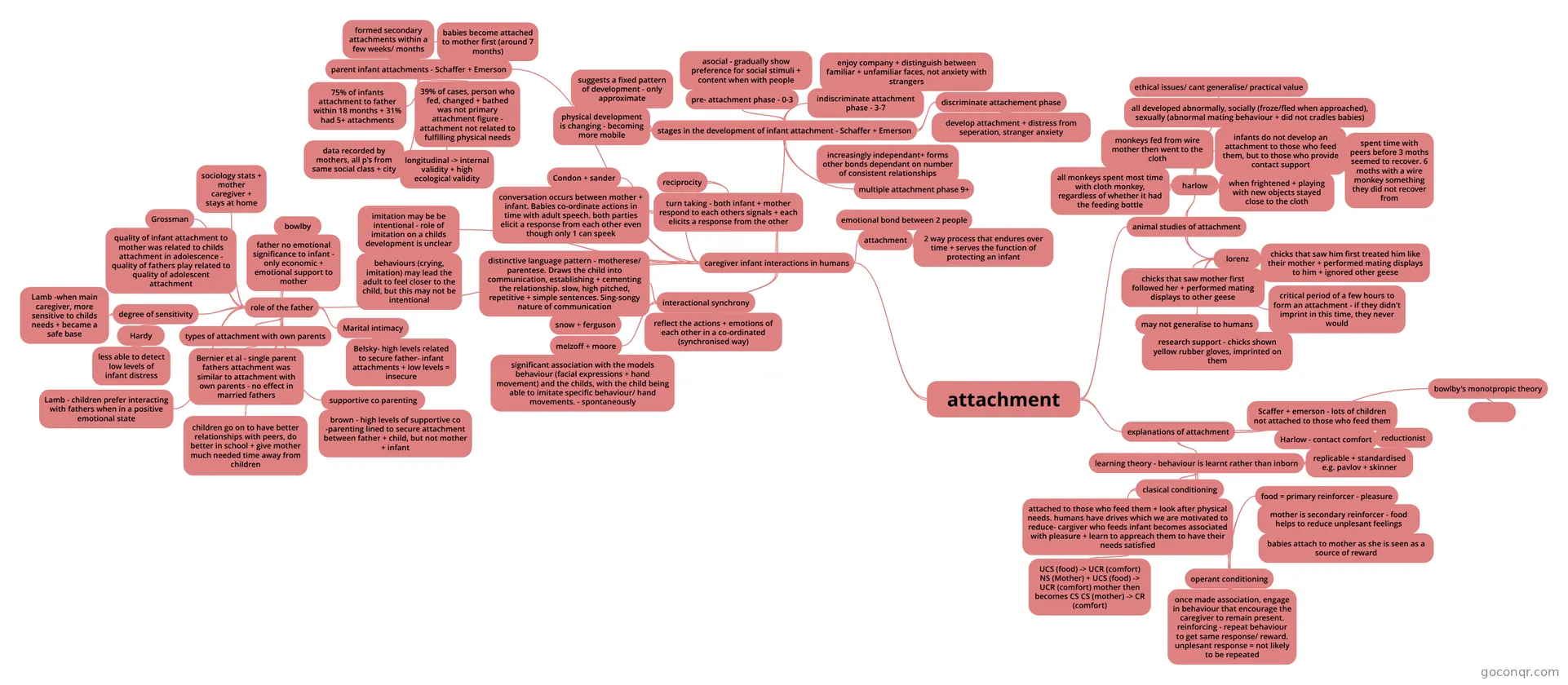
Mind map: Attachment theory and studies
Conteúdo do mapa
attachment
caregiver infant interactions in humans
- reciprocity
- turn taking - both infant + mother respond to each others signals + each elicits a response from the other
- Condon + sander
- conversation occurs between mother + infant. Babies co-ordinate actions in time with adult speech. both parties elicit a response from each other even though only 1 can speek
- Condon + sander
- turn taking - both infant + mother respond to each others signals + each elicits a response from the other
- attachment
- emotional bond between 2 people
- 2 way process that endures over time + serves the function of protecting an infant
- reflect the actions + emotions of each other in a co-ordinated (synchronised way)
- interactional synchrony
- distinctive language pattern - motherese/ parentese. Draws the child into communication, establishing + cementing the relationship. slow, high pitched, repetitive + simple sentences. Sing-songy nature of communication
- snow + ferguson
- melzoff + moore
- significant association with the models behaviour (facial expressions + hand movement) and the childs, with the child being able to imitate specific behaviour/ hand movements. - spontaneously
- distinctive language pattern - motherese/ parentese. Draws the child into communication, establishing + cementing the relationship. slow, high pitched, repetitive + simple sentences. Sing-songy nature of communication
- interactional synchrony
- imitation may be be intentional - role of imitation on a childs development is unclear
- behaviours (crying, imitation) may lead the adult to feel closer to the child, but this may not be intentional
- stages in the development of infant attachment - Schaffer + Emerson
- pre- attachment phase - 0-3
- asocial - gradually show preference for social stimuli + content when with people
- indiscriminate attachment phase - 3-7
- enjoy company + distinguish between familiar + unfamiliar faces, not anxiety with strangers
- discriminate attachement phase
- develop attachment + distress from seperation, stranger anxiety
- multiple attachment phase 9+
- increasingly independant+ forms other bonds dependant on number of consistent relationships
- suggests a fixed pattern of development - only approximate
- physical development is changing - becoming more mobile
- pre- attachment phase - 0-3
- parent infant attachments - Schaffer + Emerson
- babies become attached to mother first (around 7 months)
- formed secondary attachments within a few weeks/ months
- 75% of infants attachment to father within 18 months + 31% had 5+ attachments
- 39% of cases, person who fed, changed + bathed was not primary attachment figure - attachment not related to fulfilling physical needs
- data recorded by mothers, all p's from same social class + city
- longitudinal -> internal validity + high ecological validity
- role of the father
- bowlby
- father no emotional significance to infant - only economic + emotional support to mother
- Grossman
- quality of infant attachment to mother was related to childs attachment in adolescence - quality of fathers play related to quality of adolescent attachment
- degree of sensitivity
- Hardy
- less able to detect low levels of infant distress
- Lamb -when main caregiver, more sensitive to childs needs + became a safe base
- Hardy
- sociology stats + mother caregiver + stays at home
- types of attachment with own parents
- Bernier et al - single parent fathers attachment was similar to attachment with own parents - no effect in married fathers
- Marital intimacy
- Belsky- high levels related to secure father- infant attachments + low levels = insecure
- supportive co parenting
- brown - high levels of supportive co -parenting lined to secure attachment between father + child, but not mother + infant
- Lamb - children prefer interacting with fathers when in a positive emotional state
- children go on to have better relationships with peers, do better in school + give mother much needed time away from children
- bowlby
- reciprocity
animal studies of attachment
- harlow
- all monkeys spent most time with cloth monkey, regardless of whether it had the feeding bottle
- monkeys fed from wire mother then went to the cloth
- when frightened + playing with new objects stayed close to the cloth
- infants do not develop an attachment to those who feed them, but to those who provide contact support
- all developed abnormally, socially (froze/fled when approached), sexually (abnormal mating behaviour + did not cradles babies)
- spent time with peers before 3 moths seemed to recover. 6 moths with a wire monkey something they did not recover from
- ethical issues/ cant generalise/ practical value
- lorenz
- chicks that saw him first treated him like their mother + performed mating displays to him + ignored other geese
- chicks that saw mother first followed her + performed mating displays to other geese
- critical period of a few hours to form an attachment - if they didn't imprint in this time, they never would
- may not generalise to humans
- research support - chicks shown yellow rubber gloves, imprinted on them
- harlow
explanations of attachment
- learning theory - behaviour is learnt rather than inborn
- clasical conditioning
- attached to those who feed them + look after physical needs. humans have drives which we are motivated to reduce- cargiver who feeds infant becomes associated with pleasure + learn to appreach them to have their needs satisfied
- UCS (food) -> UCR (comfort) NS (Mother) + UCS (food) -> UCR (comfort) mother then becomes CS CS (mother) -> CR (comfort)
- attached to those who feed them + look after physical needs. humans have drives which we are motivated to reduce- cargiver who feeds infant becomes associated with pleasure + learn to appreach them to have their needs satisfied
- operant conditioning
- once made association, engage in behaviour that encourage the caregiver to remain present. reinforcing - repeat behaviour to get same response/ reward. unplesant response = not likely to be repeated
- food = primary reinforcer - pleasure
- mother is secondary reinforcer - food helps to reduce unplesant feelings
- babies attach to mother as she is seen as a source of reward
- mother is secondary reinforcer - food helps to reduce unplesant feelings
- Scaffer + emerson - lots of children not attached to those who feed them
- Harlow - contact comfort
- reductionist
- replicable + standardised e.g. pavlov + skinner
- clasical conditioning
- bowlby's monotpropic theory
- learning theory - behaviour is learnt rather than inborn
Informações
- Descrição
- Mapa Mental sobre attachment, criado por abi evans em 21-05-2018.
- Criado por
- abi evans
- Visualizações
- 0
- Avaliação