
Mapa mental
Learning Approach
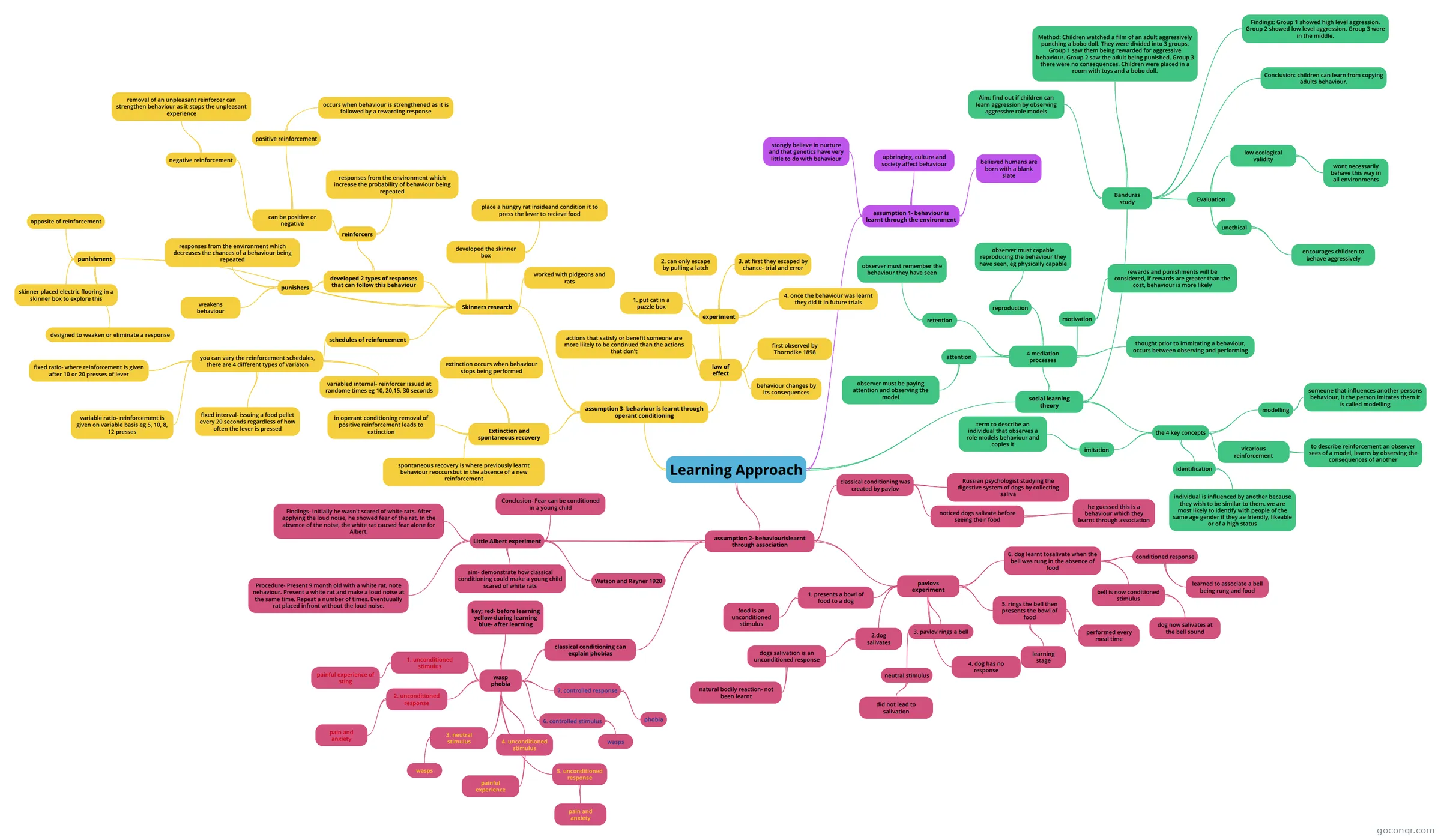
Mind map: learning approach psychology
Conteúdo do mapa
Learning Approach
assumption 1- behaviour is learnt through the environment
- believed humans are born with a blank slate
- upbringing, culture and society affect behaviour
- stongly believe in nurture and that genetics have very little to do with behaviour
assumption 2- behaviourislearnt through association
- classical conditioning was created by pavlov
- Russian psychologist studying the digestive system of dogs by collecting saliva
- noticed dogs salivate before seeing their food
- he guessed this is a behaviour which they learnt through association
- pavlovs experiment
- 1. presents a bowl of food to a dog
- food is an unconditioned stimulus
- 2.dog salivates
- dogs salivation is an unconditioned response
- natural bodily reaction- not been learnt
- dogs salivation is an unconditioned response
- 3. pavlov rings a bell
- neutral stimulus
- did not lead to salivation
- neutral stimulus
- 4. dog has no response
- 5. rings the bell then presents the bowl of food
- learning stage
- performed every meal time
- 6. dog learnt tosalivate when the bell was rung in the absence of food
- conditioned response
- learned to associate a bell being rung and food
- bell is now conditioned stimulus
- dog now salivates at the bell sound
- conditioned response
- 1. presents a bowl of food to a dog
- classical conditioning can explain phobias
- wasp phobia
- 1. unconditioned stimulus
- painful experience of sting
- 2. unconditioned response
- pain and anxiety
- 3. neutral stimulus
- wasps
- 4. unconditioned stimulus
- painful experience
- 5. unconditioned response
- pain and anxiety
- 6. controlled stimulus
- wasps
- 7. controlled response
- phobia
- key; red- before learning yellow-during learning blue- after learning
- 1. unconditioned stimulus
- wasp phobia
- Little Albert experiment
- Watson and Rayner 1920
- aim- demonstrate how classical conditioning could make a young child scared of white rats
- Procedure- Present 9 month old with a white rat, note nehaviour. Present a white rat and make a loud noise at the same time. Repeat a number of times. Eventuually rat placed infront without the loud noise.
- Findings- Initially he wasn't scared of white rats. After applying the loud noise, he showed fear of the rat. In the absence of the noise, the white rat caused fear alone for Albert.
- Conclusion- Fear can be conditioned in a young child
- classical conditioning was created by pavlov
assumption 3- behaviour is learnt through operant conditioning
- law of effect
- behaviour changes by its consequences
- first observed by Thorndike 1898
- experiment
- 1. put cat in a puzzle box
- 2. can only escape by pulling a latch
- 3. at first they escaped by chance- trial and error
- 4. once the behaviour was learnt they did it in future trials
- actions that satisfy or benefit someone are more likely to be continued than the actions that don't
- Skinners research
- worked with pidgeons and rats
- developed the skinner box
- place a hungry rat insideand condition it to press the lever to recieve food
- developed 2 types of responses that can follow this behaviour
- reinforcers
- responses from the environment which increase the probability of behaviour being repeated
- can be positive or negative
- positive reinforcement
- occurs when behaviour is strengthened as it is followed by a rewarding response
- negative reinforcement
- removal of an unpleasant reinforcer can strengthen behaviour as it stops the unpleasant experience
- positive reinforcement
- punishers
- responses from the environment which decreases the chances of a behaviour being repeated
- weakens behaviour
- reinforcers
- punishment
- opposite of reinforcement
- designed to weaken or eliminate a response
- skinner placed electric flooring in a skinner box to explore this
- schedules of reinforcement
- you can vary the reinforcement schedules, there are 4 different types of variaton
- fixed ratio- where reinforcement is given after 10 or 20 presses of lever
- variable ratio- reinforcement is given on variable basis eg 5, 10, 8, 12 presses
- fixed interval- issuing a food pellet every 20 seconds regardless of how often the lever is pressed
- variabled internal- reinforcer issued at randome times eg 10, 20,15, 30 seconds
- you can vary the reinforcement schedules, there are 4 different types of variaton
- Extinction and spontaneous recovery
- extinction occurs when behaviour stops being performed
- in operant conditioning removal of positive reinforcement leads to extinction
- spontaneous recovery is where previously learnt behaviour reoccursbut in the absence of a new reinforcement
- law of effect
social learning theory
- Banduras study
- Aim: find out if children can learn aggression by observing aggressive role models
- Method: Children watched a film of an adult aggressively punching a bobo doll. They were divided into 3 groups. Group 1 saw them being rewarded for aggressive behaviour. Group 2 saw the adult being punished. Group 3 there were no consequences. Children were placed in a room with toys and a bobo doll.
- Findings: Group 1 showed high level aggression. Group 2 showed low level aggression. Group 3 were in the middle.
- Conclusion: children can learn from copying adults behaviour.
- Evaluation
- low ecological validity
- wont necessarily behave this way in all environments
- unethical
- encourages children to behave aggressively
- low ecological validity
- the 4 key concepts
- imitation
- term to describe an individual that observes a role models behaviour and copies it
- identification
- individual is influenced by another because they wish to be similar to them. we are most likely to identify with people of the same age gender if they ae friendly, likeable or of a high status
- modelling
- someone that influences another persons behaviour, it the person imitates them it is called modelling
- vicarious reinforcement
- to describe reinforcement an observer sees of a model, learns by observing the consequences of another
- imitation
- 4 mediation processes
- attention
- observer must be paying attention and observing the model
- retention
- observer must remember the behaviour they have seen
- reproduction
- observer must capable reproducing the behaviour they have seen, eg physically capable
- motivation
- rewards and punishments will be considered, if rewards are greater than the cost, behaviour is more likely
- thought prior to immitating a behaviour, occurs between observing and performing
- attention
- Banduras study
Informações
- Descrição
- A-Level Psychology Mapa Mental sobre Learning Approach, criado por Emily Butcher em 29-12-2015.
- Criado por
- Emily Butcher
- Visualizações
- 11
- Avaliação
Mais sobre Classical conditioning