
Mapa mental
Age and SLA
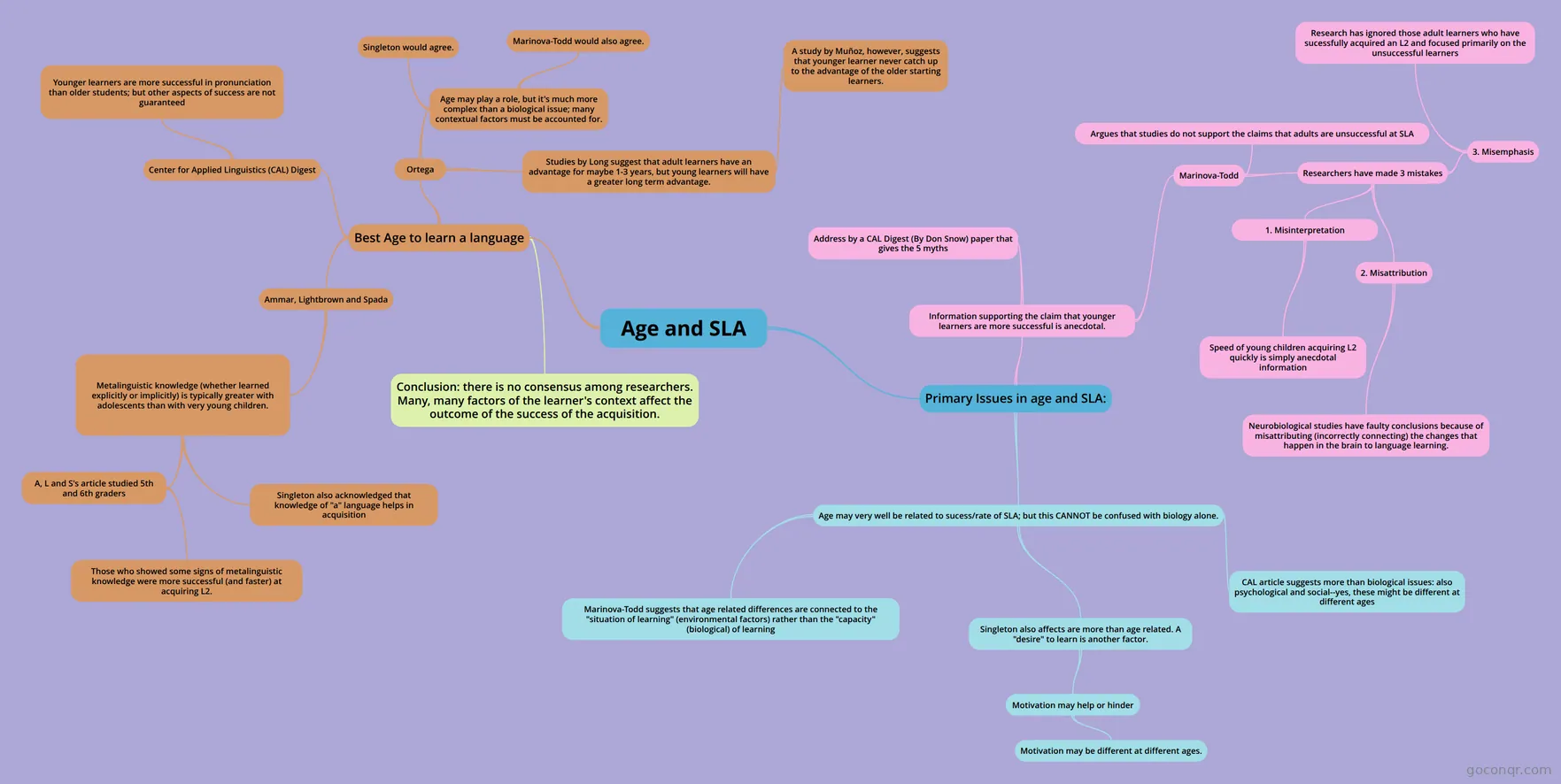
Mind map: Age and SLA
Conteúdo do mapa
Age and SLA
Best Age to learn a language
- Ammar, Lightbrown and Spada
- Metalinguistic knowledge (whether learned explicitly or implicitly) is typically greater with adolescents than with very young children.
- A, L and S's article studied 5th and 6th graders
- Those who showed some signs of metalinguistic knowledge were more successful (and faster) at acquiring L2.
- Singleton also acknowledged that knowledge of "a" language helps in acquisition
- A, L and S's article studied 5th and 6th graders
- Metalinguistic knowledge (whether learned explicitly or implicitly) is typically greater with adolescents than with very young children.
- Center for Applied Linguistics (CAL) Digest
- Younger learners are more successful in pronunciation than older students; but other aspects of success are not guaranteed
- Ortega
- Age may play a role, but it's much more complex than a biological issue; many contextual factors must be accounted for.
- Singleton would agree.
- Marinova-Todd would also agree.
- Studies by Long suggest that adult learners have an advantage for maybe 1-3 years, but young learners will have a greater long term advantage.
- A study by Muñoz, however, suggests that younger learner never catch up to the advantage of the older starting learners.
- Age may play a role, but it's much more complex than a biological issue; many contextual factors must be accounted for.
- Conclusion: there is no consensus among researchers. Many, many factors of the learner's context affect the outcome of the success of the acquisition.
- Ammar, Lightbrown and Spada
Primary Issues in age and SLA:
- Information supporting the claim that younger learners are more successful is anecdotal.
- Address by a CAL Digest (By Don Snow) paper that gives the 5 myths
- Marinova-Todd
- Argues that studies do not support the claims that adults are unsuccessful at SLA
- Researchers have made 3 mistakes
- 1. Misinterpretation
- Speed of young children acquiring L2 quickly is simply anecdotal information
- 2. Misattribution
- Neurobiological studies have faulty conclusions because of misattributing (incorrectly connecting) the changes that happen in the brain to language learning.
- 3. Misemphasis
- Research has ignored those adult learners who have sucessfully acquired an L2 and focused primarily on the unsuccessful learners
- 1. Misinterpretation
- Age may very well be related to sucess/rate of SLA; but this CANNOT be confused with biology alone.
- Marinova-Todd suggests that age related differences are connected to the "situation of learning" (environmental factors) rather than the "capacity" (biological) of learning
- Singleton also affects are more than age related. A "desire" to learn is another factor.
- Motivation may help or hinder
- Motivation may be different at different ages.
- Motivation may help or hinder
- CAL article suggests more than biological issues: also psychological and social--yes, these might be different at different ages
- Information supporting the claim that younger learners are more successful is anecdotal.
Informações
- Descrição
- Some organizational points for Age and SLA midterm question
- Criado por
- Caleb A
- Visualizações
- 99
- Tags
- Avaliação
Mais sobre Age and the Critical Period