
Mapa mental
End of war - 1919
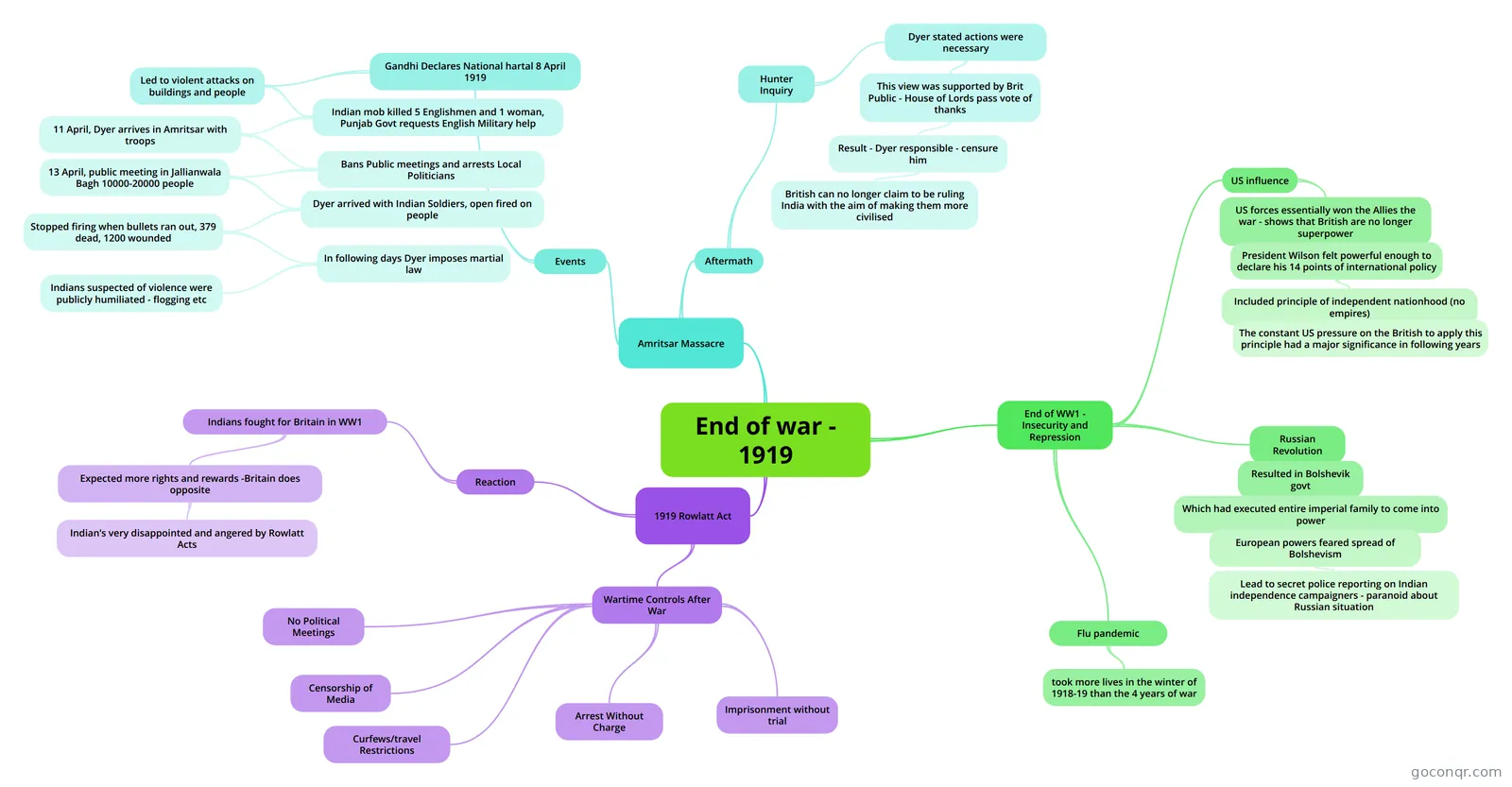
Mind map: End of war 1919
Conteúdo do mapa
End of war - 1919
Amritsar Massacre
- Events
- Gandhi Declares National hartal 8 April 1919
- Led to violent attacks on buildings and people
- Indian mob killed 5 Englishmen and 1 woman, Punjab Govt requests English Military help
- 11 April, Dyer arrives in Amritsar with troops
- Bans Public meetings and arrests Local Politicians
- 13 April, public meeting in Jallianwala Bagh 10000-20000 people
- Dyer arrived with Indian Soldiers, open fired on people
- Stopped firing when bullets ran out, 379 dead, 1200 wounded
- In following days Dyer imposes martial law
- Indians suspected of violence were publicly humiliated - flogging etc
- In following days Dyer imposes martial law
- Stopped firing when bullets ran out, 379 dead, 1200 wounded
- Dyer arrived with Indian Soldiers, open fired on people
- 13 April, public meeting in Jallianwala Bagh 10000-20000 people
- Bans Public meetings and arrests Local Politicians
- 11 April, Dyer arrives in Amritsar with troops
- Indian mob killed 5 Englishmen and 1 woman, Punjab Govt requests English Military help
- Led to violent attacks on buildings and people
- Gandhi Declares National hartal 8 April 1919
- Aftermath
- Hunter Inquiry
- Dyer stated actions were necessary
- This view was supported by Brit Public - House of Lords pass vote of thanks
- Result - Dyer responsible - censure him
- British can no longer claim to be ruling India with the aim of making them more civilised
- Result - Dyer responsible - censure him
- This view was supported by Brit Public - House of Lords pass vote of thanks
- Dyer stated actions were necessary
- Hunter Inquiry
- Events
1919 Rowlatt Act
- Wartime Controls After War
- No Political Meetings
- Censorship of Media
- Curfews/travel Restrictions
- Imprisonment without trial
- Arrest Without Charge
- Reaction
- Indians fought for Britain in WW1
- Expected more rights and rewards -Britain does opposite
- Indian's very disappointed and angered by Rowlatt Acts
- Expected more rights and rewards -Britain does opposite
- Indians fought for Britain in WW1
- Wartime Controls After War
End of WW1 - Insecurity and Repression
- US influence
- US forces essentially won the Allies the war - shows that British are no longer superpower
- President Wilson felt powerful enough to declare his 14 points of international policy
- Included principle of independent nationhood (no empires)
- The constant US pressure on the British to apply this principle had a major significance in following years
- Included principle of independent nationhood (no empires)
- President Wilson felt powerful enough to declare his 14 points of international policy
- US forces essentially won the Allies the war - shows that British are no longer superpower
- Russian Revolution
- Resulted in Bolshevik govt
- Which had executed entire imperial family to come into power
- European powers feared spread of Bolshevism
- Lead to secret police reporting on Indian independence campaigners - paranoid about Russian situation
- European powers feared spread of Bolshevism
- Which had executed entire imperial family to come into power
- Resulted in Bolshevik govt
- Flu pandemic
- took more lives in the winter of 1918-19 than the 4 years of war
- US influence
Informações
- Descrição
- A-Levels India History Mapa Mental sobre End of war - 1919, criado por jacksearle em 26-04-2013.
- Criado por
- jacksearle
- Visualizações
- 169
- Tags
- Avaliação