
Mapa mental
Intelligence, creativity & wisdom
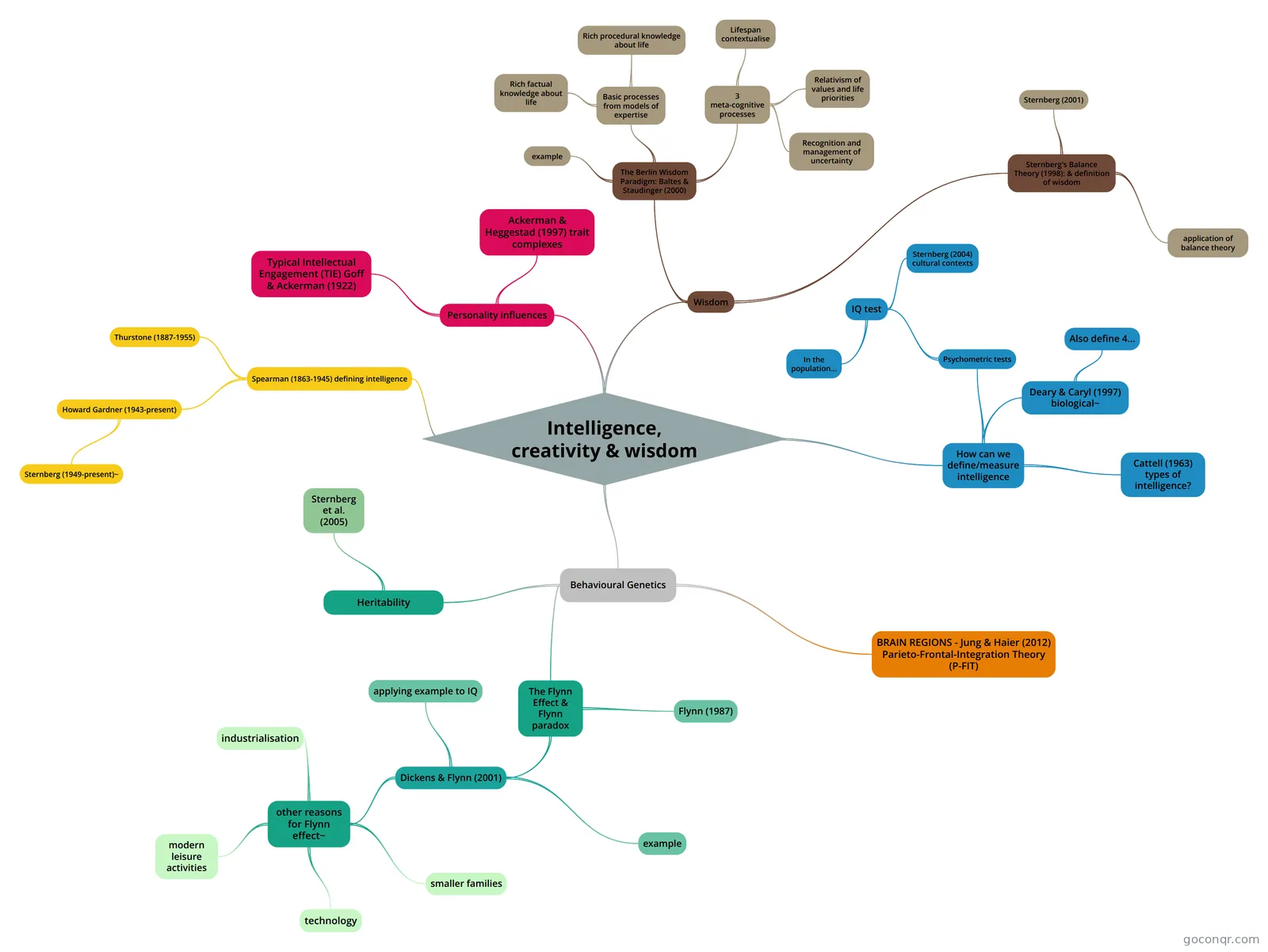
Mind map: Intelligence, creativity & wisdom
Conteúdo do mapa
Intelligence, creativity & wisdom
How can we define/measure intelligence
- Deary & Caryl (1997) biological~
- surveyed research into the biological bases of human intelligence differences. Work on brain event-related potentials (ERPs) suggests that people with high IQ test scores show faster responses in certain test conditions, they have ERP waveforms that can be easily distinguished from people with lower IQs, and higher IQ scorers also have less variability in their ERPs. People with higher psychometric intelligence have, on average, larger brains, and possibly faster neural connection speeds. This has led to the speculation that brighter people have more ‘efficient’ brains.
- Also define 4...
- also identify 4 different types of intelligence that can be measured: real life impact (educational achievements, employment success etc.), cognitive intelligence (reaction times etc.), biological measure (brain event related potentials, brain size etc.) and intelligence quotients (reasoning, comprehension & judgement etc.).
- Cattell (1963) types of intelligence?
- suggests that there are 2 different forms of intelligence: crystallised and fluid. Crystallised intelligence is the ability to use skills, knowledge and experience that are learnt in one’s lifetime. This knowledge improves with age in the form of vocabulary/oral style of writing etc. Fluid intelligence is the capacity to reason and solve novel problems independent of any knowledge from the past e.g. Piagetian reasoning, inductive reasoning, reading speed etc. This knowledge is determined by biological potential and declines later in life. States that IQ measures mainly fluid intelligence~
- Psychometric tests
- come in many forms, some use only a single type of item/question. Raven's progressive matrices for example is a nonverbal test that attempts to measure ability to apply inductive reasoning~
- IQ test
- Intelligence Tests are designed to measure a variety of mental functions such as reasoning, comprehension, and judgment. IQ tests produce an 'intelligence quotient', this is the most widely accepted intelligence test that assesses various abilities: mathematical, spatial, verbal, logic and memory. Example question: 'If Bob sold 15 apples in a working week, what is the average number of apples he sells each day?' - 'Pig is to pork as cow is to____' : Lamb/beef/stew/cattle~~
- It is however a highly questionable method, can it accurately measure intelligence? Can you adapt and survive if you don't have a high IQ? - IQ suggest that there are some basic processes that underlie higher order learning that can be measured~~
- Sternberg (2004) cultural contexts
- When looking at different measures/definitions of intelligence they typically contain ideas about morality, helping and your place in society. Sternberg (2004) states that intelligence cannot be fully or even meaningfully understood outside its cultural context because different cultures have different concepts of ‘fitting into society’, so measures of intelligence may fail to identify the range of skills & knowledge that actually might constitute intelligence. Modern IQ tests are designed to measure the western concept of intelligence i.e. problem solving, verbal ability and social competence, other cultures for example in Zambia, it intelligence is considered to be based more on cooperativeness, social responsibility and obedience. So do IQ tests really measure ‘intelligence’? Or merely measure a western-specific aspect of intelligence?
- In the population...
- Typically IQ produces a normal distribution across populations, meaning that a majority of people (64%) are around 100 points, with the rest of the population filtering to the higher/lower ends of the scale~
- Deary & Caryl (1997) biological~
Behavioural Genetics
- The Flynn Effect & Flynn paradox
- Flynn discovered that IQ scores appeared to increase from one generation to the next for all 14 of the countries for which the data existed. This interesting phenomenon has been called the ‘Flynn Effect’, and is still not fully explained by researchers.
- Flynn effect is supporting evidence for interaction between genes and environment~ can see that both types of intelligence changes~
- Flynn (1987)
- identified that both fluid and crystallised intelligence is increasing through generation to generation; fluid intelligence show an increase of roughly 15 points per annum on tests such as Ravens Progressive Matrices, and crystallised intelligence shows an increase of roughly 9 points on tests that measure vocabulary & math skills~ - so bigger Flynn effect for 'innate' intelligence than developing intelligence, however both importantly fluctuate~
- states that IQ tests do not measure intelligence but rather correlate with a weak causal link to intelligence. Flynn believes that increases from generation in crystallised intelligence are actually increases in abstract problem solving and gene-environment matching, and so favours environmental explanations for increases in test scores.
- Dickens & Flynn (2001)
- present a model of the process determining IQ, in which IQ is affected by both environment and genes, but in which their environments are matched to their genes. The link between IQ and environment leads to a positive correlation between environment and genotype that masks the full effect of environment on IQ (environment provided by relatives~ suggests similarities are caused by genetics BUT actually just similar environment they were raised in~). Judging the size of environmental effects by the fraction of variance not explained by genotype will understate its full magnitude because to do so ignores environmental effects induced by differences in genotype.
- example
- They use example: a father who loves basketball and who has a son with slightly better than average genes for the relevant physical traits is likely to play basketball with his son at an early age, and they are likely to play together more often than most. *Genes might not necessarily be from dad, but has inherent potential to play basketball later in life that is further fulfilled by dad’s love of basketball~ Now imagine he doesn’t have the initial advantage, still plays basketball but will be less influenced by dad, and possibly put other activities in front of basketball because the innate motivation isn’t there~
- describe that although the boy in the example profited from good genes and environment, the advantage could have been environmental only i.e. the fact that his father enjoyed basketball. The analogy could show that anything that makes someone better at something improves skills that improve the environment (motivation~) that further improves skills and so on (reciprocal causation causes multiplier effect~).
- applying example to IQ
- Applying the basketball analogy to explaining IQ gains over time: assume that within a generation there is high correlation between favourable genes for IQ and quality of environment. A parsimonious conclusion is that as people mature and the influence of family wanes, there emerges a match between genes and environment quality.
- other reasons for Flynn effect~
- industrialisation
- Due to industrialisation it is likely that the cognitive complexity of the average person’s job has increased over the last century. There is no doubt that more demanding educational credentials control the access to a wide range of jobs. There are far more people in scientific, managerial, and technical positions than ever before.
- modern leisure activities
- increased leisure time is another possible trigger for IQ gains, as some activities undertaken during extended leisure (reading, puzzles, games such as chess~) may be honing people’s facilities.
- technology
- It is also possible that the machinery we surround ourselves with (e.g. cars, phones, computers etc.) have increased the demands on our cognitive capabilities.
- smaller families
- Also the shift to fewer children in the family, affording more time to cater to each child’s curiosity and richer individual interactions, may have played a role~
- industrialisation
- Heritability
- it is estimated that between 48% to 80% of variability in IQ scores can be attributed to genetics. But if IQ scores also seem to fluctuate across one's lifetime.
- Sternberg et al. (2005)
- genes are heritability functions that affect the PROBABILITY of an IQ level, heritability is not the same as a definite genetic influence because modification to IQ is still possible regardless of level of heritability. So there must be some interaction between genes and environment~
- BRAIN REGIONS - Jung & Haier (2012) Parieto-Frontal-Integration Theory (P-FIT)
- review data from 37 neuroimaging studies that investigate the cortical interaction between parietal and frontal structures associated with reasoning & problem solving, which underpins individual differences in human reasoning. Essentially basic sensory information is gathered via auditory and visual process centres (temporal and occipital lobes), then fed forwards to parietal lobes for symbolism, abstraction and elaboration. The parietal cortex interacts with frontal cortex for hypothesis testing of various solutions. The brain then inhibits competing responses. Important to note that the brain depends on integrity of white matter for error free transmission~
- so faster information processing (can be seen as higher cognitive capability) is associated with better white matter integrity for error free transmission between important areas of the brain for human reasoning~
- The Flynn Effect & Flynn paradox
Personality influences
- It is apparent that there is no definite cause/effect relationship between personality and intelligence, although personality can influence performance on intelligence tests, or indirectly increase intelligence by influencing interests (that may develop intelligence~) - Also personality-related traits may simply have effect on how person behaves within a test e.g. anxiety may cause a person to make cognitive-mistakes and seem less intelligent~
- looking at the link between personality and intelligence can show if intelligence is typical expression or a one-off maximal performance like on psychometric tests~
- Typical Intellectual Engagement (TIE) Goff & Ackerman (1922)
- introduce TIE as an individuals' typical expression of a desire to engage & understand their world, their interest in a wide range of things, and their preference for a complex topic or problem. For example "I prefer watching educational entertainment programmes". TIE is highly linked to Openness, low neuroticism, and conscientiousness. In terms of IQ TIE is associated with crystallised but NOT fluid intelligence~
- Ackerman & Heggestad (1997) trait complexes
- identify 4 trait complexes (instance when individual differences in intelligence/personality/interests interact to create coherent complexes): 1) SOCIAL - extraversion, social potency and well-being influence a person's traits e.g. enterprising and social~ 2) CLERICAL/CONVENTIONAL - control, conscientiousness, and traditionalism influences a person's perceptual speed (speed of learning~) 3) SCIENCE/MATH - realistic and investigative personality leads to better mathematical reasoning and visual perception. 4) INTELLECTUAL/CULTURAL - absorption and artistic abilities lead to TIE-openness and crystallised intelligence development~
Wisdom
- is distinct from intelligence, maturity, and creativity, and is an exceptional form of human functioning. By definition it is the co-ordinated interpersonal competence (ability to listen and give advice) that is used for one's own and others well-being. So is separate measure of intelligence to psychometric tests- is the measure of ability to apply learnt knowledge to other person's situations~
- The Berlin Wisdom Paradigm: Baltes & Staudinger (2000)
- the idea of applying models of expertise to to the study of wisdom. The knowledge and judgement about the essence of the human condition, and ways of planning, managing and understanding a good life.
- Describe how to rate a person's 'wisdom': Record how they respond to scenarios out loud, their responses are transcribed and rated along 5 dimensions: (and scores are formulated based off of these dimensions)~
- Basic processes from models of expertise
- factual/ declarative knowledge and procedural knowledge~
- Rich factual knowledge about life
- about human nature, life long development, social norms etc.
- Rich procedural knowledge about life
- Heuristics about advice, backup plans etc.
- 3 meta-cognitive processes
- Lifespan contextualise
- education, family, friends, and their interaction with time and culture~
- Relativism of values and life priorities
- tolerance for values of difference
- Recognition and management of uncertainty
- awareness that knowledge and reasoning are themselves uncertain~
- Lifespan contextualise
- example
- A 15-year old girl wants to get married right away. What should one/she consider and do?
- Sternberg's Balance Theory (1998): & definition of wisdom
- defines wisdom as: the application of tacit knowledge(procedural, acquired without help from others, relevant to attaining valued goals, knowing ‘how’ rather than ‘that’) toward the goal of achieving a common good. practical intelligence applied to ‘balancing’ interests of self (intra-personal e.g. enhance popularity/prestige/well-being of SELF), others (inter-personal e.g. popularity/prestige/well-being of OTHERS) and the context in which we live (extra-personal e.g. contribute to the welfare of the community) to max wisdom & intelligence. Use this application to cause actions: adapt to existing environments, shaping existing ones and selecting new ones.
- Sternberg (2001)
- most recent model of wisdom holds that all schools should explicitly adopt a curriculum for teaching wisdom, because teaching students to recall facts and think critically is one thing, but to practically understand and apply that knowledge they need to think wisely about it too! Wisdom adds richness, depth and orientation to the formation of the higher order thinking skills that the present curriculum sometimes appears to lack. Students should be capable of constructing and reconstructing knowledge from their own point of view and from the point of view of others.
- application of balance theory
- uses the example of ‘antibiotic resistance and prescribing’ as an application of balance theory and how doctors will develop intelligent actions based on their balance of wisdom. The intra-personal interest of the doctor is to be a good doctor and reduce antibiotic prescribing, so they produce an adaptation action to treat symptoms with paracetamol; they have an inter-personal interest to want a good relationship with the patient, so they produce a shaping (alter environment) action & advise the patient further to avoid others who are sick; they have extra-personal interests to achieve government targets & practice goals, so they produce a selective action and advise the patient to seek help elsewhere.
Spearman (1863-1945) defining intelligence
- Spearman suggests there is a general factor (G-factor) of intelligence. This is because there are eight different supposed measures of intelligence e.g. verbal ability, mathematical ability, creativity etc. and suggests that a G-factor is why people who are good at one cluster tend to also be good in other clusters (because it is really only one-scale).
- Thurstone (1887-1955)
- - a pioneer in the field of psychometrics~ administered 56 different tests to subjects & used the answers to identify 7 clusters of intelligence e.g. spatial ability, verbal comprehension, word fluency, perceptual speed, numerical ability, inductive reasoning & memory. Interestingly when other researchers tested for these clusters there WAS a link between them, such that if one person was good at verbal comprehension then also good at perceptual speed, suggesting that there may in fact be a G-factor,
- Howard Gardner (1943-present)
- a developmental psychologist~ views intelligence as multiple abilities and argued that a consistent high scorer did not suggest a G-factor. He references cases of brain damage in which one ability may be destroyed and another left intact, so the clusters of intelligence must be separate. The 8 clusters he suggests: musical, mathematical, linguistic, naturalist, interpersonal, intrapersonal, kinaesthetic abilities, & spatial.
- Sternberg (1949-present)~
- agrees with Gardner but states there are actually only 3: analytical, (problem solving), creative (adaptability), & practical (everyday tasks). BUT research can still support links between these areas to support the G-factor.
- stresses the importance of creativity on intelligence: emotional intelligence (use of emotions), & ability to choose creative environments to spur the more traditional definition of intelligence.
Informações
- Descrição
- - Second year mind maps (Personality) Mapa Mental sobre Intelligence, creativity & wisdom, criado por Rachael Jones em 03-01-2017.
- Criado por
- Rachael Jones
- Visualizações
- 2
- Avaliação