
Mapa mental
Research methods
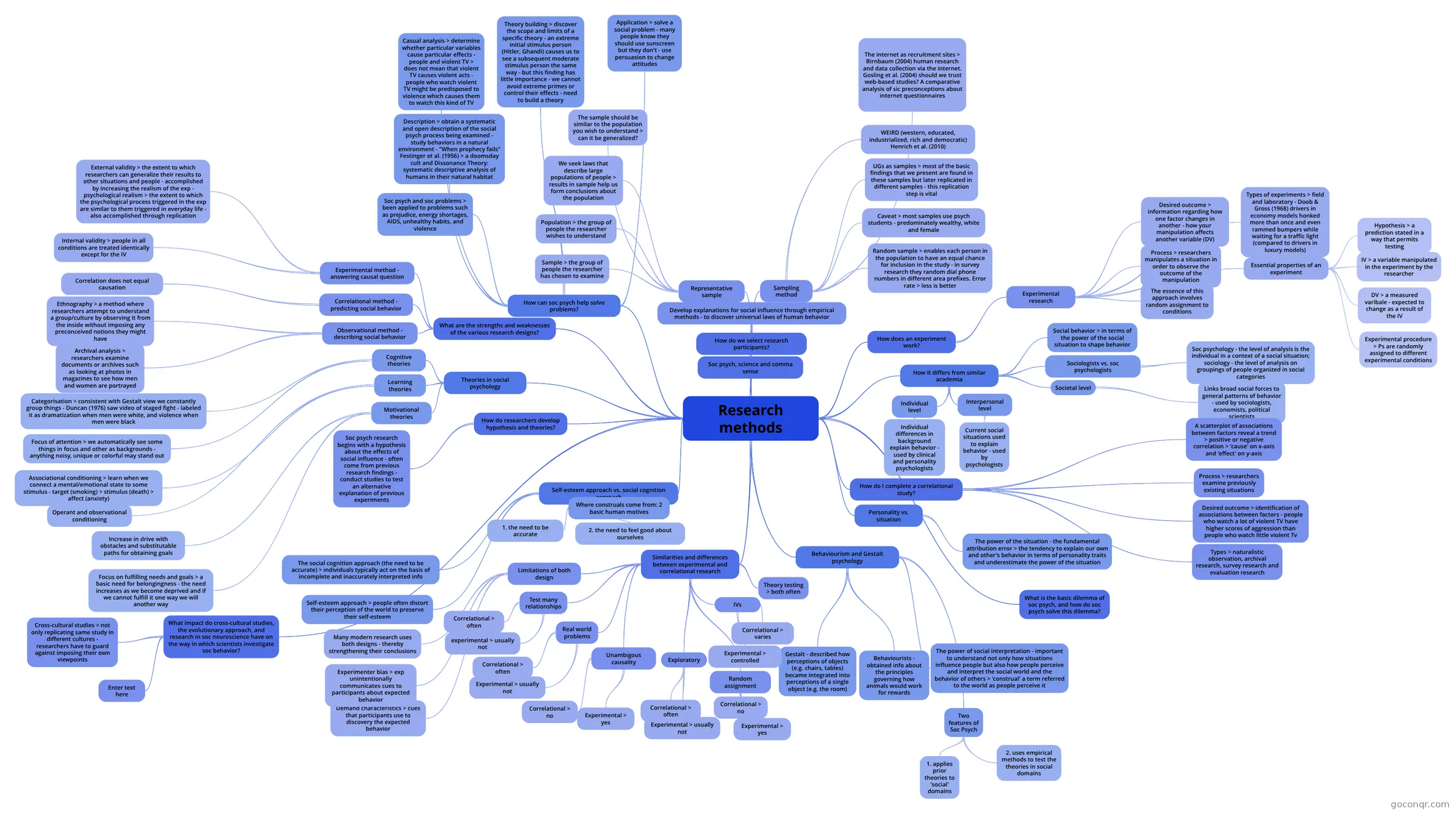
Mind map: Research methods in social psychology
Conteúdo do mapa
Research methods
Soc psych, science and comma sense
- Develop explanations for social influence through empirical methods - to discover universal laws of human behavior
How it differs from similar academia
- Social behavior > in terms of the power of the social situation to shape behavior
- Sociologists vs. soc psychologists
- Soc psychology - the level of analysis is the individual in a context of a social situation; sociology - the level of analysis on groupings of people organized in social categories
- Societal level
- Links broad social forces to general patterns of behavior - used by sociologists, economists, political scientists
- Interpersonal level
- Current social situations used to explain behavior - used by psychologists
- Individual level
- Individual differences in background explain behavior - used by clinical and personality psychologists
Personality vs. situation
- The power of the situation - the fundamental attribution error > the tendency to explain our own and other's behavior in terms of personality traits and underestimate the power of the situation
Behaviourism and Gestalt psychology
- The power of social interpretation - important to understand not only how situations influence people but also how people perceive and interpret the social world and the behavior of others > 'construal' a term referred to the world as people perceive it
- Behaviourists - obtained info about the principles governing how animals would work for rewards
- Gestalt - described how perceptions of objects (e.g. chairs, tables) became integrated into perceptions of a single object (e.g. the room)
- Two features of Soc Psych
- 1. applies prior theories to 'social' domains
- 2. uses empirical methods to test the theories in social domains
Self-esteem approach vs. social cognition approach
- Where construals come from: 2 basic human motives
- 1. the need to be accurate
- 2. the need to feel good about ourselves
- Self-esteem approach > people often distort their perception of the world to preserve their self-esteem
- The social cognition approach (the need to be accurate) > individuals typically act on the basis of incomplete and inaccurately interpreted info
- Where construals come from: 2 basic human motives
Theories in social psychology
- Motivational theories
- Focus on fulfilling needs and goals > a basic need for belongingness - the need increases as we become deprived and if we cannot fulfill it one way we will another way
- Increase in drive with obstacles and substitutable paths for obtaining goals
- Cognitive theories
- Focus of attention > we automatically see some things in focus and other as backgrounds - anything noisy, unique or colorful may stand out
- Categorisation > consistent with Gestalt view we constantly group things - Duncan (1976) saw video of staged fight - labeled it as dramatization when men were white, and violence when men were black
- Learning theories
- Associational conditioning > learn when we connect a mental/emotional state to some stimulus - target (smoking) > stimulus (death) > affect (anxiety)
- Operant and observational conditioning
- Motivational theories
How can soc psych help solve problems?
- Soc psych and soc problems > been applied to problems such as prejudice, energy shortages, AIDS, unhealthy habits, and violence
- Description > obtain a systematic and open description of the social psych process being examined - study behaviors in a natural environment - "When prophecy fails" Festinger et al. (1956) > a doomsday cult and Dissonance Theory: systematic descriptive analysis of humans in their natural habitat
- Casual analysis > determine whether particular variables cause particular effects - people and violent TV > does not mean that violent TV causes violent acts - people who watch violent TV might be predisposed to violence which causes them to watch this kind of TV
- Theory building > discover the scope and limits of a specific theory - an extreme initial stimulus person (Hitler, Ghandi) causes us to see a subsequent moderate stimulus person the same way - but this finding has little importance - we cannot avoid extreme primes or control their effects - need to build a theory
- Application > solve a social problem - many people know they should use sunscreen but they don't - use persuasion to change attitudes
How do we select research participants?
- Representative sample
- Sample > the group of people the researcher has chosen to examine
- Population > the group of people the researcher wishes to understand
- We seek laws that describe large populations of people > results in sample help us form conclusions about the population
- The sample should be similar to the population you wish to understand > can it be generalized?
- Sampling method
- Random sample > enables each person in the population to have an equal chance for inclusion in the study - in survey research they random dial phone numbers in different area prefixes. Error rate > less is better
- Caveat > most samples use psych students - predominately wealthy, white and female
- UGs as samples > most of the basic findings that we present are found in these samples but later replicated in different samples - this replication step is vital
- WEIRD (western, educated, industrialized, rich and democratic) Henrich et al. (2010)
- The internet as recruitment sites > Birnbaum (2004) human research and data collection via the internet. Gosling et al. (2004) should we trust web-based studies? A comparative analysis of sic preconceptions about internet questionnaires
- Representative sample
How does an experiment work?
- Experimental research
- Process > researchers manipulates a situation in order to observe the outcome of the manipulation
- The essence of this approach involves random assignment to conditions
- Desired outcome > information regarding how one factor changes in another - how your manipulation affects another variable (DV)
- Types of experiments > field and laboratory - Doob & Gross (1968) drivers in economy models honked more than once and even rammed bumpers while waiting for a traffic light (compared to drivers in luxury models)
- Essential properties of an experiment
- Hypothesis > a prediction stated in a way that permits testing
- IV > a variable manipulated in the experiment by the researcher
- DV > a measured varibale - expected to change as a result of the IV
- Experimental procedure > Ps are randomly assigned to different experimental conditions
- Experimental research
How do I complete a correlational study?
- Process > researchers examine previously existing situations
- Desired outcome > identification of associations between factors - people who watch a lot of violent TV have higher scores of aggression than people who watch little violent Tv
- A scatterplot of associations between factors reveal a trend > positive or negative correlation > 'cause' on x-axis and 'effect' on y-axis
- Types > naturalistic observation, archival research, survey research and evaluation research
Similarities and differences between experimental and correlational research
- IVs
- Correlational > varies
- Experimental > controlled
- Random assignment
- Correlational > no
- Experimental > yes
- Unambigous causality
- Correlational > no
- Experimental > yes
- Theory testing > both often
- Exploratory
- Correlational > often
- Experimental > usually not
- Real world problems
- Correlational > often
- Experimental > usually not
- Test many relationships
- Correlational > often
- experimental > usually not
- Limitations of both design
- Demand characteristics > cues that participants use to discovery the expected behavior
- Experimenter bias > exp unintentionally communicates cues to participants about expected behavior
- Many modern research uses both designs - thereby strengthening their conclusions
- IVs
How do researchers develop hypothesis and theories?
- Soc psych research begins with a hypothesis about the effects of social influence - often come from previous research findings - conduct studies to test an alternative explanation of previous experiments
What are the strengths and weaknesses of the various research designs?
- Observational method - describing social behavior
- Ethnography > a method where researchers attempt to understand a group/culture by observing it from the inside without imposing any preconceived notions they might have
- Archival analysis > researchers examine documents or archives such as looking at photos in magazines to see how men and women are portrayed
- Correlational method - predicting social behavior
- Correlation does not equal causation
- Experimental method - answering causal question
- Internal validity > people in all conditions are treated identically except for the IV
- External validity > the extent to which researchers can generalize their results to other situations and people - accomplished by increasing the realism of the exp - psychological realism > the extent to which the psychological process triggered in the exp are similar to them triggered in everyday life - also accomplished through replication
- Observational method - describing social behavior
What impact do cross-cultural studies, the evolutionary approach, and research in soc neuroscience have on the way in which scientists investigate soc behavior?
- Cross-cultural studies > not only replicating same study in different cultures - researchers have to guard against imposing their own viewpoints
- Enter text here
What is the basic dilemma of soc psych, and how do soc psych solve this dilemma?
Informações
- Descrição
- Mapa Mental sobre Research methods, criado por Christiana Lucin em 03-05-2014.
- Criado por
- Christiana Lucin
- Visualizações
- 26
- Avaliação