
Mapa mental
Attachment
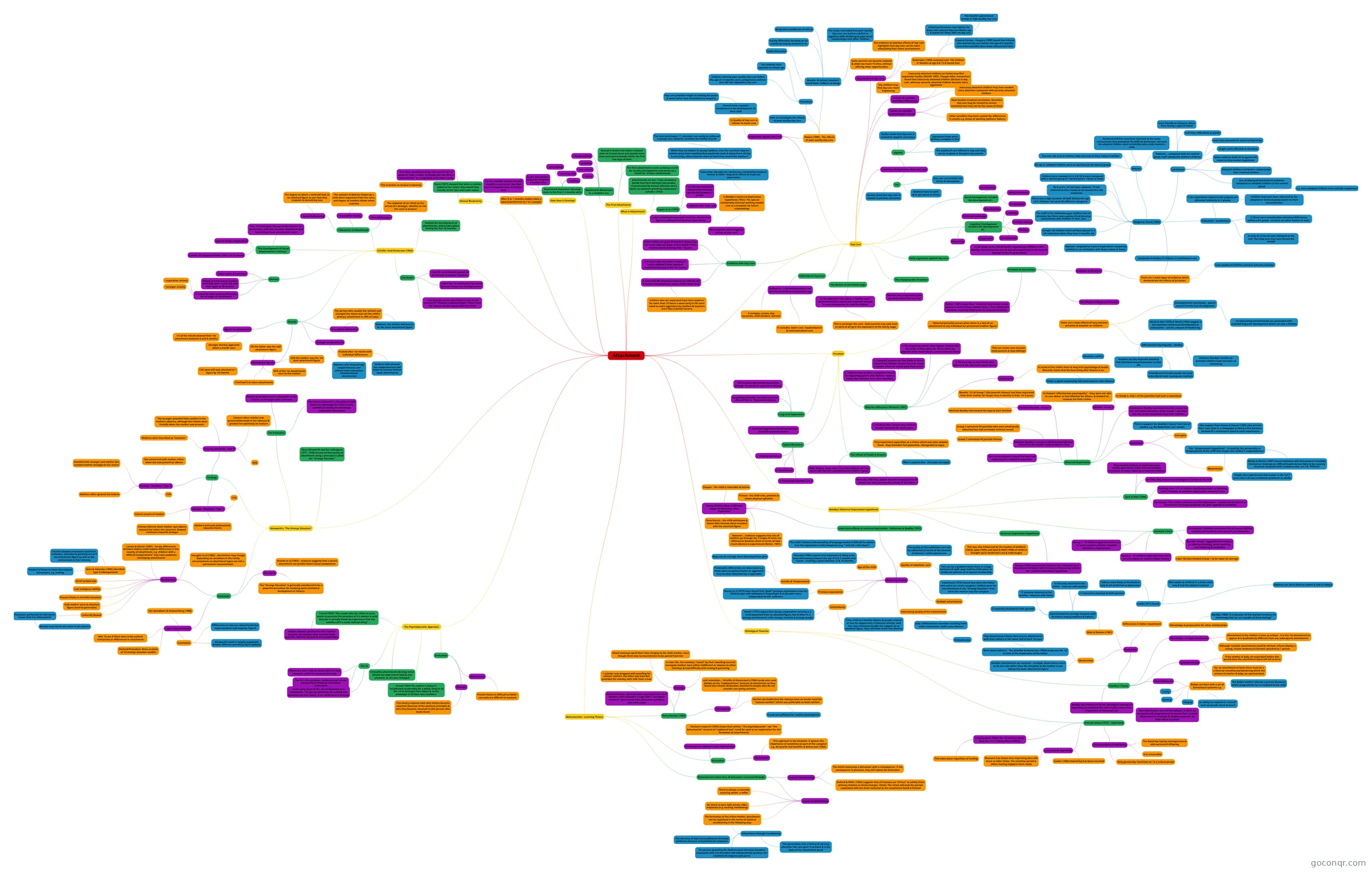
Mind map: Attachment psychology
Conteúdo do mapa
Attachment
What is Attachment?
- Attachments are the; "close emotional bonds that form between two people, characterised by mutual affection and a desire to maintain proximity (closeness)" - Schaffer (1993)
- Kagan et al. (1978)
- • an intense emotional relationship develops specifically between 2 people
- • endures over time, and
- • where prolonged separation from the attachment figure is accompained by stress and sorrow
The First Attachment
- The first attachment is seen as being crucial for healthy development and serves as a model for all later attachments
- Research shows that babies respond more to human faces and sounds more than mechanical sounds within the first few days of birth
- Attachment Behaviours in a newborn are:
- • crying
- • eye-contact
- • grasping
- • being soothed
How does it Develop?
- Attachment behaviour develops more in the first 2-3 months with:
- • smiling
- • reaching, and
- • arm-waving
- by the 3rd month a baby can recognise a familiar face
- Up to 3 months, babies respond equally to any career, but then start to respond more to familiar ones
- After 6 or 7 months, babies show a special preference to 1 or 2 people
- Attachment behaviour develops more in the first 2-3 months with:
Mutual Reciprocity
- Stern (1977) showed that when a mother talked to her infant, they would look intently at her face and make noises
- The infant would then stop and wait for her to speak or make a noise. Gradually the two form a "conversation" by recognising each other's cues.
- This is known as mutual reciprocity
- The infant would then stop and wait for her to speak or make a noise. Gradually the two form a "conversation" by recognising each other's cues.
- Stern (1977) showed that when a mother talked to her infant, they would look intently at her face and make noises
Schaffer And Emmerson (1964)
- Studied the development of attachments, which takes place during the first 18 months
- 3 Measures of Attachment
- • Fear of Strangers
- The response of an infant to the arrival of a stranger, whether or not the carer is present
- • Separation Anxiety
- The amount of distress shown by a child when separated from the carer, and degree of comfort shown when reunited
- • Social Referencing
- The degree to which a child will look to an attached figure to see how they respond to something new
- • Fear of Strangers
- "The Development of Social Attachments in Infancy"
- Aim: To investigate the age of the infant's 1st attachment, who they became attached to and how strong these attachments were
- Type of Study: Longitudinal
- Sample: 60 Glasgow infants, from 5 to 23 weeks
- Method
- Observation & Interview
- Visited at home every 4 weeks until they were 1 year old, and then again at 18 months
- 2 measures were used to determine the strength of attachment
- • separation anxiety
- • stranger anxiety
- Results
- Age of 1st attachment:
- 1/2 of the infants showed their 1st attachment between 6 and 8 months
- Stranger Anxiety appeared about a month later
- Attachment figures
- 13% were still only attached to 1 figure by 18 months
- 1/3rd had 5 or more attachments
- 65% of the 1st attachments were to the mother
- 30% the mother was the 1st joint attachment figure
- 3% the father was the sole attachment figure
- Strength of Attachment
- Peaked after 1st month with individual differences
- Mothers who showed high responsiveness and offered most interaction formed intense attachments
- Mothers who showed low responsiveness and failed to interact formed weak attachments
- Peaked after 1st month with individual differences
- Time Spent with Infant
- The person who usually fed, bathed and changed the infant was not the child's primary attachment in 39% of cases
- However, the mother did tend to be the main attachment figure
- The person who usually fed, bathed and changed the infant was not the child's primary attachment in 39% of cases
- Age of 1st attachment:
- Conclusion
- • Specific attachments appear to be formed at around 7 months
- • After the 1st attachment has been formed infants can develop several
- • The strength of the attachment is due to the amount of "sensitive responsiveness" rather than the amount of time spent with the infant
Ainsworth's "The Strange Situation"
- Mary Ainsworth and her colleagues (1971, 1978) measured the quality of attachment using a procedure called the "Strange Situation"
- The Procedure
- The infant is placed in a situation of mild stress (to encourage the child to seek comfort) & novelty (to encourage exploration behaviour)
- Infants were observed in a playroom as the mother, or stranger came and went
- Findings
- Securely Attached - Type B
- 66%
- Content when mother was present/distressed in her absence & greeted her positively on reuturn
- The stranger provided little comfort in the mothers absence, although the infants were friendly when the mother was present
- Mothers were described as "sensitive"
- Anxious - Avoidant - Type A
- 22%
- Not concerned with mother either when she was present or absent
- Avoided both stranger and mother but avoided mother strongly on her return
- Mothers often ignored the infants
- Anxious - Resistant - Type C
- 12%
- Infants unsure of mother
- Intense distress when mother was absent, rejected her when she returned. Showed resistance towards stranger
- Mothers behaved ambivalently towards infants
- Securely Attached - Type B
- Evaluation
- Weaknesses
- Vauughn et al (1980) - attachment may change depending on variations in the family circumstances so attachment types are not a permanent charactersistic
- Larsen & Diener (1987) - Innate differences between babies could explain differences in the waulity of attachment, e.g. children with a "difficult temperament" may have problems developing attachments
- Main & Solomon (1990) identified Type D (disorganised)
- Children showed inconsistent behaviour, confusion, indecision & generally act as if the attachment figure (as well as the environment) is fear-inducing
- Tended to freeze or show stereotyped behaviours, e.g. rocking
- Small sample size
- Low ecological validity
- Placed infants in stressful situation
- Only mother used as attached figure (hard to generalize)
- Culturally Biased
- Procedure performed in USA which means that it is ethnocentric
- Results may not be the same to all cultures
- Procedure performed in USA which means that it is ethnocentric
- Cross Cultural Studies
- Van Ijzendoorn & Kroonenberg (1988)
- Aim: To see if there were cross cultural similarities or differences in attachment
- Method/Procedure: Meta analysis of 32 strange situation studies
- Conclusion
- Ainsworth's work is largely supported despite different parenting styles globally
- Differences in insecure attachments but most countries had majority Type B
- Strengths
- The "Strange Situation" is generally considered to be a powerful procedure for studying socio-emotional development in infancy
- Stroufe et al (1983) - evidence suggests that a secure attachment can predict future social competence
- Weaknesses
The Psychodynamic Approach
- Freud (1924) "The reason why the infant in arms wants to perceive the presence of it's mother is only because it already knows by experience that she satisfies all it's needs without delay"
- Infants become attached to their mother because she satisfies their need for food, warmth, comfort, security & oral gratification
- The ID
- Infants are born with an innate drive to seek pleasure; called the pleasure principle
- The ID is the primitive, instinctive part of our personality & demands immediate satisfaction
- In the early years of life, the ID demands oral satisfaction. The person providing the satisfaction becomes the love object, & an attachment is formed
- Unhealthy attachments develop when infants are deprived of food & oral pleasure, or are over-indulged
- Freud (1924) The mother's status is "established unalterably for a whole lifetime as the 1st & strongest love-object & as the prototype of all later love-relations"
- Evaluation
- Strength
- This theory explains both why infants become attached (because of the pleasure principle) & who they become attached to (the person who feeds them)
- Weaknesses
- Freud's theory is difficult to falsify - concepts are difficult to measure
- Strength
- Freud (1924) "The reason why the infant in arms wants to perceive the presence of it's mother is only because it already knows by experience that she satisfies all it's needs without delay"
Behaviourism - Learning Theory
- Behaviourism states that all behaviour is learned through:
- Classical Conditioning
- There is always a naturally occuring action, a reflex
- An infant is born with innate reflex responses (e.g. sucking, swallowing)
- The formation of the infant-mother attachment can be explained in the terms of classical conditioning in the following way:
- Attachment through Conditoning
- The stimulus of food (unconditioned stimulus) produces pleasure (unconditioned response)
- The person providing the food (neutral stimulus) becomes associated with it & therefore will independently produce the conditioned response (pleasure)
- This generalises into a feeling of security whenever the care-giver is present & is the basis of the attachment bond
- Attachment through Conditoning
- Operant Conditioning
- The infant associates a behaviour with a consequence. If the consequence is pleasant, they will repeat the behaviour
- Dollard & Miller (1950) suggests that all humans are "driven" to satisfy these primary motives or drives (hunger, thirst). The infant will seek the person associated with the drive reduction & the attachment bond is formed
- Classical Conditioning
- Evaluation
- Weaknesses
- This approach is too simplstic. It ignores the importance of sensitivity on part of the caregiver e.g. Ainsworth and Schaffer & Emmerson (1964)
- Challenges to Cupboard Love Explanations
- Harlow's research (1959) shows that neither: "the psychodynamic" nor "the behaviourist" account of "cupboard love" could be used as an explanation for the formation of attachments
- Weaknesses
- Harry Harlow (1958)
- Infant monkeys, who had been separated from their mothers, were placed in a cage with 2 "surrogate mothers" constructed from wire mesh cylinders, each with a face
- 1 cylinder was wrapped with towelling for contact comfort, the other was bare but provided the monkey with milk from a teat
- Findings
- Infant monkeys spent their time clinging to the cloth mother, even though there was no nourishment to be gained from her
- In later life, the monkeys "raised" by their towelling-covered surrogate mother were either indifferent or abusive to other monkeys & had difficulty with mating & parenting
- Conclusions
- Harlow concluded that the moneys have an innate need for "contact comfort" which was preferable to food comfort
- It was not sufficient for healthy development
- and remember....Schaffer & Emmerson's (1964) study also casts doubts on the "cupboard love" theories of attachment as they found that infants do become attached to people who do not provide care-giving activites
- Harlow concluded that the moneys have an innate need for "contact comfort" which was preferable to food comfort
- Infant monkeys, who had been separated from their mothers, were placed in a cage with 2 "surrogate mothers" constructed from wire mesh cylinders, each with a face
- Behaviourism states that all behaviour is learned through:
Ethological Theories
- Konrad Lorenz (1937) - Imprinting
- Greylag geese follow the 1st moving object they see 12-17 hours after hatching
- This takes place regardless of feeding
- Characteristics of Imprinting
- Only genetically "switched on" in a critical period
- It is irreversible
- The bond has lasting consequences & aids survival of offspring
- Criticisms of Imprinting
- Research has shown that imprinting does still occur at other times. The sensitive period is where leaning happens more easily
- Guiton (1966) Imprinting has been reversed
- Greylag geese follow the 1st moving object they see 12-17 hours after hatching
- Bowlby's Theory
- Bowlby was influenced by the ethological concept of imprinting & combined this with Freud's views of the importance of maternal care
- New-born babies are entirely helpless at birth, so are genetically programmed to ensure their survival. Attachment is an innate & adaptive process, for both infant & parent
- Social Releasers
- Babies are born with a set of behavioural systems e.g.
- Crying
- Sucking
- Clinging
- an ability to respond to "stimuli" such as sounds, faces & touch
- The Baby's mother inherits a genetic blueprint which programmes her to respond to the child
- Babies are born with a set of behavioural systems e.g.
- Sensitive Period
- For an attachment to form there must be a critical (or sensitive) period during which the actions of mother & baby are synchronised
- If the mother & baby are separated before this period then the attachment bond will fail to form
- Monotropy - a single attachment
- Although multiple attachments could be formed, infants display a strong, innate tendency to become attached to 1 person
- Attachment to the mother is seen as unique - it is the 1st attachment to appear & is qualitatively different from any subsequent attachments
- Monotropy as preparation for other relationships
- Bowlby (1988) "It is because of this marked tendency to monotropy that we are capable of deep feelings"
- Evaluation
- Weaknesses
- Multiple attachments are common - multiple attachments seem to be the rule rather than the exception & the mother is not always the main attachment figure
- What about fathers? - The Schaffer & Emmerson (1964) study was the 1st to look at the importance of the father
- They found many infants form secure attachments with their fathers in the latter half of their 1st year
- Main & Weston (1981)
- Used Ainsworth's strange situation with 44 infants testing mothers & fathers:
- 12 securely attached to both parents
- 11 securely attached to the mother - insecure with father
- 10 securely attached to the father - insecure with mother
- 11 insecurely attached to both parents
- Used Ainsworth's strange situation with 44 infants testing mothers & fathers:
- Differences in father attachment
- Lamb (1977) found:
- Fathers more likely to do physical play & are preferred as playmates
- Mothers are more likely to soothe & talk to babies
- Men spoke to children in a more adult way & had less physical contact
- Lamb (1977) found:
- Weaknesses
- Bowlby was influenced by the ethological concept of imprinting & combined this with Freud's views of the importance of maternal care
- Konrad Lorenz (1937) - Imprinting
Bowlby's Maternal Deprivation hypothesis
- Maternal Deprivation Hypothesis
- Bowlby (1952) combined his theory of the critical period in attachment formation with his theory of monotropy to form the "maternal deprivation hypothesis"
- This was also influenced by the studies of Goldfarb (1943), Spitz (1945) and Spitz & Wolf (1946) of children brought up in residential care & orphanages
- Bowlby (1952) combined his theory of the critical period in attachment formation with his theory of monotropy to form the "maternal deprivation hypothesis"
- Maternal Deprivation
- Aim: to investigate if any of the boys had experienced a maternal separation
- Method: Bowlby's research (1944) involved 88 boys referred to the London Child Guidance Clinic
- Group 1 contained 44 juvenile thieves
- Group 2 contained 44 juveniles who were emotionally disturbed but had no known criminal record
- Method & Results - Group 1
- Method: Bowlby interviewed the boys & their families
- Results: 1/2 of Group 1 (the juvenile thieves) had been separated from their mother for longer than 6 months in their 1st 5 years
- 14 showed "affectionless psychopathy" - they were not able to care about, or feel affection for others, & showed no remorse for their crimes
- Results - Group 2
- In Group 2, only 1 of the juveniles had such a separation
- Conclusion: Bowlby concluded that the reason for the anti-social behaviour of the Group 1 juveniles was due to the separation from their mothers
- Evaluation
- Strengths
- There is support for Bowlby's theory from lots of studies e.g. the Robertson case studies
- Also support from Hazan & Shaver (1987) who printed their Love Quiz in a newspaper & found a link between Ainsworth's attachment types & adult experiences
- Weaknesses
- The "temperament hypothesis" - it could be the personality or temperament of the child that shapes the mother's responsiveness
- Belsky & Rovine (1987) found newborns with behavioural instability (tremors or shaking) are difficult babies & less likely to be securely attached compared with newborns who are not "difficult"
- People who experienced deprivation in the 1st 5 years don't all have emotional problems as adults
- The "temperament hypothesis" - it could be the personality or temperament of the child that shapes the mother's responsiveness
- Strengths
- Goldfarb (1943)
- Group 1 - 15 children aged 6 months to 3 1/2 years raised in almost complete isolation in instituations
- Group 2 - 15 children separated from their natural mother & raised in foster homes
- Results: Group 1 lagged behind Group 2 on abstract thinking, social maturity, rule following & sociability
- Later IQ tests showed Group 1 to be lower on average
- Conclusions: Goldfarb concluded that all poorer abilities could be attributed to time spent in an institution
- Spitz & Wolf (1946)
- They studied children in South American orphanages where staff were overworked, untrained, & rarely talked to, or held the children
- In 1946, they looked at orphanages in Canada & the USA
- Findings: Over 1/3 of children died before their 1st birthday. After 3 months of unbroken deprivation recovery is rare
- Conclusion: The children showed anaclitic depression - reaction to the loss of an attachment involving symptoms like poor appetite & morbidity
- Short-term effects of maternal deprivation - Robertson & Bowlby (1952)
- Young children show 3 different stages of behaviour after separation
- Protest - the child cries, protests & shows physical agitation
- Despair - the child is miserable & listless
- Detachment - the child withdraws & shows little interest when reunited with the attached figure
- However... evidence suggests that not all children go through the 3 stages % there are differences between them in terms of how much distress is experienced (Rutter, 1981)
- Mediating Factors
- Age of the child
- Maccoby (1980) reports that separation is likely to be most distressing between the age of 6 & 7 months and 3 years - reaching a peak between 12 & 18 months
- The child's limited understanding of language makes it difficult to explain that the separation is only temporary (e.g. " only for a few days")
- Maccoby (1980) reports that separation is likely to be most distressing between the age of 6 & 7 months and 3 years - reaching a peak between 12 & 18 months
- Gender & Temperament
- Boys are on average more distressed than girls
- Personality differences are also crucial e.g. those who uncommunicative or aggressive may be more disturbed by a separation
- Previous separations
- Stacey et al (1970) have found that "good" previous separations help the child to cope with subsequent separations & to become more independent & self- sufficient
- Unfamiliarity
- Rutter (1972) argues that during a separation not only is a child separated from an attached figure, but is often in a strange environment, with strange routines & strange people
- If the child has familiar objects & people around, or has the opportunity to become familiar with the new environment with the support of an attached figure, they will show much less distress
- Stimulating quality of the environment
- Jolly (1969) believes boredom resulting from under-stimulation could cause distress
- Adquate play
- Jolly (1969) believes boredom resulting from under-stimulation could cause distress
- Multiple attachments
- Kotelchuck (1976) found that when the father was active as a main caregiver, children were far less distressed in the "Strange Situation" than when the mother was the caregiver
- Quality of substitute care
- The quality of the substitute care can be influential in terms of the amount of distress a child experiences
- This can be a problem when there is a large turnover of staff, poor staff to child ratios, or deliberate policies of no special relationship
- Age of the child
- Young children show 3 different stages of behaviour after separation
- Maternal Deprivation Hypothesis
Privation
- Long term Separation
- This includes permanent separation through the death of a parent or divorce
- According to Bowlby, the most common effect of this is : Separation Anxiety
- Typical Reactions
- 1. Increased aggressive behaviour/greater demands towards mother
- 2. Clinging behaviour
- 3. Detachment
- 4. Fluctuation between 2 & 3
- The effects of Death & Divorce
- After divorce, more than 1/2 of the children will lose touch with the non-custodial parent within 2 years
- Richards (1987) has shown that the consequences of divorce are more serious than death of the father
- Why the difference? Richards (1987)
- 1. Children after divorce may harbour reunion fantasies for many years
- They experience separation as a choice which was done despite them - they therefore feel powerless, disregarded & angry
- When a parent dies - this does not apply
- They experience separation as a choice which was done despite them - they therefore feel powerless, disregarded & angry
- 2. Children may be given a negative view of the departing parent after divorce - when a father dies however he is often idealised
- 3. Custodial parents are less likely to visit a school than widows. Divorce has a far more negative effect on school work than death
- 4. The departing parent loses regular contact with the child, in-laws often do. This is often the opposite after death where a social network forms
- 5. Re-marriage is more likely after divorce & the interval is much briefer
- This can create new stresses (step-parents & step-siblings)
- Conclusions
- In terms of the child's short & long term psychological health, Richards claims that the best thing after divorce is to:
- Minimise conflict
- Foster a good relationship with both parents after divorce
- In terms of the child's short & long term psychological health, Richards claims that the best thing after divorce is to:
- 1. Children after divorce may harbour reunion fantasies for many years
- Privation & Deprivation
- Rutter (1981) states that: "maternal deprivation is too general a term & there needed to be a clear distinction between maternal deprivation & maternal privation
- Maternal privation occurs when there is a lack of an attachment to any individual (or permanent mother figure)
- The Effects of Maternal Privation
- There are 2 main effects of very extreme privation & isolation on children:
- Affectionless Psychopathy - Bowlby
- Harlow's socially deprived monkeys had disturbed sexual behaviour in later life
- Unmothered females would not mate naturally & made inadequate mothers
- However Bowlby's studies on privated children have not been as convincing
- Developmental retardation - poorer social & intellectual development
- Skeels & Dye (1939) & Skeels (1966) suggest a link between intellectual development & stimulation - not the amount of mothering
- Unstimulating environments are associated with retarded linguistic development which can last a lifetime
- Affectionless Psychopathy - Bowlby
- There are 2 main effects of very extreme privation & isolation on children:
- Evidence of Privation
- There are 2 main types of evidence which demonstrate the effects of privation:
- Longitudinal studies of children in institutional care
- Hodges & Tizard (1989)
- Method: Longitudinal natural experiment comparing children in an institution with those raised at home
- Sample: 65 children who had been placed in a UK institution when they were 4 months old
- The staff in the institution gave children lots of attention but there was a policy of not forming attachments with children in their care
- There was a high turnover of staff. Before the age of 4, children had up to 50 different caregivers
- By 8 years, 24 had been adopted, 15 had returned to their homes & 26 remained in the institution
- Children were assessed at 4, 8 & 16 & were compared with a control group of "normal peers" raised at home
- Results
- By age 8, adopted children were as attached as the control group
- This was not true of children who returned to their natural families
- Restored children may have returned to the same environment that prompted the difficult behaviour, whereas the adopted children went to families who really wanted a child
- However... compared with the control group, both adopted & restored children:
- sought adult affection & attention
- were less successful in social relationships
- had more difficulties at school
- were friendly to all peers rather than having a special friend
- Conclusion
- Some evidence both for & against the maternal deprivation hypothesis
- Adopted children had better relationships than restored children
- but all displayed behavioural problems compared to attached children in the control group
- Evaluation - weaknesses
- 1) An experiment requires that subjects are allocated randomly to 2 groups
- children may have been allocated to the adopted or restored group based on their characteristics
- e.g. were adopted children more socially responsive?
- children may have been allocated to the adopted or restored group based on their characteristics
- 2) There were considerable individual differences within each group - so there are other factors at work
- 3) Only 42 of the 65 were followed to the end. The drop outs may have biased the sample
- 1) An experiment requires that subjects are allocated randomly to 2 groups
- Hodges & Tizard (1989)
- Case studies of children raised in extreme isolation
- Longitudinal studies of children in institutional care
- There are 2 main types of evidence which demonstrate the effects of privation:
- Rutter (1981) states that: "maternal deprivation is too general a term & there needed to be a clear distinction between maternal deprivation & maternal privation
- Long term Separation
Day Care
- Definition of Day Care
- Defined as : a formal temporary care for infants/children of preschool age
- It includes: creche, day nurseries, child minders, nannies
- It excludes: foster care, hospitalisation & institutionalised care
- Defined as : a formal temporary care for infants/children of preschool age
- The demise of the family wage
- In the past men were given a "family wage" which meant their salary was regarded enough to cover themselves & a wife & children
- This is no longer the case - both parents may now have to work to bring in the equivalent of the family wage
- In the past men were given a "family wage" which meant their salary was regarded enough to cover themselves & a wife & children
- The changing role of women
- Women were expected to give up work when they married
- Early arguments against day care
- In his report to the World Health Organisation (WHO) in 1951, Bowlby claimed that the use of day care would lead to permanent damage to future generations
- Cognitive Development includes the development of...
- thinking/knowledge
- Language
- Problem solving
- Memory
- Concentration
- Imagination
- Reasoning
- Social Development includes the development of...
- Socialisation
- Ability to interact
- Relationships
- Co-operation
- Problems with Day Care
- Ruhm (2000) surveyed 4k babies & found that 3 & 4 year olds had lower verbal ability if their mothers worked during their 1st year
- 5 & 6 year olds had worse reading & maths abilities if their mothers worked during any of the 1st 3 years
- A recent NICHD (National Institute of Child Health & Human Development) report (2001) found that
- children who are separated from their mothers for more than 10 hours a week early in life were rated as more aggressive by mothers & teachers once they reached nursery
- What explains these negative effects of day care?
- 1) Bowbly's maternal deprivation hypothesis (1953): The special relationship (internal working model) acts as a template for future relationships
- Separation disrupts the continuous relationship between mother & child = long term effects of maternal deprivation
- "While they are babies or young toddlers, even the very best daycare seldom gives them anything they positively need, & being there all day & every day, often deprives them of what they need from mothers"
- The vital continuous 1-1 attention can rarely be achieved in group care, however excellent the facility may be
- "While they are babies or young toddlers, even the very best daycare seldom gives them anything they positively need, & being there all day & every day, often deprives them of what they need from mothers"
- Separation disrupts the continuous relationship between mother & child = long term effects of maternal deprivation
- 1) Bowbly's maternal deprivation hypothesis (1953): The special relationship (internal working model) acts as a template for future relationships
- Arguments against day care
- 2) Quality of day care is inferior to home care
- Parents have a greater investment in the development of their child
- Day care providers might be looking for peace & quiet rather than stimulation & empathy
- Parents have a greater investment in the development of their child
- Howes (1990) - The effects of poor quality day care
- Aim: to investigate the effects of poor quality day care
- Procedure
- Children entering poor quality day care before the age of 12 months were compared to children who did not experience day care
- The children were assessed at school age
- Results: At school, teachers rated these children as being:
- easily distracted
- having difficulties focusing on an activity (& staying involved in it)
- being less considerate of others
- The study concluded that poor quality day care can lead to a deficit in cognitive skills (thinking) & poor social relationships with other children
- 2) Quality of day care is inferior to home care
- Arguments for day care
- The evidence on positive effects of day care highlights that day care can be more stimulating than home environment
- Some parents can become isolated & allow too much TV time, without offering other opportunities
- Andersson (1992) assessed over 100 children in Sweden at age 8 & 13 & found that:
- School performance was highest for those who entered day care before age 1, & lowest for those with no day care
- The Swedish government invests in high quality day care
- Creps & Vernon - Feagans (1999) found that infants who started day care before the age of 6 months were more socialble than those who started later
- School performance was highest for those who entered day care before age 1, & lowest for those with no day care
- Factors to consider - Individual differences
- Shy children may find day care more frightening
- Insecurely attached children (at home) may find separation harder (NICHD 1997). Though other researchers found that insecurely attached children did best in day care, whereas securely attached children became more aggressive
- Insecurely attached children may have needed extra attention compared with securely attached children
- Factors to consider - methodological issues
- Most studies involved correlation, therefore day care may be related to certain outcomes but may not be the cause of them
- Other variables may have caused the differences in results e.g. stress of working mothers/ fathers
- Summary of arguments about day care
- Against
- Studies show that day care is related to negative outcomes
- Separation from one's primary caregiver is bad
- The quality of care offered in day care may not be as good as that given by parents
- For
- Studies show that day care is related to positive outcomes
- Mothers have to work &/or get bored at home
- Day care can provide lots of fun & stimulation
- Against
- Definition of Day Care
Informações
- Descrição
- New Psychology Mapa Mental sobre Attachment, criado por Jamie Caldwell em 10-05-2017.
- Criado por
- Jamie Caldwell
- Visualizações
- 1
- Avaliação