
Mapa mental
Narratives
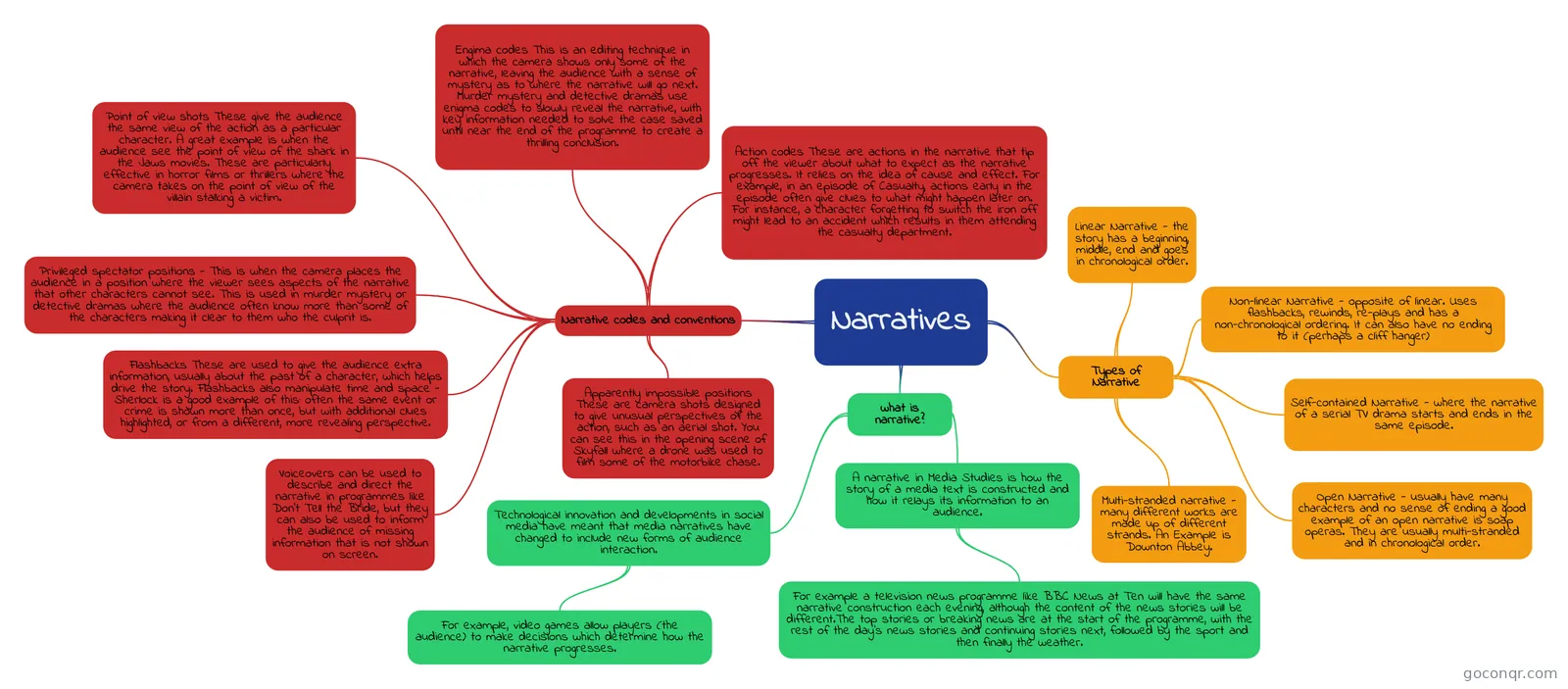
Mind map: Narratives in media studies
Conteúdo do mapa
Narratives
Types of Narrative
- Open Narrative - usually have many characters and no sense of ending a good example of an open narrative is soap operas. They are usually multi-stranded and in chronological order.
- Multi-stranded narrative - many different works are made up of different strands. An Example is Downton Abbey.
- Linear Narrative - the story has a beginning, middle, end and goes in chronological order.
- Non-linear Narrative - opposite of linear. Uses flashbacks, rewinds, re-plays and has a non-chronological ordering. It can also have no ending to it (perhaps a cliff hanger)
- Self-contained Narrative - where the narrative of a serial TV drama starts and ends in the same episode.
what is narrative?
- A narrative in Media Studies is how the story of a media text is constructed and how it relays its information to an audience.
- For example a television news programme like BBC News at Ten will have the same narrative construction each evening, although the content of the news stories will be different.The top stories or breaking news are at the start of the programme, with the rest of the day’s news stories and continuing stories next, followed by the sport and then finally the weather.
- Technological innovation and developments in social media have meant that media narratives have changed to include new forms of audience interaction.
- For example, video games allow players (the audience) to make decisions which determine how the narrative progresses.
- A narrative in Media Studies is how the story of a media text is constructed and how it relays its information to an audience.
Narrative codes and conventions
- Flashbacks These are used to give the audience extra information, usually about the past of a character, which helps drive the story. Flashbacks also manipulate time and space - Sherlock is a good example of this: often the same event or crime is shown more than once, but with additional clues highlighted, or from a different, more revealing perspective.
- Point of view shots These give the audience the same view of the action as a particular character. A great example is when the audience see the point of view of the shark in the Jaws movies. These are particularly effective in horror films or thrillers where the camera takes on the point of view of the villain stalking a victim.
- Apparently impossible positions These are camera shots designed to give unusual perspectives of the action, such as an aerial shot. You can see this in the opening scene of Skyfall where a drone was used to film some of the motorbike chase.
- Privileged spectator positions - This is when the camera places the audience in a position where the viewer sees aspects of the narrative that other characters cannot see. This is used in murder mystery or detective dramas where the audience often know more than some of the characters making it clear to them who the culprit is.
- Voiceovers can be used to describe and direct the narrative in programmes like Don't Tell the Bride, but they can also be used to inform the audience of missing information that is not shown on screen.
- Engima codes This is an editing technique in which the camera shows only some of the narrative, leaving the audience with a sense of mystery as to where the narrative will go next. Murder mystery and detective dramas use enigma codes to slowly reveal the narrative, with key information needed to solve the case saved until near the end of the programme to create a thrilling conclusion.
- Action codes These are actions in the narrative that tip off the viewer about what to expect as the narrative progresses. It relies on the idea of cause and effect. For example, in an episode of Casualty, actions early in the episode often give clues to what might happen later on. For instance, a character forgetting to switch the iron off might lead to an accident which results in them attending the casualty department.
Informações
- Descrição
- Year 11 Media Studies Mapa Mental sobre Narratives, criado por Kelly Roberts em 02-10-2017.
- Criado por
- Kelly Roberts
- Visualizações
- 5
- Avaliação