
Mapa mental
The Early Middle Ages
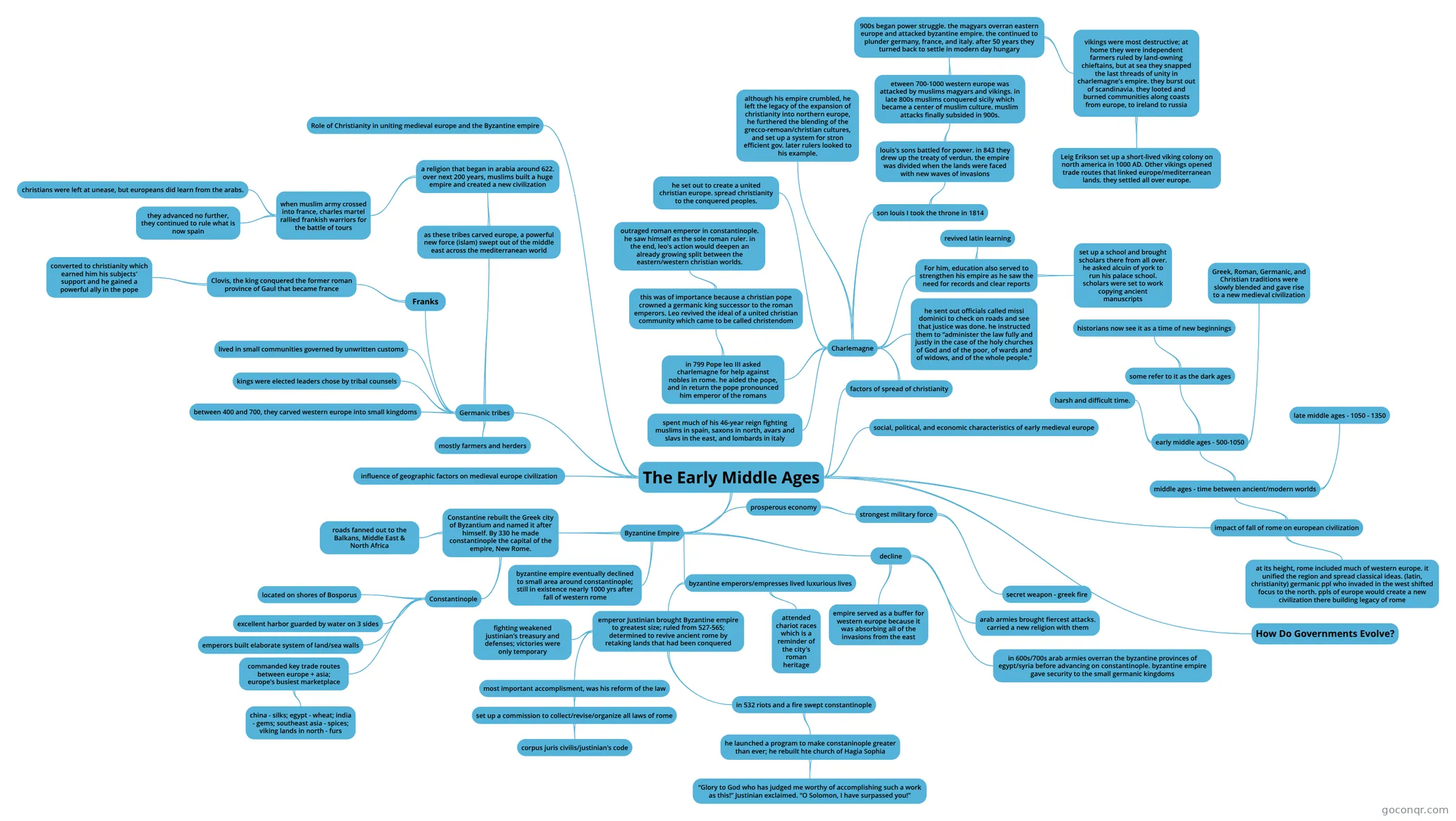
Mind map: The Early Middle Ages
Conteúdo do mapa
The Early Middle Ages
Byzantine Empire
- Constantine rebuilt the Greek city of Byzantium and named it after himself. By 330 he made constantinople the capital of the empire, New Rome.
- roads fanned out to the Balkans, Middle East & North Africa
- Constantinople
- located on shores of Bosporus
- excellent harbor guarded by water on 3 sides
- emperors built elaborate system of land/sea walls
- commanded key trade routes between europe + asia; europe's busiest marketplace
- china - silks; egypt - wheat; india - gems; southeast asia - spices; viking lands in north - furs
- byzantine emperors/empresses lived luxurious lives
- attended chariot races which is a reminder of the city's roman heritage
- emperor Justinian brought Byzantine empire to greatest size; ruled from 527-565; determined to revive ancient rome by retaking lands that had been conquered
- fighting weakened justinian's treasury and defenses; victories were only temporary
- in 532 riots and a fire swept constantinople
- he launched a program to make constaninople greater than ever; he rebuilt hte church of Hagia Sophia
- “Glory to God who has judged me worthy of accomplishing such a work as this!” Justinian exclaimed. “O Solomon, I have surpassed you!”
- he launched a program to make constaninople greater than ever; he rebuilt hte church of Hagia Sophia
- most important accomplisment, was his reform of the law
- set up a commission to collect/revise/organize all laws of rome
- corpus juris civilis/justinian's code
- set up a commission to collect/revise/organize all laws of rome
- byzantine empire eventually declined to small area around constantinople; still in existence nearly 1000 yrs after fall of western rome
- prosperous economy
- strongest military force
- secret weapon - greek fire
- strongest military force
- decline
- empire served as a buffer for western europe because it was absorbing all of the invasions from the east
- arab armies brought fiercest attacks. carried a new religion with them
- in 600s/700s arab armies overran the byzantine provinces of egypt/syria before advancing on constantinople. byzantine empire gave security to the small germanic kingdoms
- Constantine rebuilt the Greek city of Byzantium and named it after himself. By 330 he made constantinople the capital of the empire, New Rome.
social, political, and economic characteristics of early medieval europe
factors of spread of christianity
- Charlemagne
- spent much of his 46-year reign fighting muslims in spain, saxons in north, avars and slavs in the east, and lombards in italy
- in 799 Pope leo III asked charlemagne for help against nobles in rome. he aided the pope, and in return the pope pronounced him emperor of the romans
- this was of importance because a christian pope crowned a germanic king successor to the roman emperors. Leo revived the ideal of a united christian community which came to be called christendom
- outraged roman emperor in constantinople. he saw himself as the sole roman ruler. in the end, leo's action would deepen an already growing split between the eastern/western christian worlds.
- this was of importance because a christian pope crowned a germanic king successor to the roman emperors. Leo revived the ideal of a united christian community which came to be called christendom
- he set out to create a united christian europe. spread christianity to the conquered peoples.
- he sent out officials called missi dominici to check on roads and see that justice was done. he instructed them to “administer the law fully and justly in the case of the holy churches of God and of the poor, of wards and of widows, and of the whole people.”
- For him, education also served to strengthen his empire as he saw the need for records and clear reports
- revived latin learning
- set up a school and brought scholars there from all over. he asked alcuin of york to run his palace school. scholars were set to work copying ancient manuscripts
- although his empire crumbled, he left the legacy of the expansion of christianity into northern europe, he furthered the blending of the grecco-remoan/christian cultures, and set up a system for stron efficient gov. later rulers looked to his example.
- son louis I took the throne in 1814
- louis's sons battled for power. in 843 they drew up the treaty of verdun. the empire was divided when the lands were faced with new waves of invasions
- etween 700-1000 western europe was attacked by muslims magyars and vikings. in late 800s muslims conquered sicily which became a center of muslim culture. muslim attacks finally subsided in 900s.
- 900s began power struggle. the magyars overran eastern europe and attacked byzantine empire. the continued to plunder germany, france, and italy. after 50 years they turned back to settle in modern day hungary
- vikings were most destructive; at home they were independent farmers ruled by land-owning chieftains, but at sea they snapped the last threads of unity in charlemagne's empire. they burst out of scandinavia. they looted and burned communities along coasts from europe, to ireland to russia
- Leig Erikson set up a short-lived viking colony on north america in 1000 AD. Other vikings opened trade routes that linked europe/mediterranean lands. they settled all over europe.
- vikings were most destructive; at home they were independent farmers ruled by land-owning chieftains, but at sea they snapped the last threads of unity in charlemagne's empire. they burst out of scandinavia. they looted and burned communities along coasts from europe, to ireland to russia
- 900s began power struggle. the magyars overran eastern europe and attacked byzantine empire. the continued to plunder germany, france, and italy. after 50 years they turned back to settle in modern day hungary
- etween 700-1000 western europe was attacked by muslims magyars and vikings. in late 800s muslims conquered sicily which became a center of muslim culture. muslim attacks finally subsided in 900s.
- louis's sons battled for power. in 843 they drew up the treaty of verdun. the empire was divided when the lands were faced with new waves of invasions
- Charlemagne
Role of Christianity in uniting medieval europe and the Byzantine empire
influence of geographic factors on medieval europe civilization
impact of fall of rome on european civilization
- middle ages - time between ancient/modern worlds
- early middle ages - 500-1050
- harsh and difficult time.
- some refer to it as the dark ages
- historians now see it as a time of new beginnings
- Greek, Roman, Germanic, and Christian traditions were slowly blended and gave rise to a new medieval civilization
- late middle ages - 1050 - 1350
- early middle ages - 500-1050
- at its height, rome included much of western europe. it unified the region and spread classical ideas. (latin, christianity) germanic ppl who invaded in the west shifted focus to the north. ppls of europe would create a new civilization there building legacy of rome
- middle ages - time between ancient/modern worlds
How Do Governments Evolve?
Germanic tribes
- mostly farmers and herders
- lived in small communities governed by unwritten customs
- kings were elected leaders chose by tribal counsels
- between 400 and 700, they carved western europe into small kingdoms
- Franks
- Clovis, the king conquered the former roman province of Gaul that became france
- converted to christianity which earned him his subjects' support and he gained a powerful ally in the pope
- Clovis, the king conquered the former roman province of Gaul that became france
- as these tribes carved europe, a powerful new force (islam) swept out of the middle east across the mediterranean world
- a religion that began in arabia around 622. over next 200 years, muslims built a huge empire and created a new civilization
- when muslim army crossed into france, charles martel rallied frankish warriors for the battle of tours
- they advanced no further, they continued to rule what is now spain
- christians were left at unease, but europeans did learn from the arabs.
- when muslim army crossed into france, charles martel rallied frankish warriors for the battle of tours
- a religion that began in arabia around 622. over next 200 years, muslims built a huge empire and created a new civilization
Informações
- Descrição
- 10th grade World History (The Middle Ages) Mapa Mental sobre The Early Middle Ages, criado por Emily J em 28-09-2019.
- Criado por
- Emily J
- Visualizações
- 0
- Avaliação