
Mapa mental
Appeasement and the First World War
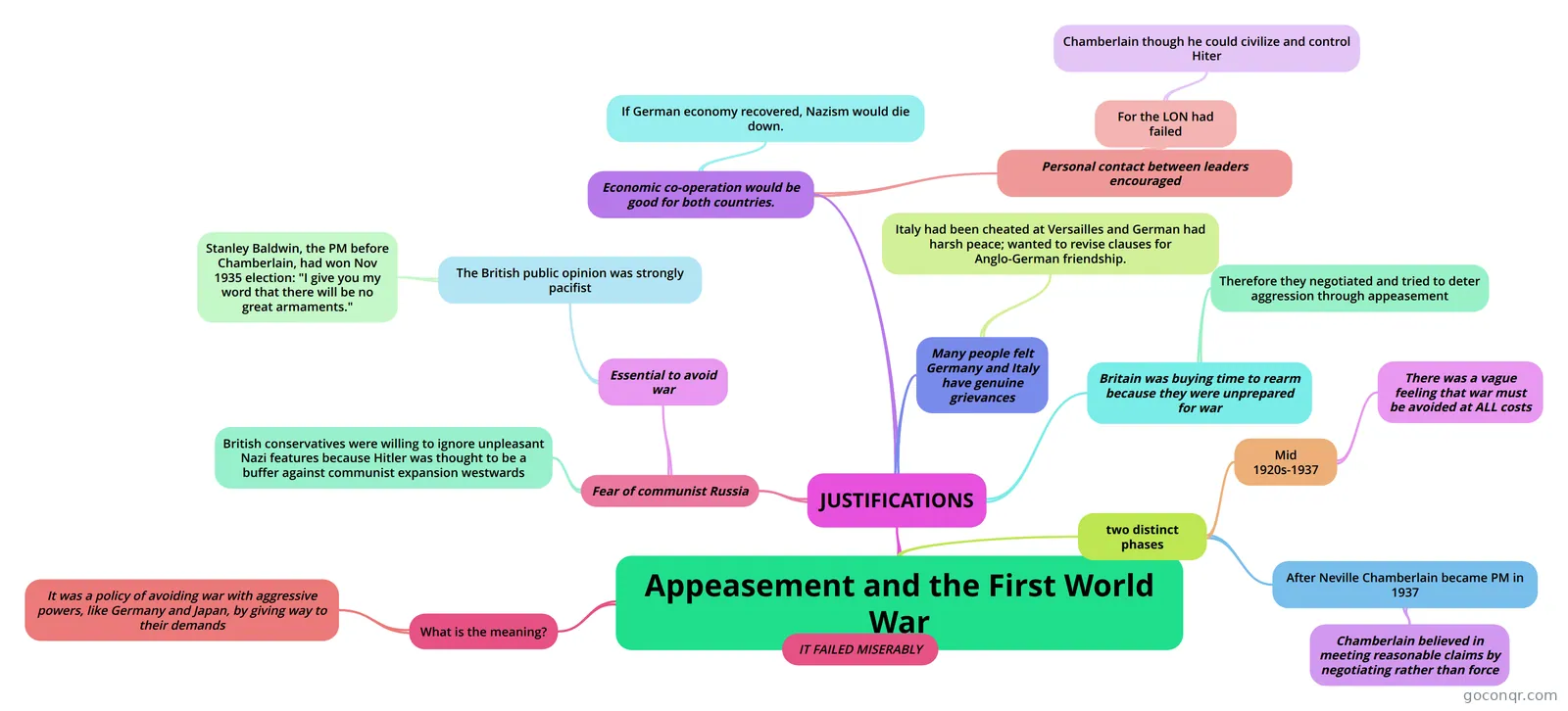
Mind map: Appeasement and the First World War
Conteúdo do mapa
Appeasement and the First World War
What is the meaning?
- It was a policy of avoiding war with aggressive powers, like Germany and Japan, by giving way to their demands
two distinct phases
- Mid 1920s-1937
- There was a vague feeling that war must be avoided at ALL costs
- After Neville Chamberlain became PM in 1937
- Chamberlain believed in meeting reasonable claims by negotiating rather than force
- Mid 1920s-1937
IT FAILED MISERABLY
JUSTIFICATIONS
- Many people felt Germany and Italy have genuine grievances
- Italy had been cheated at Versailles and German had harsh peace; wanted to revise clauses for Anglo-German friendship.
- Fear of communist Russia
- Essential to avoid war
- The British public opinion was strongly pacifist
- Stanley Baldwin, the PM before Chamberlain, had won Nov 1935 election: "I give you my word that there will be no great armaments."
- The British public opinion was strongly pacifist
- British conservatives were willing to ignore unpleasant Nazi features because Hitler was thought to be a buffer against communist expansion westwards
- Essential to avoid war
- Britain was buying time to rearm because they were unprepared for war
- Therefore they negotiated and tried to deter aggression through appeasement
- Economic co-operation would be good for both countries.
- If German economy recovered, Nazism would die down.
- Personal contact between leaders encouraged
- For the LON had failed
- Chamberlain though he could civilize and control Hiter
- For the LON had failed
- Many people felt Germany and Italy have genuine grievances
Informações
- Descrição
- A mind-map illustrating the justifications and reasons for this policy that was carried out in the pre-war era.
- Criado por
- thedarknessinside
- Visualizações
- 143
- Tags
- Avaliação