
Mapa mental
Human Relationships
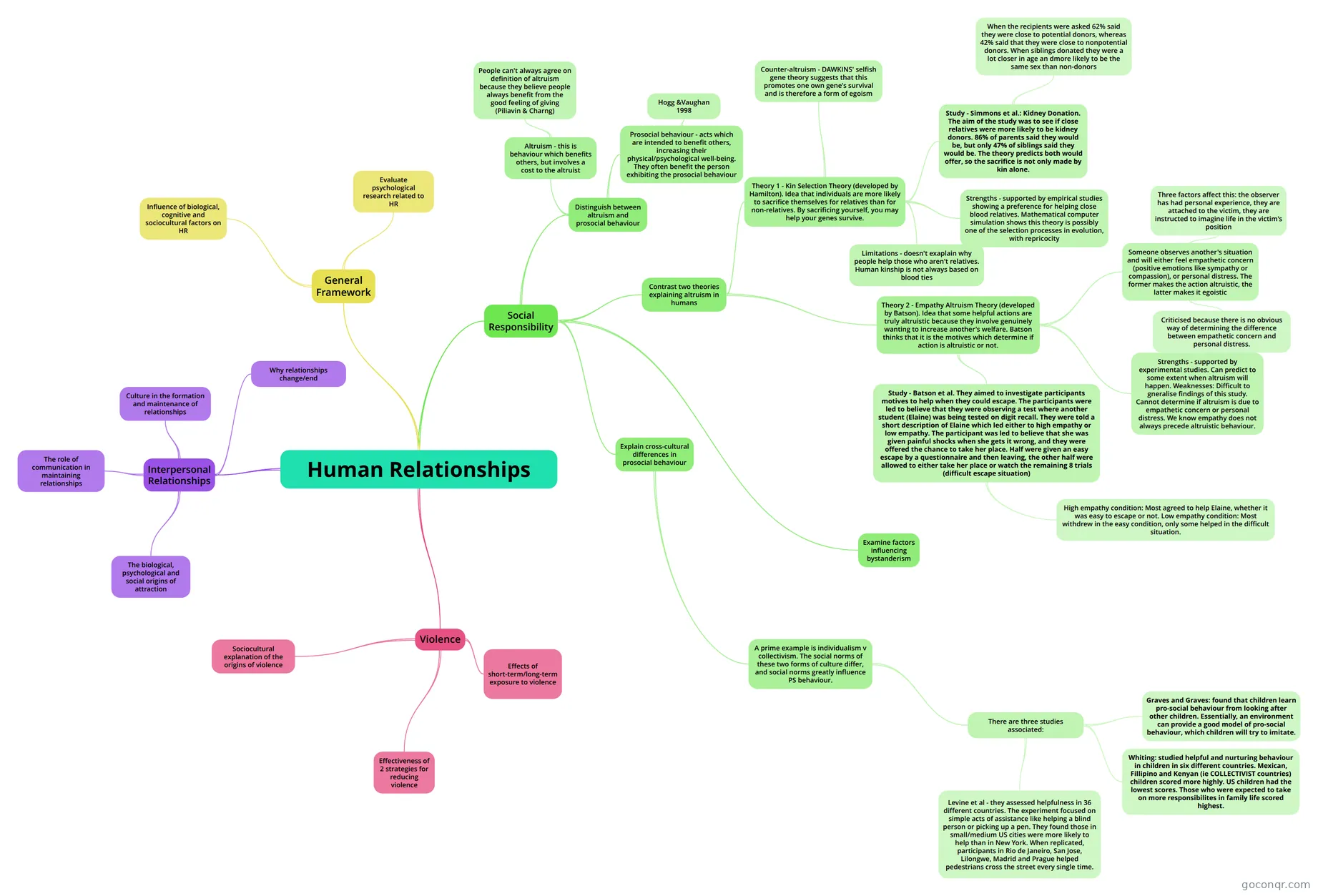
Mind map: Human relationships psychology
Conteúdo do mapa
Human Relationships
Violence
- Sociocultural explanation of the origins of violence
- Effectiveness of 2 strategies for reducing violence
- Effects of short-term/long-term exposure to violence
General Framework
- Influence of biological, cognitive and sociocultural factors on HR
- Evaluate psychological research related to HR
Social Responsibility
- Distinguish between altruism and prosocial behaviour
- Altruism - this is behaviour which benefits others, but involves a cost to the altruist
- People can't always agree on definition of altruism because they believe people always benefit from the good feeling of giving (Piliavin & Charng)
- Prosocial behaviour - acts which are intended to benefit others, increasing their physical/psychological well-being. They often benefit the person exhibiting the prosocial behaviour
- Hogg &Vaughan 1998
- Altruism - this is behaviour which benefits others, but involves a cost to the altruist
- Examine factors influencing bystanderism
- Explain cross-cultural differences in prosocial behaviour
- A prime example is individualism v collectivism. The social norms of these two forms of culture differ, and social norms greatly influence PS behaviour.
- There are three studies associated:
- Levine et al - they assessed helpfulness in 36 different countries. The experiment focused on simple acts of assistance like helping a blind person or picking up a pen. They found those in small/medium US cities were more likely to help than in New York. When replicated, participants in Rio de Janeiro, San Jose, Lilongwe, Madrid and Prague helped pedestrians cross the street every single time.
- Graves and Graves: found that children learn pro-social behaviour from looking after other children. Essentially, an environment can provide a good model of pro-social behaviour, which children will try to imitate.
- Whiting: studied helpful and nurturing behaviour in children in six different countries. Mexican, Fillipino and Kenyan (ie COLLECTIVIST countries) children scored more highly. US children had the lowest scores. Those who were expected to take on more responsibilites in family life scored highest.
- There are three studies associated:
- A prime example is individualism v collectivism. The social norms of these two forms of culture differ, and social norms greatly influence PS behaviour.
- Contrast two theories explaining altruism in humans
- Theory 1 - Kin Selection Theory (developed by Hamilton). Idea that individuals are more likely to sacrifice themselves for relatives than for non-relatives. By sacrificing yourself, you may help your genes survive.
- Counter-altruism - DAWKINS' selfish gene theory suggests that this promotes one own gene's survival and is therefore a form of egoism
- Study - Simmons et al.: Kidney Donation. The aim of the study was to see if close relatives were more likely to be kidney donors. 86% of parents said they would be, but only 47% of siblings said they would be. The theory predicts both would offer, so the sacrifice is not only made by kin alone.
- When the recipients were asked 62% said they were close to potential donors, whereas 42% said that they were close to nonpotential donors. When siblings donated they were a lot closer in age an dmore likely to be the same sex than non-donors
- Strengths - supported by empirical studies showing a preference for helping close blood relatives. Mathematical computer simulation shows this theory is possibly one of the selection processes in evolution, with repricocity
- Limitations - doesn't exaplain why people help those who aren't relatives. Human kinship is not always based on blood ties
- Theory 2 - Empathy Altruism Theory (developed by Batson). Idea that some helpful actions are truly altruistic because they involve genuinely wanting to increase another's welfare. Batson thinks that it is the motives which determine if action is altruistic or not.
- Someone observes another's situation and will either feel empathetic concern (positive emotions like sympathy or compassion), or personal distress. The former makes the action altruistic, the latter makes it egoistic
- Three factors affect this: the observer has had personal experience, they are attached to the victim, they are instructed to imagine life in the victim's position
- Criticised because there is no obvious way of determining the difference between empathetic concern and personal distress.
- Study - Batson et al. They aimed to investigate participants motives to help when they could escape. The participants were led to believe that they were observing a test where another student (Elaine) was being tested on digit recall. They were told a short description of Elaine which led either to high empathy or low empathy. The participant was led to believe that she was given painful shocks when she gets it wrong, and they were offered the chance to take her place. Half were given an easy escape by a questionnaire and then leaving, the other half were allowed to either take her place or watch the remaining 8 trials (difficult escape situation)
- High empathy condition: Most agreed to help Elaine, whether it was easy to escape or not. Low empathy condition: Most withdrew in the easy condition, only some helped in the difficult situation.
- Strengths - supported by experimental studies. Can predict to some extent when altruism will happen. Weaknesses: Difficult to gneralise findings of this study. Cannot determine if altruism is due to empathetic concern or personal distress. We know empathy does not always precede altruistic behaviour.
- Someone observes another's situation and will either feel empathetic concern (positive emotions like sympathy or compassion), or personal distress. The former makes the action altruistic, the latter makes it egoistic
- Theory 1 - Kin Selection Theory (developed by Hamilton). Idea that individuals are more likely to sacrifice themselves for relatives than for non-relatives. By sacrificing yourself, you may help your genes survive.
- Distinguish between altruism and prosocial behaviour
Interpersonal Relationships
- The biological, psychological and social origins of attraction
- The role of communication in maintaining relationships
- Culture in the formation and maintenance of relationships
- Why relationships change/end
Informações
- Descrição
- International Baccalaureate Psychology Mapa Mental sobre Human Relationships, criado por jemima em 06-05-2013.
- Criado por
- jemima
- Visualizações
- 41
- Tags
- Avaliação