
Mapa mental
research methods
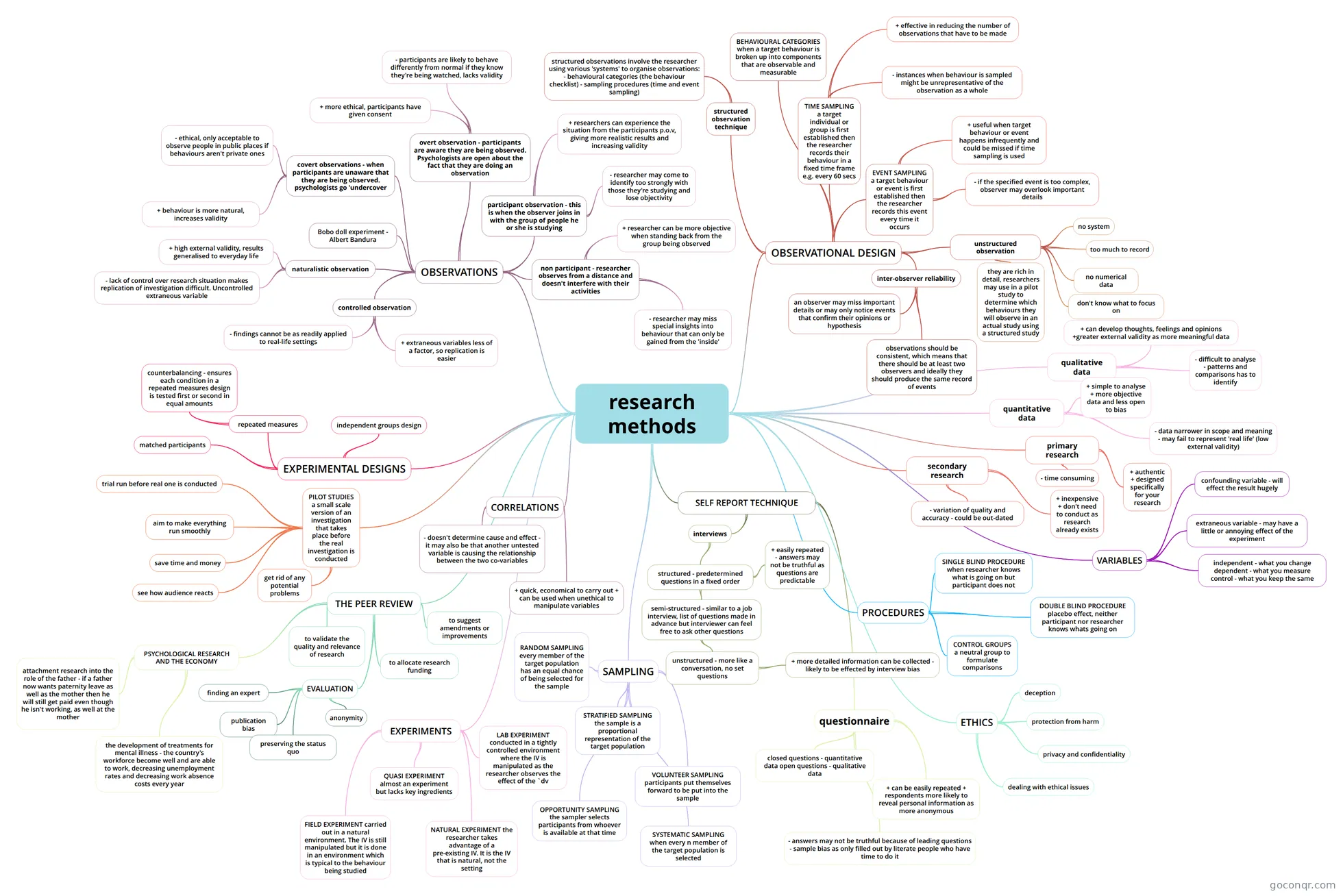
Mind map: research methods
Conteúdo do mapa
research methods
VARIABLES
- extraneous variable - may have a little or annoying effect of the experiment
- confounding variable - will effect the result hugely
- independent - what you change dependent - what you measure control - what you keep the same
EXPERIMENTAL DESIGNS
- repeated measures
- counterbalancing - ensures each condition in a repeated measures design is tested first or second in equal amounts
- independent groups design
- matched participants
- repeated measures
PILOT STUDIES a small scale version of an investigation that takes place before the real investigation is conducted
- trial run before real one is conducted
- aim to make everything run smoothly
- save time and money
- see how audience reacts
- get rid of any potential problems
PROCEDURES
- SINGLE BLIND PROCEDURE when researcher knows what is going on but participant does not
- DOUBLE BLIND PROCEDURE placebo effect, neither participant nor researcher knows whats going on
- CONTROL GROUPS a neutral group to formulate comparisons
EXPERIMENTS
- FIELD EXPERIMENT carried out in a natural environment. The IV is still manipulated but it is done in an environment which is typical to the behaviour being studied
- NATURAL EXPERIMENT the researcher takes advantage of a pre-existing IV. It is the IV that is natural, not the setting
- LAB EXPERIMENT conducted in a tightly controlled environment where the IV is manipulated as the researcher observes the effect of the `dv
- QUASI EXPERIMENT almost an experiment but lacks key ingredients
SAMPLING
- RANDOM SAMPLING every member of the target population has an equal chance of being selected for the sample
- STRATIFIED SAMPLING the sample is a proportional representation of the target population
- OPPORTUNITY SAMPLING the sampler selects participants from whoever is available at that time
- VOLUNTEER SAMPLING participants put themselves forward to be put into the sample
- SYSTEMATIC SAMPLING when every n member of the target population is selected
ETHICS
- deception
- protection from harm
- privacy and confidentiality
- dealing with ethical issues
OBSERVATIONS
- covert observations - when participants are unaware that they are being observed. psychologists go 'undercover
- + behaviour is more natural, increases validity
- - ethical, only acceptable to observe people in public places if behaviours aren't private ones
- overt observation - participants are aware they are being observed. Psychologists are open about the fact that they are doing an observation
- + more ethical, participants have given consent
- - participants are likely to behave differently from normal if they know they're being watched, lacks validity
- Bobo doll experiment - Albert Bandura
- participant observation - this is when the observer joins in with the group of people he or she is studying
- + researchers can experience the situation from the participants p.o.v, giving more realistic results and increasing validity
- - researcher may come to identify too strongly with those they're studying and lose objectivity
- non participant - researcher observes from a distance and doesn't interfere with their activities
- + researcher can be more objective when standing back from the group being observed
- - researcher may miss special insights into behaviour that can only be gained from the 'inside'
- naturalistic observation
- + high external validity, results generalised to everyday life
- - lack of control over research situation makes replication of investigation difficult. Uncontrolled extraneous variable
- controlled observation
- + extraneous variables less of a factor, so replication is easier
- - findings cannot be as readily applied to real-life settings
- covert observations - when participants are unaware that they are being observed. psychologists go 'undercover
OBSERVATIONAL DESIGN
- BEHAVIOURAL CATEGORIES when a target behaviour is broken up into components that are observable and measurable
- EVENT SAMPLING a target behaviour or event is first established then the researcher records this event every time it occurs
- + useful when target behaviour or event happens infrequently and could be missed if time sampling is used
- - if the specified event is too complex, observer may overlook important details
- TIME SAMPLING a target individual or group is first established then the researcher records their behaviour in a fixed time frame e.g. every 60 secs
- + effective in reducing the number of observations that have to be made
- - instances when behaviour is sampled might be unrepresentative of the observation as a whole
- unstructured observation
- no system
- too much to record
- no numerical data
- don't know what to focus on
- they are rich in detail, researchers may use in a pilot study to determine which behaviours they will observe in an actual study using a structured study
- structured observation technique
- structured observations involve the researcher using various 'systems' to organise observations: - behavioural categories (the behaviour checklist) - sampling procedures (time and event sampling)
- inter-observer reliability
- an observer may miss important details or may only notice events that confirm their opinions or hypothesis
- observations should be consistent, which means that there should be at least two observers and ideally they should produce the same record of events
THE PEER REVIEW
- to allocate research funding
- to validate the quality and relevance of research
- to suggest amendments or improvements
- EVALUATION
- finding an expert
- publication bias
- anonymity
- preserving the status quo
- PSYCHOLOGICAL RESEARCH AND THE ECONOMY
- attachment research into the role of the father - if a father now wants paternity leave as well as the mother then he will still get paid even though he isn't working, as well at the mother
- the development of treatments for mental illness - the country's workforce become well and are able to work, decreasing unemployment rates and decreasing work absence costs every year
CORRELATIONS
- + quick, economical to carry out + can be used when unethical to manipulate variables
- - doesn't determine cause and effect - it may also be that another untested variable is causing the relationship between the two co-variables
SELF REPORT TECHNIQUE
- questionnaire
- closed questions - quantitative data open questions - qualitative data
- + can be easily repeated + respondents more likely to reveal personal information as more anonymous
- - answers may not be truthful because of leading questions - sample bias as only filled out by literate people who have time to do it
- interviews
- structured - predetermined questions in a fixed order
- semi-structured - similar to a job interview, list of questions made in advance but interviewer can feel free to ask other questions
- unstructured - more like a conversation, no set questions
- + more detailed information can be collected - likely to be effected by interview bias
- unstructured - more like a conversation, no set questions
- + easily repeated - answers may not be truthful as questions are predictable
- semi-structured - similar to a job interview, list of questions made in advance but interviewer can feel free to ask other questions
- structured - predetermined questions in a fixed order
- questionnaire
qualitative data
- + can develop thoughts, feelings and opinions +greater external validity as more meaningful data
- - difficult to analyse - patterns and comparisons has to identify
quantitative data
- + simple to analyse + more objective data and less open to bias
- - data narrower in scope and meaning - may fail to represent 'real life' (low external validity)
primary research
- + authentic + designed specifically for your research
- - time consuming
secondary research
- + inexpensive + don't need to conduct as research already exists
- - variation of quality and accuracy - could be out-dated
Informações
- Descrição
- Mapa Mental sobre research methods, criado por Ellie Lapage em 12-01-2017.
- Criado por
- Ellie Lapage
- Visualizações
- 0
- Avaliação