
Quiz
Inflammation self asessment quiz
Perguntas do quiz (10)
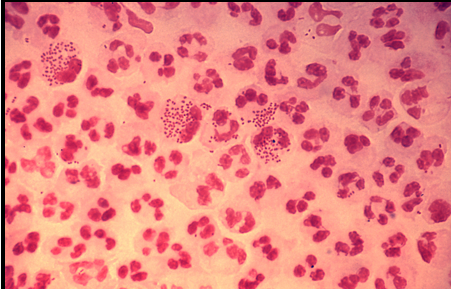
1A 20-year-old man presents with painful urination for 4 days following sexual intercourse with a new partner. Urethritis is suspected and Neisseria gonorrheae (bacteria) is confirmed by nucleic acid amplification test from the purulent urethral exudate. Numerous inflammatory cells are noted by microscopy in a smear of the exudate. Which of the following mediators facilitate the movement of the inflammatory cells to reach the site of infection?
- AHistamine
- BProstaglandin
- CHageman factor
- DBradykinin
- EComplement C5a
2A 4-year-old female child presents with history of recurrent pyogenic bacterial infections and not responding well to antibiotics. An in vitro analysis of the girl’s neutrophil function in specially constructed tubes lined with human endothelium shows a defect in rolling. Which of the following serves as a ligand to bind the molecules on the endothelium that is involved in rolling?
- AICAM-1
- BLactoferrin
- CLFA-1
- DSialyl-Lewis X
- EVCAM-1
3A 16-year-old female has a history of recurrent pyogenic bacterial infections of the skin and soft tissues not responding well to antibiotics. The physician suspects an immunological disorder and orders tests for neutrophil function. Results show production of O2- , H2O2, OH- by neutrophils to be normal and production of HOCl is decreased following stimulation by opsonized bacteria. Which of the following is most likely defective?
- ACatalase
- BGlutathione peroxidase
- CMyeloperoxidase
- DNADPH oxidase
- ESuperoxide dismutase
4Which one of the following is an example of a condition that meets at least one of the criteria listed in the image given below?

- ABacterial pneumonia
- BCongestive heart failure
- CCirrhosis
- DNephrotic syndrome
- ESuperior venacaval obstruction
5Your patient is a four-month-old boy with recurrent hospitalizations because of pneumonia, several episodes of acute otitis media with non-purulent drainage from the ear, and positive bacterial growth in laboratory cultures. His medical history included neonatal sepsis. Laboratory studies: CBC showed marked leukocytosis with a WBC count >40X103/microliter (normal:4-12X103/microliter), predominance of morphologically normal neutrophils and normal numbers of CD19+ and CD3+ cells in the peripheral blood that persisted during this hospitalization despite the antibiotic treatment. DHR and the NBT test is normal. Which of the following is the most likely underlying cause for his recurrent infections?
- ADefect in NADPH oxidase generation
- BDefective CD18
- CDeficiency of myeloperoxidase
- DComplement protein deficiency
- EDefective phagolysosome fusion
6A 2-month-old boy is admitted to the hospital for workup of a possible immunologic disorder. His history is remarkable for the occurrence of multiple pyogenic bacterial skin infections. PE shows generalized tender lymphadenopathy. Blood tests reveal an elevated ESR and morphologically normal WBC and neutrophilia. NBT test and DHR flow cytometry assay (dihydrorhodamine) is negative. Which of the following is the most likely defect in the child?
- AC3 deficiency
- BDeficiency of CD18
- CMyeloperoxidase deficiency
- DNADPH oxidase deficiency
- EDefective phagolysosome function
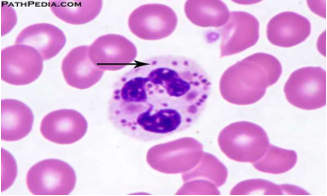
7A six-year-old male with patchy, non-pigmented skin, silvery hair and symptoms suggestive of peripheral neuropathy is brought by concerned parents to a physician. He has a history of recurrent pyogenic infections since birth. A blood sample is sent for examination. The peripheral smear reveals findings seen in the image. Which of the following is the most likely underlying defect in this disease?
- AAlpha 1 anti-trypsin deficiency
- BBone marrow suppression
- CDefective phagolysosome function
- DLAD2 deficiency
- ENADPH oxidase deficiency
8A 35-year-old male presents with complaints of a hypopigmented skin lesion on the right forearm, associated with loss of sensation. Physical examination reveals a thickened median nerve, and loss of cutaneous sensation in the area innervated by median nerve. Biopsy of the skin lesion shows numerous granulomas surrounding the skin lesions and nerve endings. Special stains reveal acid fast bacilli (Mycobacterium leprae). Production of which of the following mediators is responsible for the activation of macrophages in the granulomatous response?
- AIFN- γ
- BIL-12
- CIL-1
- DTGF-beta
- ETNF-alpha
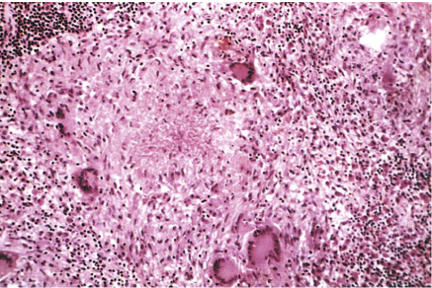
9A 45-year-old female presented with cough with hemoptysis, fever and chills for past three weeks. A chest X-ray showed consolidation in the right middle lobe of lung. Transbronchial biopsy was done and microscopic appearance is seen in image. Which of following terms best describes the pathologic condition of the patient?
- AAcute inflammation
- BPurulent inflammation
- CGranulomatous inflammation
- DFibrinous inflammation
- ESerous inflammation
10A 40-year-old woman presents with a painless lesion on her right ear lobe (shown in the image). She reports that her ears
were pierced 4 months ago. Which of the following best explains the pathogenesis of this lesion?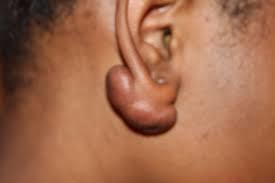
- AClonal expansion of smooth muscle cells
- BExuberant formation of granulation tissue
- CIncreased growth of capillary endothelial cells
- DIncreased turnover of extracellular matrix proteoglycans
- EMaturation arrest of collagen assembly
Informações
- Descrição
- O usuário eliminou as informações de disciplina Quiz sobre Inflammation self asessment quiz, criado por Usuário eliminado em 24-02-2020.
- Autor
- Usuário eliminado
- Idioma
- English
- Visualizações
- 66
- Histórico
- Criado em 24 fev 2020 · atualizado em 6 mar 2020
- Etiquetas
- Avaliação
- Ainda sem avaliações Avalie este quiz