
Untitled
Slides in this set (10)
-
-
- Blood
- Phlegm
- Black Bile
- Yellow Bile
- The 'four humours' used by Greek doctors as a basis for medical diagnosis
-
- The most famous Greek doctor was Hippocrates of Kos. He wrote: Sickness is not sent by the gods or taken away by them. It has a natural basis. If we can find the cause, we can find the cure.
- Hippocrates is often called the ‘Father of Modern Medicine.’
- Promoted the four humours - Hippocrates encouraged doctors to look for natural causes and cures of diseases, encouranging them to move away from supernatural beliefs.
- Recording of symptoms - Hippocrates encouraged doctors to question patients, finding out detailed information about symptoms and to record them accurately. This would then lead to better treatments.
- The Hippocratic Oath - Doctors would swear to treat patients and keep their records and symptoms in confidence.
- The Hippocratic Corpus - A collection of over 60 books written by Hippocrates and other Greek doctors, noting symptoms, treatments and their effectiveness
-
- The Greeks did not have an extensive public health system, so there were no sewers and no supplies of running water.
- Many rich Greeks, however, followed a programme for health. This included keeping themselves at an even temperature, eating properly, washing themselves, cleaning their teeth, going for walks and keeping fit. This was closely linked to their theory of the four humours, and changed according to the season. In addition, Pythagoras's theory of the balance of opposites led Greek doctors to advocate 'moderation in all things'.
- Hippocrates accepted that ordinary people would be too busy or too poor to follow such a regime, and would therefore be less healthy.
- While medicine was still in its early stages, people continued to appeal to the gods for healing at the asclepion. As time went on, however, these places also became health resorts, with facilities such as a gymnasium, an athletics stadium and baths.
-
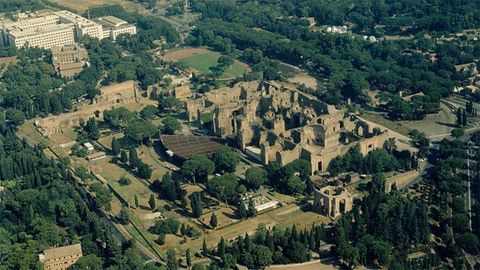
- Caption: Roman city
-
- Roman doctors learned a lot about the human body as they tended gladiators wounded in the amphitheatres. However, dissection of humans was forbidden in the Roman Empire, so Roman anatomists such as Galen had to rely mainly on dissections of animals to further their knowledge. Galen recommended dissecting monkeys that walked on two legs, like men.
- Galen did manage to work a little with the human body, and described how he had human corpses to dissect when he found a hanged criminal, and when a flood washed some bodies out of a cemetery. Despite this, he made various errors in his analyses of how bodies work.
-
- Galen's books show a good knowledge of bone structure. He also studied the lungs, the muscles, the heart and blood and the nervous system. He conducted experiments on pigs, and when he cut the spinal cord in different places he realised how the nervous system takes messages from the brain to the muscles. As he mainly relied on dissecting pigs and monkeys, Galen also made mistakes in his anatomical discoveries.
- Galen based most of his information about anatomy on what he saw when he dissected the bodies of animals. This led him to make mistakes. Some of his errors were:
- He thought that muscles attach to the bone in the same way in humans and in dogs.
- He thought that blood was created in the liver. He realised that it flowed round the body, but said it was burned up as fuel for the muscles.
- He thought he saw holes through the septum, which allowed the blood to flow from one side of the heart to the other.
- He made mistakes about the blood vessels in the brain.
- He thought the human jaw-bone was made up of two bones, like a dog's.
- He was mistaken about the shape of the human liver.
- Galen accepted the Greek theory of the four humours as the cause of disease. However, the Romans did not continue the Greeks' investigations into disease and rejected Greek ideas, so Roman knowledge of disease did not progress.
-
- Roman ideas about disease were muddled. For example:
- Crinas of Massilia thought illness was caused by the stars (astrology)
- Varro blamed creatures too tiny to be seen
- Columella blamed poisonous vapours in the swamps
- All these ideas survived until the 19th century.
- Roman surgery Through their work with gladiators and wounded soldiers, Roman doctors became experts at practical first aid and external surgery.
- They could do a large number of simple external operations, such as removing polyps up the nose and goitres from the neck.
- We know that the Romans developed new surgical and midwifery instruments - though they look barbaric to us nowadays. They also developed the Caesarean section to remove a baby from the womb (although it is not true that Julius Caesar was born this way). In those times the mother always died - Roman Caesarean sections were usually performed to save the baby of a woman who had died during childbirth.
- We have no evidence that Roman surgeons successfully operated inside the body. Roman doctors did not have anaesthetics, and had only herbal antiseptics - so successful surgical operations would have been extremely difficult for them to perform.
-
- After the conquest of Greece in 47 BC, most doctors in Rome were Greeks, brought to Rome as slaves. Yet, whilst they flocked to see these doctors, the Romans were also suspicious of them.
- Pliny, the ancient Roman writer and naturalist, represented them as vain self-publicists, who tried out their too-clever theories at the cost of their patients' lives.
- The most famous Roman doctor was Galen, who came from Pergamum and had been trained at Alexandria. Galen learned his trade at a school of gladiators.
- The Romans neglected to develop further the Greeks' ideas about the nature of disease, and in some ways medicine regressed under their rule. However, Roman doctors did develop ideas of bad air and tiny creatures as causes of disease, and these ideas were to have a great impact on the history of medicine.
- The Romans also developed hospitals, and employed trained military nurses called medici. They were skilled surgeons, and they built on the Greeks' knowledge of anatomy and physiology (though not without errors).
Information
- Description
- Year 11 History Slide Set on Untitled, created by Steph James on 24/01/2017.
- Created by
- Steph James
- Views
- 0
- Rating