
Karteikarten
BMS09-1014 - Bone Development and Ossification
Karten in diesem Stapel (23)
- 1What is the difference between appositional and interstitial growth?Appositional is matrix deposition ON existing matrix, growth in length
Interstitial is matrix deposition from WITHIN matrix, growth in width - 2Appositional growth occurs inBone and cartilage
- 3Interstitial growth occurs inOnly cartilage (bone too rigid)
- 4What is intramembranous ossification?Direct bone formation from osteoprogenitors
- 5What are the steps of intramembranous ossification?1. Formation of periosteum
2. Differentiation to osteoblasts
3. Matrix deposition
4. Mineralisation
5. Vascularisation, blood vessels
6. Growth/remodelling - 6What is the periosteum and its two layers?A dense fibrous layer lining bone
Outer fibrous layer and inner cambium layer - 7What is in the outer fibrous layer of the periosteum?Collagen/nerve fibers/blood supply
- 8What is in the inner cambium layer of the periosteum?Osteoblasts
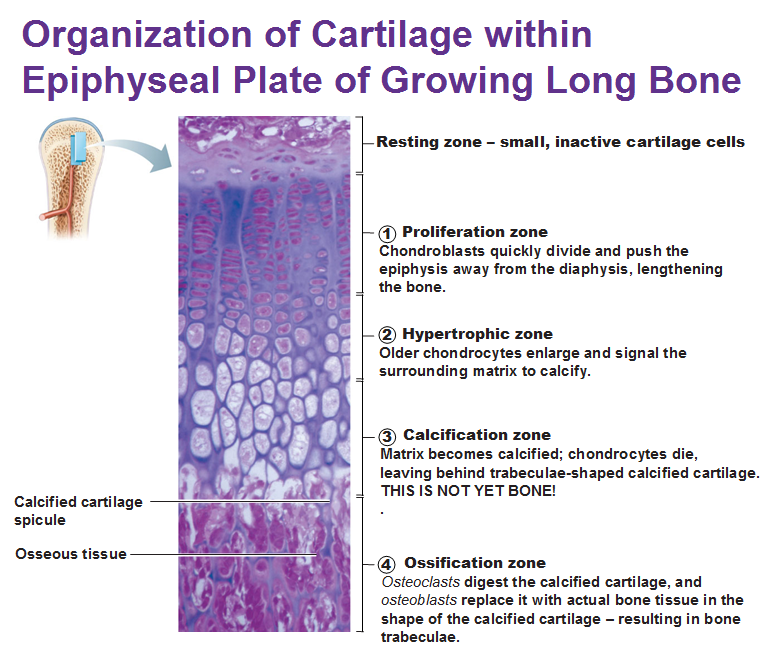
- 9Label the five zones of the epiphyseal growth plate1. Resting zone
2. Proliferation zone
- chrondoblasts divide quickly
3. Hypertrophic zone
- chrondocytes enlarge, initiate calcification
4. Calcification zone
- matrix calcifies, chrondocytes die
5. Ossification zone
- osteoclasts digest calcified tissue, osteoblasts replace with bone - 10What zone do chrondocytes die in?Calcification zone
- 11The epiphyseal growth plate ends before the ... zoneOssification zone (in metaphysis)
- 12What is the primary spongiosa? Where is the primary spongiosa located?Bars of cartilage for bone to be built on
Under the growth plate (metaphysis) - 13What type of bone is first made in the primary spongiosa? What is it replaced by?First woven (primary) bone
Then remodelled into lamellar (secondary) bone - 14Where is the secondary spongiosa? How is it different from the primary?Right under the primary spongiosa
Less cartilage, more new bone
More organised, parallel rings of collagen
Later becomes trabecular or cortical (compact) bone - 15What is the process of endochondral ossification?1. PeriCHONdrium (cartilage) develops
2. Periostuem forms bony collar around diaphysis
2a. This becomes the primary ossification centre
3. Secondary ossification center develops at epiphysis
4. Growth plate develops between epiphysis/metaphysis - 16Where is the primary ossification center? What happens here?Diaphysis
Capillaries invade periostuem, osteoclasts migrate and invade - 17Where is the secondary ossification center?At the epiphysis
- 18Where does the epiphyseal growth plate develop?Between the metaphysis and the epiphysis
- 19Label the BoneTop is Epiphysis
Middle is Metaphysis
Then diaphysis
Metaphysis
Epiphysis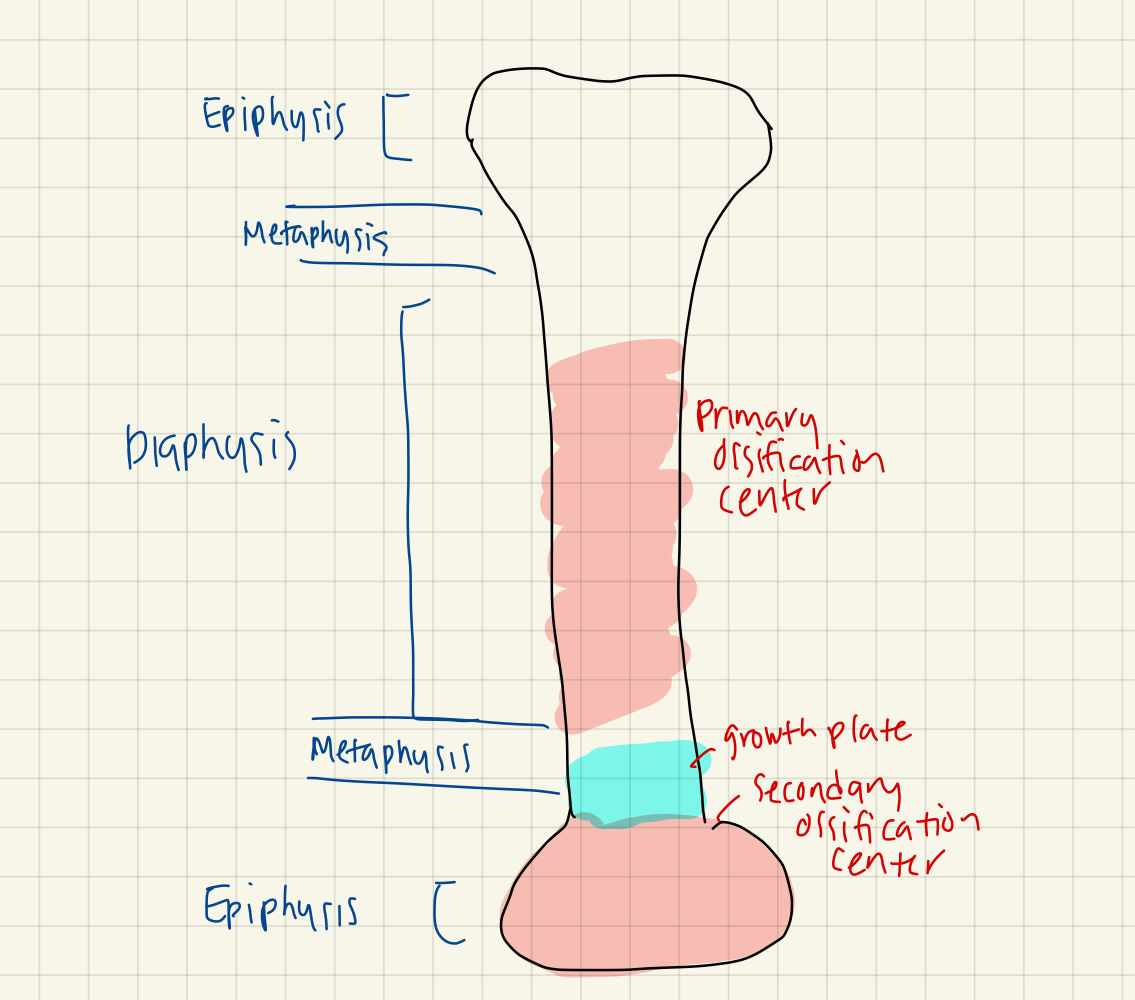
- 20What are the three types of cartilage?1. Hyaline
- Type II collagen fibers
- Periosteum
- Weakest of three
2. Fibro
- alternating strips of hyaline cartilage and thick collagen strips
- no perichondrium
- strongest
3. Elastic
- threadlike network of elastic fibers
- perichondrium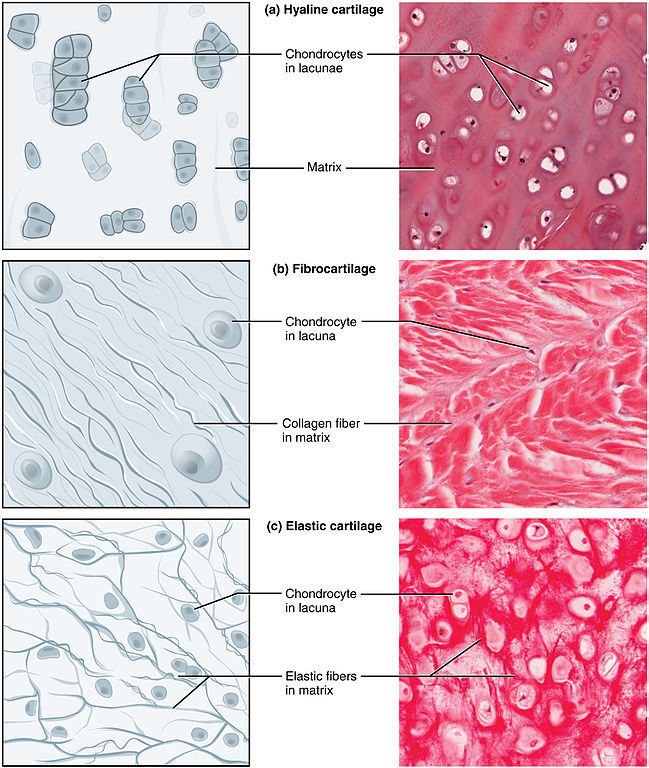
- 21Where is hyaline cartilage usually found?ribs, nose, larynx, trachea
- 22Where is fibrocartilage usually found?Transition between hyaline cartilage and tendon/ligament
invertebral discs, joint capsules, ligaments - 23Where is elastic cartilage usually found?external ear, epiglottis and larynx
Informationen
- Beschreibung
- main types of cartilage/location. characteristics of main types of cartilage. method of growth of cartilage vs. bone. Where cartilage can be replaced by bone. origin/lineage of cells found in bone. processes of intramembranous/endochondral ossification+sequence of bone formation location and the differences of primary/ secondary ossification centres+primary/secondary spongiosa structure, characteristics, function of epiphyseal growth plate appositional vs.. interstitial
- Erstellt von
- Evian Chai
- Aufrufe
- 1.996
- Tags
- Bewertung