
Mindmap
Social exchange theory
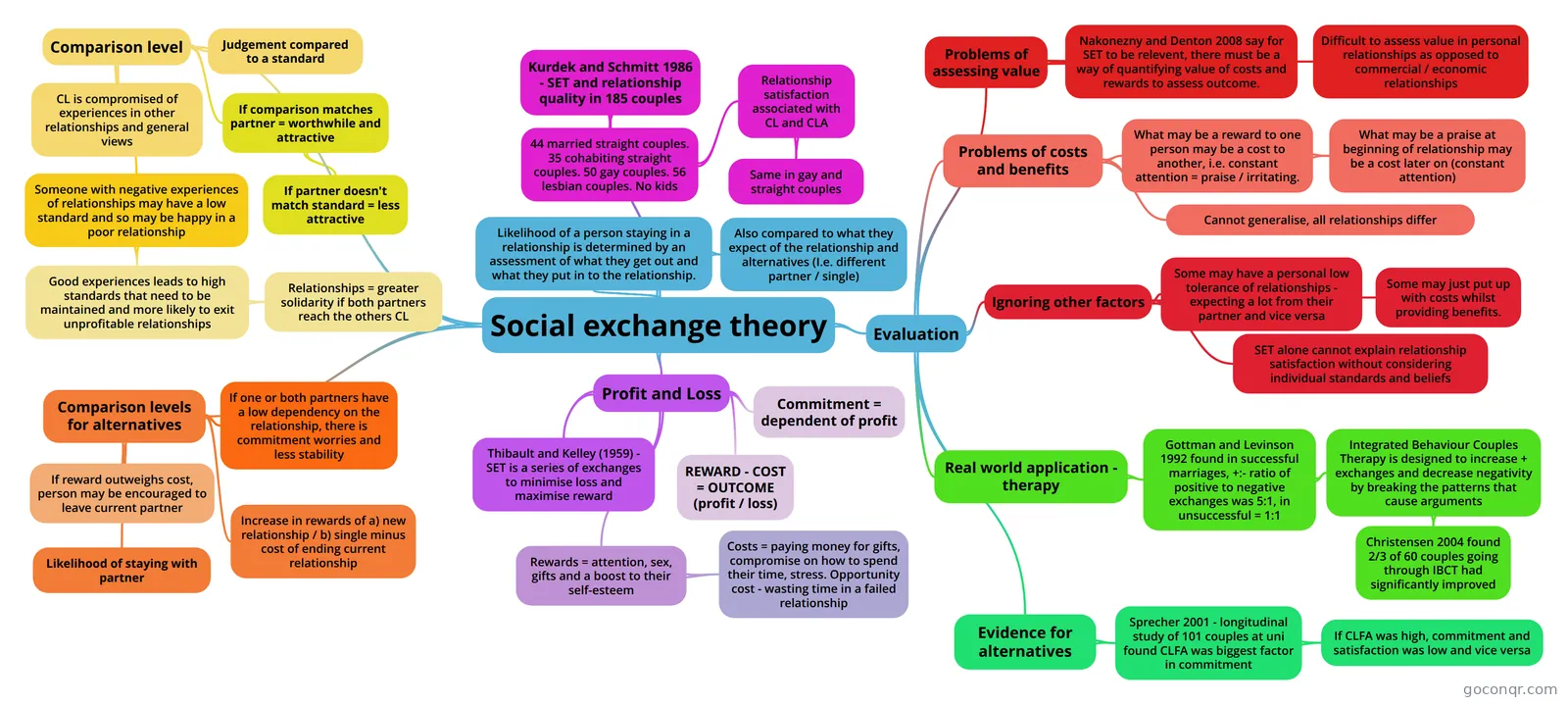
Mind map: Social exchange theory
Inhalt der Mindmap
Social exchange theory
Likelihood of a person staying in a relationship is determined by an assessment of what they get out and what they put in to the relationship.
- Also compared to what they expect of the relationship and alternatives (I.e. different partner / single)
Profit and Loss
- Thibault and Kelley (1959) - SET is a series of exchanges to minimise loss and maximise reward
- Rewards = attention, sex, gifts and a boost to their self-esteem
- Costs = paying money for gifts, compromise on how to spend their time, stress. Opportunity cost - wasting time in a failed relationship
- REWARD - COST = OUTCOME (profit / loss)
- Commitment = dependent of profit
Comparison level
- Judgement compared to a standard
- CL is compromised of experiences in other relationships and general views
- If comparison matches partner = worthwhile and attractive
- If partner doesn't match standard = less attractive
- Someone with negative experiences of relationships may have a low standard and so may be happy in a poor relationship
- Good experiences leads to high standards that need to be maintained and more likely to exit unprofitable relationships
- Relationships = greater solidarity if both partners reach the others CL
- Good experiences leads to high standards that need to be maintained and more likely to exit unprofitable relationships
Comparison levels for alternatives
- Likelihood of staying with partner
- Increase in rewards of a) new relationship / b) single minus cost of ending current relationship
- If reward outweighs cost, person may be encouraged to leave current partner
- If one or both partners have a low dependency on the relationship, there is commitment worries and less stability
Kurdek and Schmitt 1986 - SET and relationship quality in 185 couples
- 44 married straight couples. 35 cohabiting straight couples. 50 gay couples. 56 lesbian couples. No kids
- Relationship satisfaction associated with CL and CLA
- Same in gay and straight couples
- Relationship satisfaction associated with CL and CLA
- 44 married straight couples. 35 cohabiting straight couples. 50 gay couples. 56 lesbian couples. No kids
Evaluation
- Problems of assessing value
- Nakonezny and Denton 2008 say for SET to be relevent, there must be a way of quantifying value of costs and rewards to assess outcome.
- Difficult to assess value in personal relationships as opposed to commercial / economic relationships
- Problems of costs and benefits
- What may be a reward to one person may be a cost to another, i.e. constant attention = praise / irritating.
- What may be a praise at beginning of relationship may be a cost later on (constant attention)
- Cannot generalise, all relationships differ
- What may be a reward to one person may be a cost to another, i.e. constant attention = praise / irritating.
- Ignoring other factors
- Some may have a personal low tolerance of relationships - expecting a lot from their partner and vice versa
- Some may just put up with costs whilst providing benefits.
- SET alone cannot explain relationship satisfaction without considering individual standards and beliefs
- Real world application - therapy
- Gottman and Levinson 1992 found in successful marriages, +:- ratio of positive to negative exchanges was 5:1, in unsuccessful = 1:1
- Integrated Behaviour Couples Therapy is designed to increase + exchanges and decrease negativity by breaking the patterns that cause arguments
- Christensen 2004 found 2/3 of 60 couples going through IBCT had significantly improved
- Integrated Behaviour Couples Therapy is designed to increase + exchanges and decrease negativity by breaking the patterns that cause arguments
- Gottman and Levinson 1992 found in successful marriages, +:- ratio of positive to negative exchanges was 5:1, in unsuccessful = 1:1
- Evidence for alternatives
- Sprecher 2001 - longitudinal study of 101 couples at uni found CLFA was biggest factor in commitment
- If CLFA was high, commitment and satisfaction was low and vice versa
- Sprecher 2001 - longitudinal study of 101 couples at uni found CLFA was biggest factor in commitment
- Problems of assessing value
Informationen
- Beschreibung
- A-Level Psychology A2 (Relationships) Mindmap am Social exchange theory, erstellt von Jess Hughes am 07/11/2016.
- Erstellt von
- Jess Hughes
- Aufrufe
- 2
- Bewertung
Mehr zu Relationship maintenance